

On Saturday night, under the lights at Croke Park, Katie Taylor will walk to the ring one final time. Eighty thousand people will be on their feet. The roar will shake Dublin’s north side. And somewhere in that noise will be the sound of an era ending, not with a whimper, but with the kind of thunder only Ireland can produce for one of its own.
Taylor, 40, is defending her super-lightweight titles in what she and those closest to her have confirmed is her last professional fight. The Olympic gold medallist and long-reigning world champion has built a career so singular that even her brother-in-law, Trevor McMahon, who founded the gym where she trains, struggles to imagine it being matched. As The Guardian reports from her home town, the feeling around her community ahead of Saturday is equal parts celebration and quiet grief.
A Career That Changed Everything
To understand what Taylor’s retirement means, you have to understand what she built from scratch. When she arrived on the amateur boxing scene, women’s boxing was, in many countries, a footnote, an afterthought sandwiched between the bouts that people actually bought tickets to see. Taylor did not accept that framing. She won five World Amateur Boxing Championships and six European titles before claiming Olympic gold at London 2012, a moment that many Irish sports fans still rank among the most electric in the country’s history.
Turning professional, she did not slow down. She unified world titles and became the blueprint for what women’s professional boxing could look like when backed by genuine skill, relentless conditioning, and an absolute refusal to be treated as a sideshow. Promoters noticed. Broadcasters noticed. Young girls watching at home noticed most of all.
What Her Home Town Feels
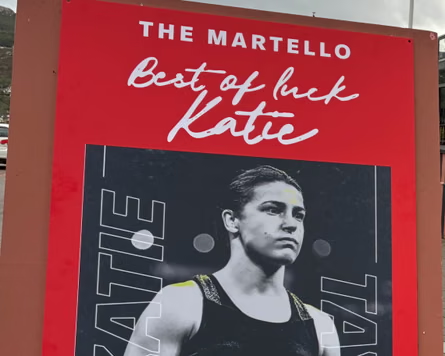
Back in Bray, the coastal town in County Wicklow where Taylor grew up, the response to her farewell fight has been deeply personal. McMahon, who has watched her train over years and who has a front-row seat to her dedication, put it plainly: “The end of an era. It’ll be an amazing night but it’ll also be a little bit sad. Everything she did, it might not ever be achieved again.”
That last sentence carries weight. Not because it is hyperbole, but because it is an honest assessment from someone who has seen what Taylor’s work ethic looks like up close. Careers like hers are not built on talent alone. They are built on choices, thousands of mornings where you get up and go to the gym when nobody is watching, when there is no crowd and no title on the line.
The Girls Who Watched and Decided to Try
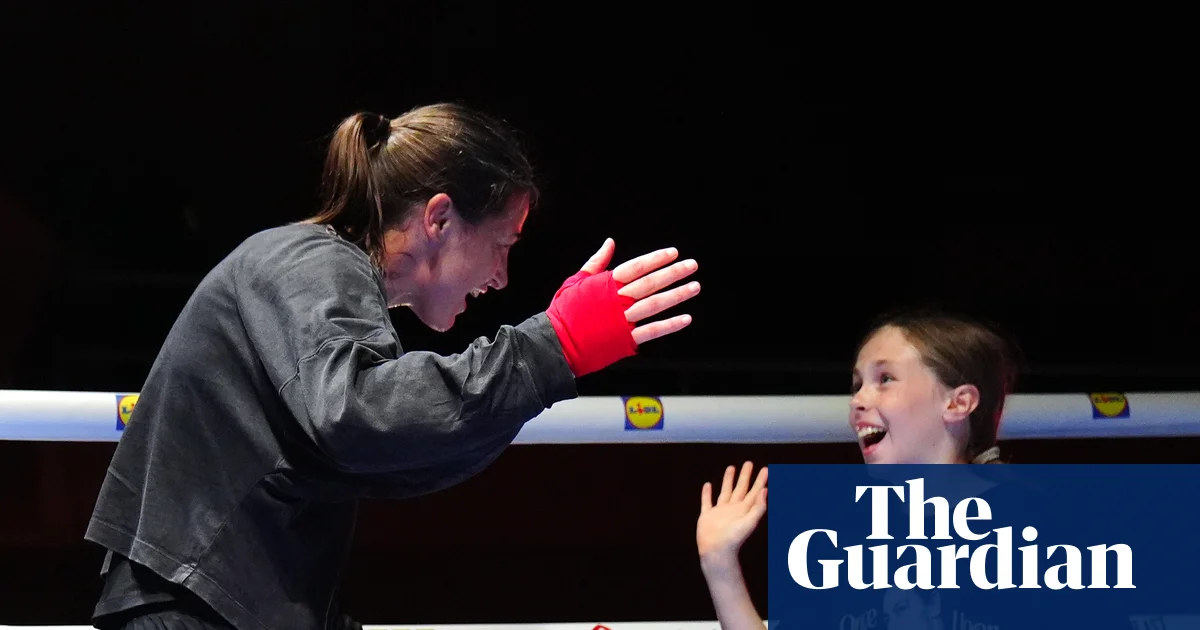
Perhaps the most lasting legacy Taylor leaves behind is not measured in belts or records. It is measured in gym membership lists. Across Ireland, and in boxing communities far beyond it, young girls took up the sport because they saw her and understood, maybe for the first time, that this was something available to them. “Every girl now wants to be a boxer,” as the mood in her home town captures it. That is not a marketing slogan. That is a cultural shift, and it has Taylor’s name written all over it.
Youth coaches speak about the “Taylor effect” as a real, observable phenomenon. Girls who would not have considered the sport a decade ago now show up to gyms with focus and intent. Some of them will go on to compete. A few might make it to world-class level. And if one of them, someday, stands in a ring the way Taylor has, that lineage traces directly back to Saturday night at Croke Park.
The Magnitude of 80,000
Croke Park, the home of Gaelic games and one of Europe’s largest stadiums, will be filled to a capacity that most world title fights could never dream of. The scale of the venue tells its own story about where women’s boxing sits in the public imagination now versus where it sat when Taylor turned professional. She did not just compete at the top of the sport. She expanded what the top looked like.
For context: Croke Park hosting 80,000 fans for a women’s boxing match is not a coincidence or a lucky booking. It is the direct result of Taylor’s ability to draw people who might not otherwise call themselves boxing fans. She made the sport feel like something worth showing up for, worth dressing up for, worth the trip from Cork or Galway or the diaspora communities across Britain and the United States.
Bittersweet Is the Right Word
McMahon’s word, bittersweet, is the honest one. There is no version of this night that is purely joyful, because joy and loss arrive together when something extraordinary comes to a close. Taylor is 40. She has done more than most athletes accomplish in two careers. Retiring now, on her own terms, in front of her own people, in the country’s most iconic stadium, is the correct ending. But correct endings still sting.
Ireland has a complicated, often turbulent relationship with its sports heroes. The pressure placed on those who carry national hopes can be crushing. Taylor has worn that weight for nearly two decades without letting it distort her focus or her character. That, too, is part of the legacy, the grace of it, the consistency, the refusal to be anything other than entirely herself.
After the Bell Rings
When the final bell sounds on Saturday and the judges’ scorecards are read, a chapter closes. What comes next for Taylor personally remains her own story to write. But the sport she leaves behind is fundamentally different from the one she entered. More girls box. More promoters invest in women’s cards. More broadcasters schedule women’s fights in prime slots. More people know that a women’s world title fight can fill Croke Park.
She did not do that alone, of course. But she was the clearest, most consistent force pushing in that direction. The fact that her brother-in-law fears it may never be achieved again says less about the limitations of future athletes and more about the rarity of the combination Taylor represents: elite skill, longevity, charisma, and an almost stubborn sense of purpose.
Saturday night is a celebration. It is also, quietly, a challenge to everyone watching, the young boxers in the crowd, the coaches, the promoters, the broadcasters. The work Katie Taylor started does not retire when she does. So as the lights dim at Croke Park and Ireland holds its breath one last time for her, the real question is this: who picks up the torch?