




Israel woke up on October 28, 2026, to a result that no political strategist could have scripted with a straight face. Voting across the country wrapped up, exit polls landed, and the numbers told a story of almost perfect deadlock: Benjamin Netanyahu’s political bloc and the opposition grouping led by Gadi Eisenkot each came in at 51 seats in the Knesset, according to updated exit poll figures. A nation that has been through more elections in recent years than most democracies see in a generation is, once again, staring down the barrel of political uncertainty.
A Nation That Voted, and Still Got No Answer
The anticipation had been building for weeks. Tens of thousands of Israeli citizens living abroad made the trip back to cast their ballots, according to Aid Coalition, a US-based nonprofit that focuses on strengthening Israeli democracy. That level of civic energy speaks to just how much this election felt like it mattered. Israeli law, notably strict on this point, generally requires citizens to vote in person within the country, with only narrow exceptions carved out for diplomats and certain official emissaries. The sight of overseas Israelis booking flights home to vote is not a casual detail. It signals a population that understands the weight of this moment.
And yet, for all that energy, the exit polls handed both camps a number so evenly matched it could double as a geometry problem. Fifty-one seats each. A number that, on its face, tells both sides they are relevant, powerful, and utterly unable to govern alone.
Netanyahu Speaks into the Uncertainty
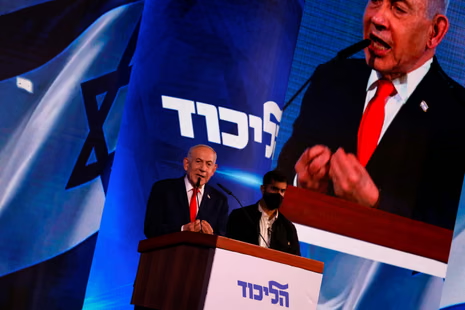
As the exit poll figures circulated, Netanyahu addressed supporters. The details of what he said matter less, in some ways, than the fact that he had to say anything at all in the face of results this ambiguous. A tied exit poll is not a victory speech situation. It is a moment for careful language, coalition signalling, and the kind of political chess that happens behind closed doors before it ever reaches a podium.
For Netanyahu, a figure who has dominated Israeli politics for decades with the kind of staying power that defies conventional political gravity, a 51-51 tie is both a lifeline and a frustration. His bloc is not defeated. But it is not triumphant either. The path to a governing majority runs through partners, and the post-election negotiation period will be as consequential as the vote itself.
The Story Nobody Expected: Palestinian Parties Surge
If the tied blocs are the headline, the surge of Palestinian parties in the Knesset is the story that will echo longest. According to live election coverage from The Guardian, analysts are already noting that the rise of Palestinian parties will redraw Israel’s political landscape in ways that go well beyond who forms the next government.
This is not a minor footnote. A stronger showing from Palestinian parties inside the Knesset changes the composition of the legislature, alters the arithmetic of coalition building, and raises questions about representation, identity, and the future shape of Israeli democracy that have been simmering for years. When a political group gains ground in conditions as charged as these, the implications ripple outward fast.
What a Surge Actually Means for Coalition Math
In Israeli coalition politics, every seat is a negotiating chip. A surge in Palestinian party representation does not hand them governing power in any immediate sense, but it does shift the weight distribution in the chamber. It puts pressure on both the Netanyahu bloc and the Eisenkot opposition to think carefully about whom they can realistically approach for coalition support, and whom they cannot. Coalition building in Israel has always been a complex, often ungainly exercise. With these results, that exercise becomes even more intricate.
The Diaspora Factor and What It Tells Us
The thousands of Israelis who flew home to vote deserve more than a passing mention. Aid Coalition’s tracking of this diaspora mobilisation reflects something genuinely significant about the state of Israeli civic engagement in 2026. Elections that feel existential produce this kind of behaviour. People do not book international flights, arrange childcare, and take days off work unless they believe, at a gut level, that their vote is worth the disruption.
That energy, distributed across both camps, likely contributed to the tight result. High turnout elections rarely produce landslides when a country is as divided as Israel has been. Instead, they produce this: a mirror image of the electorate, split almost perfectly down the middle, each half insisting it represents the country’s future.
What Happens Next
Exit polls, it is worth saying clearly, are not final results. They are sophisticated estimates, and in elections this close, the margin between an exit poll and the certified count can be enough to change the narrative entirely. The coming hours and days will see official tallies come in, coalition conversations begin in earnest, and the political class start the exhausting, high-stakes process of figuring out who gets to govern.
What is already clear, regardless of how the final numbers shift, is that neither side has a clean mandate. The Eisenkot opposition cannot claim a decisive public verdict in its favour. Netanyahu’s bloc cannot either. Israel’s voters, in their collective wisdom or their collective ambivalence, have produced a result that demands compromise, creativity, or yet another round of political brinkmanship.
The broader regional context, particularly the ongoing situation in Gaza, hangs over all of this. Whoever forms Israel’s next government will inherit a set of security, diplomatic, and humanitarian challenges that are as complex as any the country has faced. A government born from a bruising, inconclusive election does not enter that environment from a position of easy strength.
Israel has been here before, of course. It has weathered inconclusive elections and protracted coalition negotiations. But the specific combination of a near-perfect tie, a Palestinian party surge, and a charged regional atmosphere makes this moment feel different from the cycles that came before it.
So here is the question worth sitting with: in a democracy where every election seems to produce a new deadlock, is the system itself sending a message that the country’s political architecture needs rethinking, or is a 51-51 split simply what genuine pluralism looks like when it shows up to vote?