



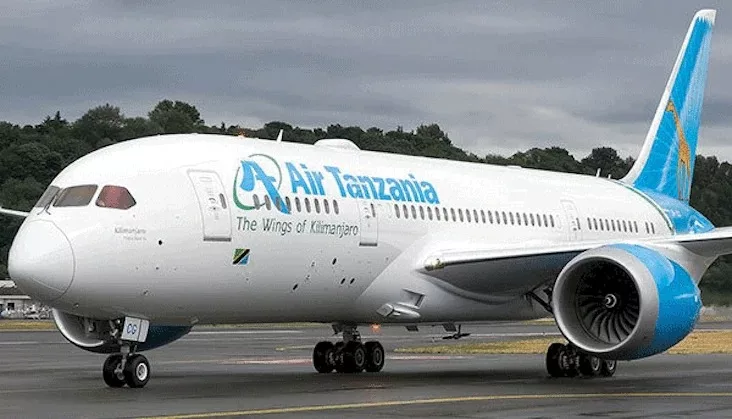
Dar es Salaam, September 5, 2026. Air Tanzania, Tanzania’s state-owned national carrier, has suspended its direct service between Dar es Salaam and Moscow after a security review flagged concerns about the safety of operating that corridor, putting it at the centre of a rapidly widening debate about whether Russian airspace is fit for commercial aviation.
The airline announced on September 3 that flights TC422 and TC423 would be grounded from September 4, citing what it described as a “routine risk assessment of the operating environment along the route.” The public notice was brief, clinical even. Safety, the airline said, “always takes precedence over commercial” considerations. No specific threats were named. No direct connection was drawn to the war in Ukraine.

But the timing was impossible to ignore.
Zelensky’s Warning to the Aviation World
Days before Air Tanzania made its announcement, Ukrainian President Volodymyr Zelensky delivered one of his more pointed addresses to the international community, one directed not at soldiers or diplomats but at airline executives, insurers, and aviation regulators. His message was stark: Ukraine is expanding its long-range drone operations, those drones are increasingly operating deep inside Russian territory, and the skies above Russia are, in his words, “becoming completely unsafe.”
“There will simply be drones in Russia’s skies on a scale that has to be taken into account,” Zelensky said. Ukraine, he added, had formally notified international aviation bodies and partner governments about the situation. The warning was less a threat and more a statement of operational reality, a heads-up to an industry that was perhaps not yet reading the situation clearly enough.
When Air Tanzania’s suspension became public, Zelensky moved quickly to frame it as validation. “We’re getting word that the first airlines have started to suspend flights to Russian airports following our announcement about the drone hazard that objectively exists in Russian airspace,” he said, describing the carrier’s decision as “the right and perfectly logical response to the facts as they are.” You can read more about the Air Tanzania Moscow flight suspension as it was first reported.
Why an African Carrier Is at the Centre of This Story
There is something quietly significant about Air Tanzania being the airline in this particular headline. This is not Lufthansa or Air France or some major European carrier with decades of experience navigating politically sensitive routes. This is a state-owned African airline, one that launched its Dar es Salaam to Moscow service as part of a broader push to grow Tanzania’s international footprint. The fact that it has now pulled back tells you something about how widely the ripple effects of the Ukraine conflict are spreading.
African carriers have generally avoided direct entanglement in the geopolitical fallout from Russia’s invasion of Ukraine. Most Western airlines ceased Russian operations in 2022 following sanctions and insurance complications. Carriers from Africa, Asia, and the Middle East largely filled that gap, continuing to service Russian airports when European competitors could not. Air Tanzania was operating in that space. Its withdrawal, whether driven by the drone threat specifically or a broader read of the risk environment, signals that the calculation is shifting even for those who had stayed in the game.
The Insurance Question No One Wants to Answer Publicly
Behind every airline’s risk assessment for a conflict-adjacent route sits an insurance conversation, and that conversation has grown increasingly uncomfortable for anyone still flying into or over Russian territory. War risk insurance for Russian routes has been a fraught issue since 2022, and the prospect of drone activity at scale, potentially disrupting radar, creating airspace conflicts with civilian traffic, or worse, makes underwriters nervous in ways that very directly affect whether an airline can afford to keep flying.
Air Tanzania did not mention insurance in its statement. But the phrase “risk assessment of the operating environment” is precisely the kind of language that reflects both operational and financial calculations made in consultation with insurers and risk advisors. Airlines do not ground profitable international routes lightly. When they do, the reasons are usually more concrete than the press releases suggest.
What This Means for Aviation and the Broader Conflict
Zelensky’s framing of the Air Tanzania decision as evidence of a trend is strategically savvy. Ukraine has an obvious interest in presenting Russian airspace as a no-go zone. Every airline that suspends a Moscow route tightens economic pressure on Russia, reduces the international normalisation of flying into Russian airports, and amplifies the message that the drone campaign is having real-world consequences beyond the battlefield.
For the aviation industry, the question is more pragmatic. The war in Ukraine forced a fundamental rethink of European airspace routing as far back as 2022. If drone operations inside Russia genuinely reach the scale Zelensky is describing, carriers from Africa, South Asia, and Southeast Asia, many of which still transit Russian airspace on routes between their home regions and Europe, will face hard choices about alternative routing, which often means significantly longer flight times and higher fuel costs.
The MH17 disaster over eastern Ukraine in 2014 permanently changed how the aviation world thinks about conflict zone overflights. That tragedy demonstrated, at devastating cost, that civilian aircraft and active conflict zones cannot coexist in the same airspace. The industry developed better frameworks after 2014, but those frameworks are only as good as the information flowing into them. Zelensky is, in effect, trying to ensure that information is flowing.
Tanzania’s Position
For Tanzania specifically, the suspension creates an awkward moment. The country has maintained workable diplomatic and commercial relations with Russia, and the Moscow route was part of a genuine effort to grow Air Tanzania’s network and deepen connectivity between Tanzania and Russian-speaking markets. Grounding that route, even temporarily, is a commercial setback. Whether the airline resumes service will depend on how the security picture evolves in the months ahead.
Air Tanzania has not said when or whether flights TC422 and TC423 will resume. The suspension, described as temporary, carries the quiet implication that the airline is watching the situation carefully before committing to a return date. That watchfulness is rational. It is also a quiet acknowledgment that the war in Ukraine, now more than four years old, has not stopped finding new industries and new continents to touch.
As drone technology advances and Ukraine’s long-range strike capability continues to develop, the question facing airlines, insurers, and regulators alike is a serious one: at what point does flying into Russia become commercially uninsurable, and who will be the next carrier to quietly pull its schedule?