

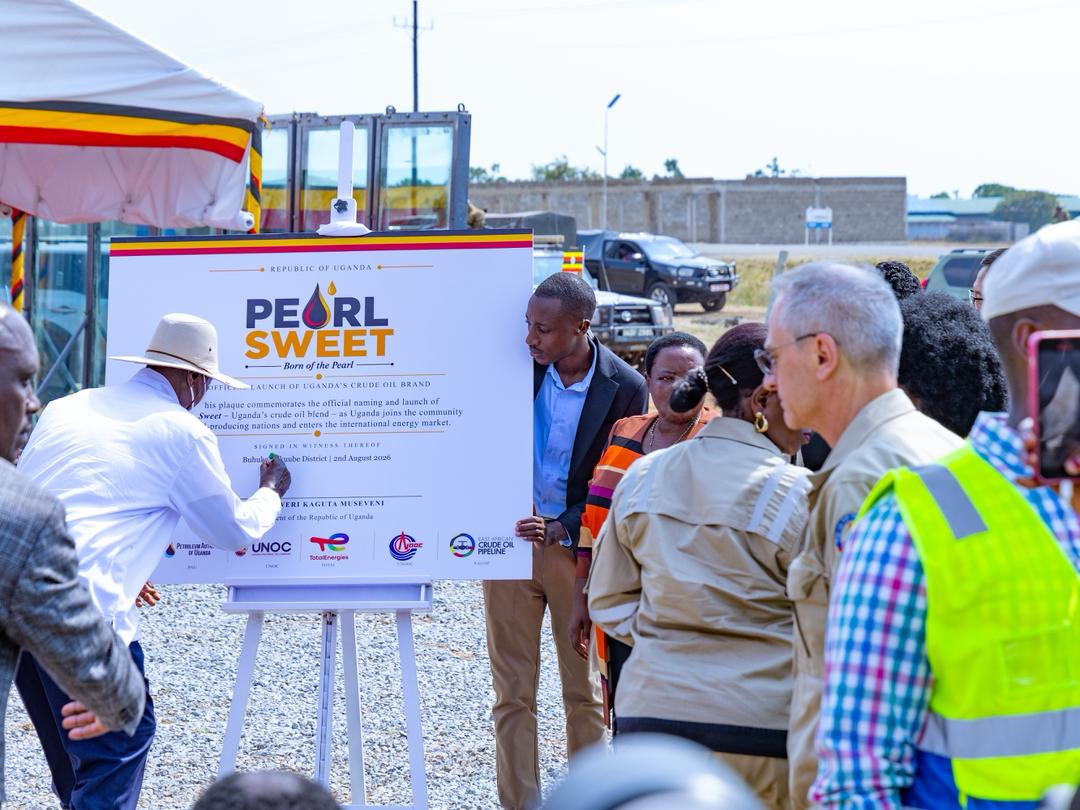
At the Kingfisher oil fields in Kikuube District, Uganda did something last week that most of its citizens have been waiting nearly two decades to witness. The country officially unveiled its first crude oil brand, named Pearl Sweet, a milestone that transforms years of geological surveys, environmental negotiations, and infrastructure battles into something tangible: a product with a name, a price, and a buyer.
According to NTV Uganda’s reporting from the launch event, Energy Ministry Permanent Secretary Irene Bateebe confirmed that commercial oil production is expected to begin before the close of 2026, with the Kingfisher Development Area having already reached mechanical completion and now entering the commissioning phase. That is not a promise anymore. That is an engineering schedule.

What the Numbers Actually Mean
The initial production figure of 25,000 barrels per day at Kingfisher is modest by global standards, but for Uganda, a landlocked country that has never exported a single barrel of crude, it is an economic category shift. Bateebe indicated that output would climb to 40,000 barrels per day early in 2027, and the revenue projections attached to those volumes are striking.
At the opening production levels, Uganda expects to collect roughly 500 million US dollars annually. That figure alone would represent a substantial injection into a national budget that has historically leaned heavily on external borrowing and donor support. When production reaches its peak, the annual haul is projected to hit two billion dollars. To put that in context, Uganda’s entire national budget for the 2024/2025 fiscal year was approximately 52 trillion Ugandan shillings, which translates to roughly 14 billion US dollars. Two billion dollars in annual oil revenue, therefore, represents a genuinely consequential share of government income.
Pearl Sweet: More Than Just a Marketing Exercise
Naming a crude oil grade is not a ceremonial gesture. It is a commercial act. Crude oil is traded on global markets by grade, and each grade carries specific characteristics that refiners value differently. The name Pearl Sweet signals that Uganda’s oil is a light, low-sulphur crude, a classification that commands a premium over heavier, sour varieties. Sweet crude costs less to refine and produces higher yields of gasoline, jet fuel, and diesel, which makes it attractive to buyers in Asia and Europe alike.
By branding the oil at the point of its official launch rather than quietly shipping anonymous barrels, Uganda is positioning itself as a serious player in the global crude market from day one. It is a calculated signal to traders, refiners, and investors that this is not an ad hoc operation.
The Kingfisher Field: A Long Road to the Finish Line
The Kingfisher Development Area sits within the Albertine Graben, a rift basin along Uganda’s western border with the Democratic Republic of Congo that geologists identified as oil-bearing more than two decades ago. The journey from discovery to commercial production has been anything but smooth. Debates over environmental protections, the rights of communities displaced near the fields, and the sheer complexity of building oil infrastructure in a landlocked country have tested every stakeholder involved.
The associated East African Crude Oil Pipeline, which will carry Uganda’s oil approximately 1,443 kilometres to the Tanzanian port of Tanga on the Indian Ocean, remains one of the most ambitious infrastructure projects on the continent. Without that pipeline, landlocked Uganda has no route to market. The fact that Kingfisher is now mechanically complete and entering commissioning suggests that the broader production ecosystem is converging, even if the pipeline timeline continues to attract scrutiny.
What This Means for Ordinary Ugandans
Resource wealth and citizen welfare do not automatically align, and Uganda’s leadership knows this. Across Africa, oil discoveries have an uneven record of translating into broadly shared prosperity. Nigeria’s decades of oil production and its persistent poverty rates, or the experience of South Sudan, where oil revenue became fuel for conflict rather than development, serve as cautionary references that Ugandan policymakers frequently cite in their own planning conversations.
The Ugandan government has, at various points, committed to channelling oil revenues into infrastructure, education, and health. Whether those commitments hold once the money starts flowing is a question that civil society groups, international observers, and ordinary citizens will watch closely. Five hundred million dollars a year is life-changing money for a country of Uganda’s size, but it needs to be governed well to deliver on its promise.
Regional Implications Worth Watching
Uganda’s arrival as an oil producer carries weight beyond its own borders. Tanzania benefits directly through pipeline transit fees and port revenues at Tanga. Kenya, which had its own oil ambitions in the Lokichar basin, has watched its production timeline slip repeatedly and will be observing Kampala’s progress with considerable interest. For East Africa as a region, a functioning Ugandan oil operation validates the model of developing landlocked reserves via long export pipelines, which could influence financing and political will for similar projects elsewhere on the continent.
International energy markets will also be paying attention. At 40,000 barrels per day, Uganda is not going to move global oil prices. But it adds to a growing set of African producers whose combined output is quietly reshaping supply diversification strategies among Asian refiners in particular, many of whom are actively reducing dependence on Middle Eastern crude.
A Brand Launch That Carries Real Weight
The ceremony at Kikuube District was more than a ribbon-cutting. It was Uganda telling the world that Pearl Sweet is ready for business. The commissioning phase now underway will test every valve, pump, and control system before the first commercial barrel is certified for export. If that phase proceeds without major delays, Uganda could realistically close 2026 as an oil-producing nation for the first time in its history.
That is a sentence that would have seemed speculative not long ago. Today, with the Kingfisher Development Area mechanically complete and a crude brand officially on the books, it reads more like a schedule.
The question worth sitting with is this: with half a billion dollars a year about to start arriving, will Uganda build the governance frameworks strong enough to make sure that money builds the country its citizens have been waiting for, or will Pearl Sweet become another African oil story where the wealth stops short of the people it was meant to reach?