

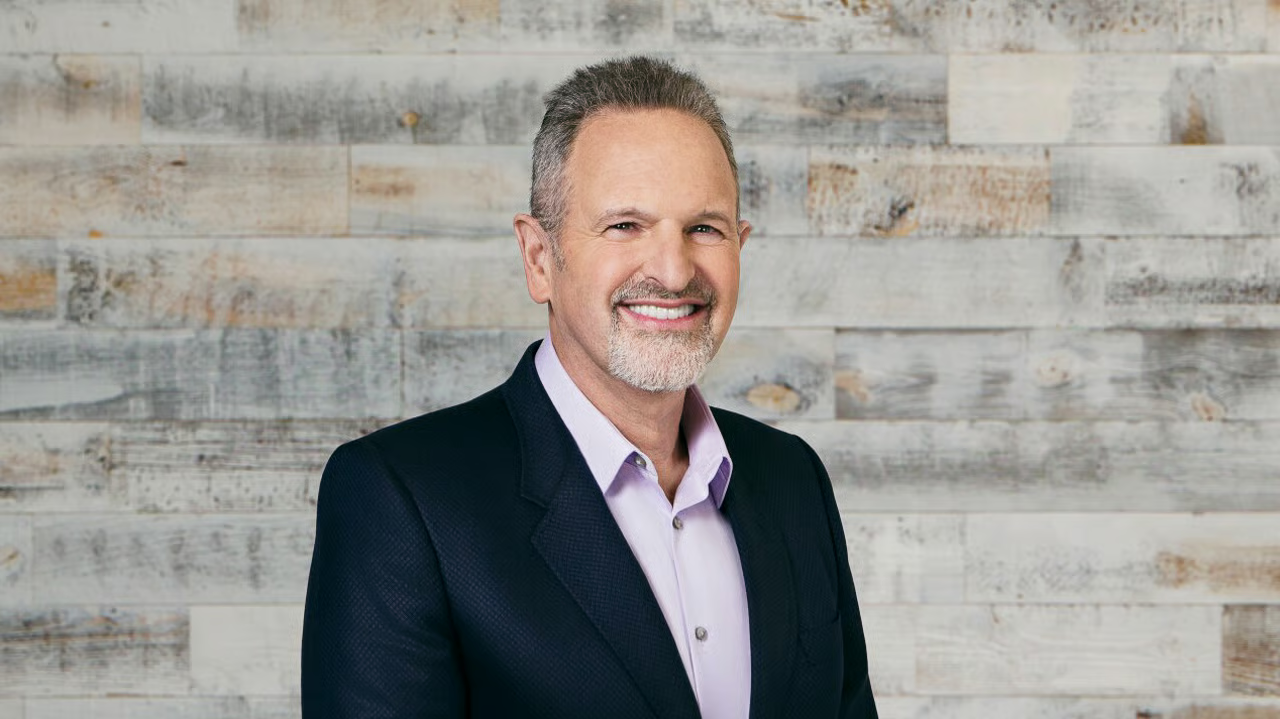

Singer Tracy Melon is not holding back. The talented vocalist has gone public with a sharp rebuke aimed at individuals who use artificial intelligence to recreate artists’ songs and then push those versions onto music streaming platforms, calling the practice deeply unfair and emotionally draining for the people whose work is being replicated.
Her frustration, which she made clear in remarks reported by Mbu, reflects a frustration that is growing louder across the music industry as AI tools become more sophisticated and more accessible to anyone with a laptop and a grudge against originality.
The Real Cost Behind Every Song
What makes Melon’s argument land so hard is the detail. She is not speaking in abstractions. She is talking about hours spent in the studio, about voices pushed to their limits, about money spent on production, engineers, mixing and mastering, and all the invisible labour that goes into turning a raw idea into a finished song that people actually want to listen to.
To pour all of that into a piece of music, release it to the world, and then discover that someone has fed your voice into an algorithm and produced a near-identical version with almost zero effort, that is a particular kind of sting. It is not just about the money, although the financial implications are very real. It is about the sense that your creative output, something that cost you genuine pieces of yourself, has been reduced to a data set.
Melon’s call is direct: remove artists’ music from AI-generated versions. It is a demand that cuts to the heart of a debate the music industry has been circling for the past few years without ever quite resolving.
When the Clone Outperforms the Original
Perhaps the most unsettling element of Melon’s complaint is the claim that some of these AI-generated versions are actually performing better on streaming platforms than the original recordings. That is not just frustrating. That is a structural problem.
Streaming algorithms do not care about authenticity. They care about engagement, about completion rates, about saves and shares. If an AI version of a song is engineered to be more palatable or more loop-friendly than the artist’s own recording, the algorithm will reward it accordingly. The original artist ends up competing against a version of their own work that was built without the constraints of creative integrity or human effort.
This creates a perverse incentive where the people doing the least creative work can, in some cases, capture the most financial reward. That is the kind of outcome that should make everyone who cares about music uncomfortable, regardless of how they feel about AI as a tool in general.
A Broader Crisis the Industry Can No Longer Ignore
Tracy Melon’s outburst is not an isolated moment of frustration from a single artist. It is a signal of where things stand as AI music generation tools have moved from novelty to nuisance to genuine threat within a relatively short window of time.
The technology itself is not inherently the villain. AI has legitimate uses in music production, from helping composers sketch ideas to assisting with sound design. But there is a meaningful difference between using AI as a creative tool and using it to clone another artist’s voice and style for commercial gain without their consent.
The legal frameworks around this are still catching up. Copyright law, as it exists in most jurisdictions, was written long before anyone imagined a world where a machine could convincingly replicate a human voice after being trained on a handful of recordings. The gap between what is technically possible and what is legally or ethically protected is wide, and artists like Melon are living in that gap right now.
What Artists Are Actually Asking For
At its core, Melon’s demand is not complicated. She wants her music, and the music of other artists, removed from AI training data and from AI-generated outputs that are commercially distributed. She wants the effort, the investment and the humanity behind real music to count for something in the marketplace.
That is not an unreasonable ask. It is, in fact, the minimum that anyone who genuinely values music as a human art form should be willing to support. The question is whether streaming platforms, AI developers and lawmakers are prepared to act on it or whether artists will continue to shout into a void while the algorithms quietly redistribute their work.
Melon’s voice is one of many rising on this issue, but it carries weight. Every artist who speaks openly about this makes it harder for the industry to look away. The conversation she is forcing is one that needs to happen, loudly and urgently, before the damage becomes irreversible.
So here is the question worth sitting with: if we allow AI to strip the effort and humanity out of music creation without consequence, what exactly are we left with, and would we even recognise it as music anymore?