








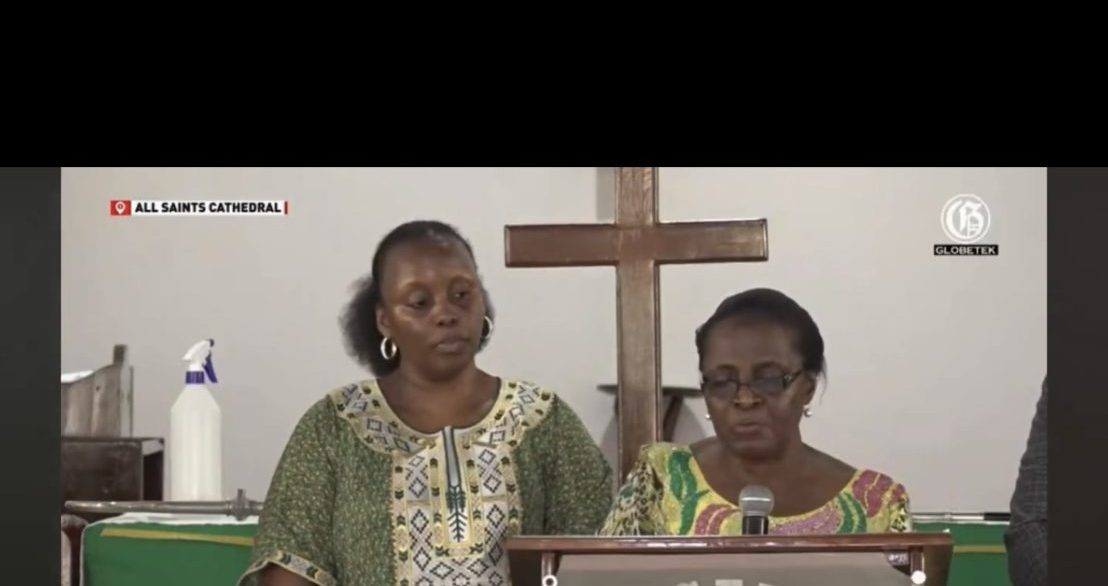
Grief has a way of stripping away pretense. But at All Saints Cathedral in Kampala on the first anniversary of Dr James Garuga Musinguzi’s death, what was stripped away was not pretense alone. It was the last remaining veneer of family unity, peeled back in front of mourners by the man’s own widow.

Peace Kesiime Musinguzi, who had largely stayed silent as court cases piled up and accusations flew in the months following her husband’s passing, chose Garuga’s memorial service to speak plainly. Her target was Alwyn Carl Garuga Musinguzi, her eldest son, and Matthew Rukikaire, a businessman she accuses of teaming up with Alwyn to pursue litigation against her and fellow business associate Agaba Maguru.
Silence Was the First Strategy. It Didn’t Hold.
Peace explained that the family had made a calculated decision to stay quiet in the face of what she described as a sustained campaign of accusations. The thinking, she said, was damage control. Say nothing, and the noise dies down. It is a strategy many families instinctively reach for when disputes turn ugly, hoping that public restraint will eventually exhaust the aggressor.
It did not work here. According to Peace, Alwyn’s legal offensive continued, and the pain it caused reached a point where silence felt less like dignity and more like surrender. So she spoke.
“My oldest son Alwyn has had fraudulent tendencies for a long time,” she told mourners, according to reporting by Chimpreports. She described his relationship with his father as having already been severed before Garuga’s death, pointing to a 2019 court dispute between father and son as the moment the estrangement became formal.
The Accusations on Both Sides Are Serious
What makes this dispute particularly combustible is that neither side is trading minor grievances. Alwyn has alleged in court filings that Peace and Agaba Maguru are fraudulently assuming control of the companies in which his father held interests. He has also publicly accused his mother of obstructing efforts to fly Garuga abroad for specialised medical treatment, and has suggested that decisions around his father’s care contributed to his death.
Garuga died at Nakasero Hospital on August 6, 2025, at the age of 71. Those are heavy accusations to level at a grieving spouse, and Peace did not let them go unanswered at the memorial. She described Alwyn as having immediately pivoted from mourner to litigant the moment his father died, filing cases before the family had even had space to grieve.
“Immediately following James’s passing, Alwyn did not even allow us to mourn our dear one,” she said. “He immediately embarked on false slanderous allegations against me and our long-time business partners.”
Matthew Rukikaire’s Role in the Dispute
The involvement of Matthew Rukikaire adds another layer of complexity to an already tangled situation. Peace alleges that Rukikaire, a businessman, joined forces with Alwyn to file multiple court cases ostensibly aimed at protecting Garuga’s interests in various companies. From Peace’s perspective, those cases are not protection at all. They are, she argues, a coordinated attempt to wrest control of assets away from her and Maguru.
Rukikaire’s connection to the Garuga estate underlines a reality common in high-value succession disputes: the principals are rarely limited to immediate family members. Business partners, associates, and long-standing allies all find themselves drawn into the gravitational pull of a contested estate, and the courts become the arena where competing claims of loyalty and legality are thrashed out.
The Numbers Behind the Noise
It is worth pausing on the scale of what is being contested. Alwyn has reportedly estimated in court filings that the estate is worth more than one trillion Ugandan shillings. That is a figure substantial enough to reshape family dynamics entirely, to turn allies into adversaries and mourning into maneuvering. Very few families emerge from disputes of that magnitude without lasting damage to relationships that once seemed unshakeable.
Peace acknowledged the toll the dispute has taken. “This has caused a lot of pain and distress,” she said, while also expressing hope that the matter would eventually reach what she called “a logical end.” Whether that end comes through the courts, through mediation, or through simple exhaustion remains to be seen.
When a Memorial Becomes a Public Record
There is something worth noting about the choice of venue for this confrontation. A memorial service at a cathedral is, by its nature, a public act. It is attended by community members, business associates, and the wider social circle of the deceased. By speaking out at that specific moment, Peace ensured that her version of events reached an audience that extends well beyond the courtroom.
It is a reminder that succession disputes, particularly at this financial scale, are fought on multiple fronts at once. The legal battle is one arena. Public perception is another. And a cathedral full of mourners, listening carefully to a widow describe her eldest son as having “fraudulent tendencies,” is a powerful setting in which to make a statement.
Garuga built a business reputation during his lifetime. The fight over what he left behind threatens to define how that reputation is remembered, and who controls the narrative going forward is almost as contested as the companies themselves.
As the court cases continue and both sides harden their positions, one question sits at the centre of all of this: when a family’s private grief becomes a public legal war, is there any version of resolution that leaves everyone’s dignity intact?