






She arrived at the Uganda Communications Commission offices carrying a painting and a career on the rise. Lukia Nakabazzi, who took home top honours at the 2024 Uganda Film Festival, sat down with UCC Executive Director Nyombi Thembo to reflect on what a single moment of recognition can do for an artist’s life, and what it still cannot fix.
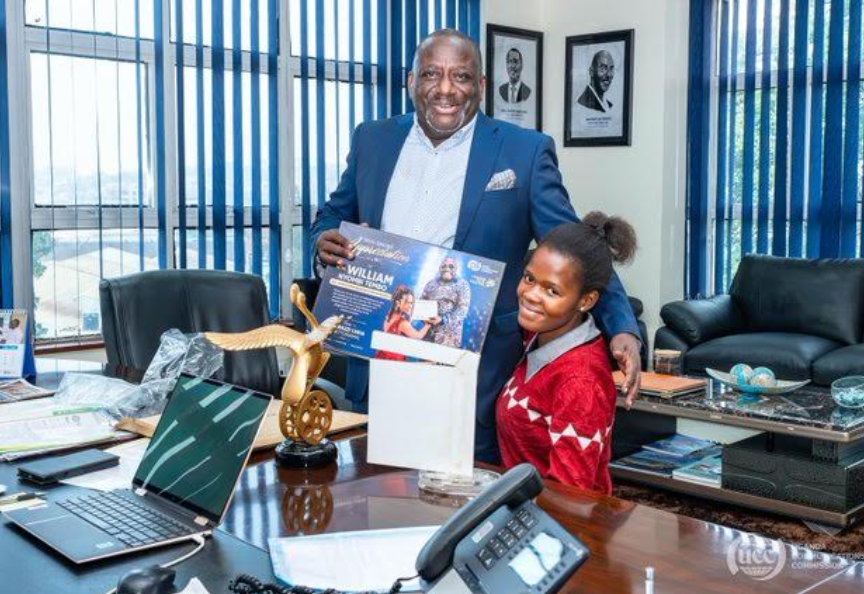
The meeting, which Thembo described with evident warmth, was more than a courtesy call. It set the stage for a broader conversation that Uganda’s creative community has needed to have for years: celebrating talent is not the same as sustaining it.
A Gift, A Gesture, and What It Means
Nakabazzi brought something tangible with her to the meeting. She presented an original artwork to the Commission as a gesture of gratitude for its ongoing investment in local creative talent. Thembo confirmed that the piece has been formally accepted into the UCC’s cultural collection, where it will be catalogued and preserved for future generations.
There is something quietly powerful about that. A young Ugandan woman, whose work was recognised on a national stage, chose to give something back rather than simply receive. That instinct says a great deal about the character of people Uganda’s creative industry produces, and makes the economic hardship many of them endure even more difficult to justify.
Thembo acknowledged as much. Speaking about the visit, he noted that Nakabazzi’s resilience and dedication to her craft remain inspiring, and that her desire to complete her university education is an aspiration the Commission is actively working to support through its network of educational and industry partners.
Beyond the Award: The Structural Problem No Festival Can Solve
Here is where the conversation gets uncomfortable. Nakabazzi’s story is, by any measure, a success story. She won a prestigious award. She gained recognition. She sat across from the head of one of Uganda’s most influential regulatory bodies and was listened to. And yet, her situation still reflects what Thembo himself called a broader reality, the socioeconomic vulnerabilities that Uganda’s finest creatives continue to live with, often invisibly, behind the shine of their work.
Film festivals are extraordinary. They create moments. They change trajectories. But they do not pay rent. They do not cover tuition. They do not offer health insurance or retirement savings. An artist can win every award on offer and still be one medical emergency away from financial collapse.
Thembo did not shy away from that tension. He made clear that the UCC’s responsibility extends well beyond celebrating individual success stories. What Uganda’s creative economy actually needs, he argued, is long-term systemic support, structural solutions that protect artists’ welfare not just on the night they win, but every ordinary day before and after it.
What Structural Support Actually Looks Like
This is the harder part of the conversation, because structural support is not a speech or a handshake photo. It requires investment in artist welfare frameworks, accessible funding mechanisms, education pathways, intellectual property protection, and industry contracts that don’t exploit the very people who make the work worth watching.
Uganda is not short of creative firepower. The country consistently produces filmmakers, visual artists, musicians, and storytellers whose work punches well above its budget. The gap is not talent. It is infrastructure. It is the absence of a safety net strong enough to let artists take creative risks without risking their livelihoods in the process.
Nakabazzi’s ambition to complete her university education is telling. Education should not feel like a luxury for someone who has already demonstrated enough skill to be recognised at a national festival. That it apparently remains an uncertain goal for her underlines exactly the kind of structural gap Thembo is talking about.
The UCC’s Role, and Its Limits
The Uganda Communications Commission occupies an interesting position in all of this. As a regulatory and communications authority, it has real reach, across broadcast media, telecommunications, and content distribution. Its ability to shape how creative work is consumed, distributed, and monetised within Uganda gives it genuine leverage in the creative economy conversation.
Thembo’s pledge to seek support for Nakabazzi through the Commission’s network of educational and industry partners is a meaningful step. If the UCC can open doors that artists cannot open alone, that matters. But the Commission cannot be the only institution carrying this weight. Government ministries, private sector sponsors, and civil society organisations all have roles to play in building the kind of creative economy that rewards its contributors with more than applause.
What the Nakabazzi visit accomplished, perhaps more than anything else, is that it forced a quiet but important admission into the public record: talent alone is not enough, and Uganda’s institutions know it. The question now is whether that knowledge translates into action or simply into better speeches at the next awards ceremony.
A Moment That Deserves to Be More Than a Moment
Lukia Nakabazzi walked into the UCC with a painting and a story. She walked out, by all accounts, with renewed support and genuine encouragement. That is real, and it should not be minimised. But the most lasting gift the UCC, and Uganda’s broader institutional ecosystem, could give her, and the hundreds of equally talented artists who will never make it to an executive director’s office, is a system that does not require individual acts of mercy to function.
Uganda’s creative sector is not waiting to be discovered. It has already been discovered, repeatedly, by audiences and award panels alike. What it is waiting for is the kind of sustained, serious investment that treats artists as professionals with rights and needs, not just stories to be told at press conferences.
So here is the question worth sitting with: if Uganda’s institutions already know that its best creative minds are living with real economic vulnerability, what exactly is still standing in the way of fixing it?