


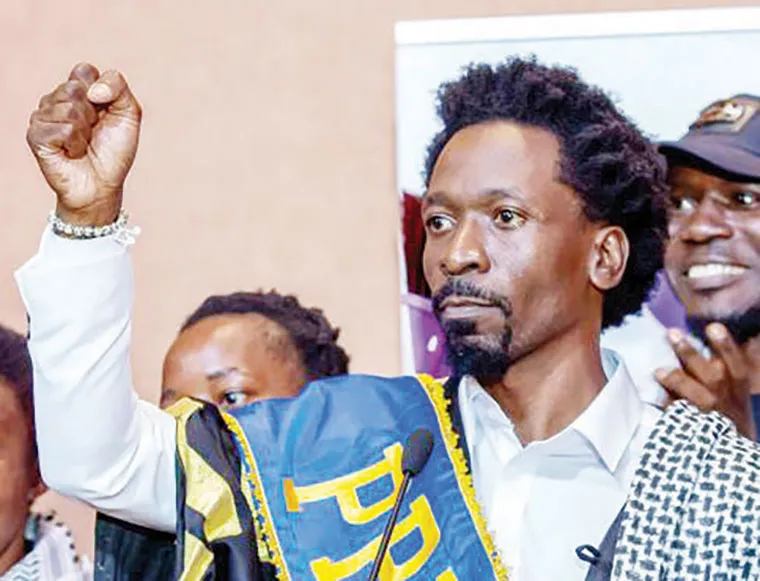
For a man who built his reputation on holding Uganda’s legal establishment accountable, Isaac Kimaze Ssemakadde is now locked in a battle with that very establishment over something deeply personal: his own freedom. The Uganda Law Society (ULS) President, who has never been shy about confronting power, has fired off a sharply worded formal complaint against the Judiciary, accusing it of deliberately dragging its feet on an application that could spare him two years behind bars.
The Sentence That Started It All
The sequence of events traces back to February 14, 2025, when Justice Musa Ssekaana handed Ssemakadde a two-year imprisonment order for contempt of court. Six days later, on February 20, 2025, Ssemakadde moved swiftly, filing High Court Miscellaneous Application No. 137 of 2025 against lawyer Hashim Mugisha, seeking a stay of execution on that sentence while he pursues a full appeal.
What followed, according to Ssemakadde, was not justice in motion but justice stuck in sand. The court adjourned the matter no fewer than five times, with three of those postponements falling within a single fortnight in September 2025, specifically on the 15th, 23rd, and 30th of that month, each time when a ruling had been expected.
A Letter to the Acting Principal Judge
By October 13, 2025, Ssemakadde had reached his limit. He addressed a formal letter to the Acting Principal Judge, laying out his frustrations with pointed, constitutional language. As reported by Chimpreports, the ULS president wrote that the ongoing delay “undermines the principles of justice and fairness, particularly given the straightforward nature of the application.”
He did not stop at expressing disappointment. Ssemakadde reached directly into Uganda’s constitutional framework, invoking Article 28(1), which guarantees every person the right to a fair hearing, and Article 126(2)(b), which explicitly requires that justice must not be delayed. These are not obscure provisions. They sit at the heart of what Uganda’s legal system is supposed to stand for, and Ssemakadde knows their weight better than most.
Requests Rejected, Options Narrowing
The complaints go beyond the delays themselves. Ssemakadde also disclosed that his request for the presiding judge to recuse herself from the matter was turned down. A separate request for an administrative stay of execution met the same fate. With those doors closed and the ruling still not delivered, his legal options have grown increasingly tight.
Adding pressure to an already strained situation, Ssemakadde noted that the High Court’s inaction has created a knock-on effect for his appeal before the Court of Appeal, where Civil Appeal No. 102 of 2025 is currently pending. Without clarity from the lower court, navigating the appellate process becomes considerably more complicated.
Why This Case Carries Weight Beyond One Man
There is a certain irony that is impossible to ignore here. The head of the body tasked with advocating for legal practitioners and upholding the rule of law in Uganda now finds himself accusing the country’s courts of violating the very constitutional guarantees his organisation exists to protect. Whether one sympathises with Ssemakadde or not, that irony forces a broader conversation about how Uganda’s judiciary handles cases involving prominent critics of the system.
Contempt of court proceedings are, by their nature, sensitive. They sit at the intersection of judicial authority and individual rights, and they require courts to demonstrate that the process is not being weaponised. When the subject of such proceedings is the elected president of the national bar association, the standard of procedural transparency should arguably be even higher, not lower.
Repeated adjournments on a stay of execution application, especially one involving a custodial sentence, create real-world consequences. Every day the ruling is delayed is a day Ssemakadde technically remains under threat of imprisonment. That is not an abstract concern. It is a lived pressure that affects his ability to function professionally and to pursue his legal remedies effectively.
What Uganda’s Constitution Says
The constitutional provisions Ssemakadde cited are not technicalities. Article 28(1) of Uganda’s Constitution enshrines the right to have one’s case determined without undue delay. Article 126(2)(b) goes further, directing courts to administer substantive justice without procedural technicality and without delay. These are affirmative obligations placed on the judiciary, not aspirational suggestions.
Legal scholars and practitioners across the country have long flagged case backlog and delayed rulings as persistent weaknesses in Uganda’s court system. Ssemakadde’s case puts a face to what is, for many ordinary litigants, a nameless and grinding frustration. The difference, of course, is that most of those ordinary litigants do not have the platform or the legal knowledge to write to the Acting Principal Judge and demand answers.
The Bigger Picture for Uganda’s Legal Profession
The Uganda Law Society under Ssemakadde has been notably assertive. His tenure has been marked by a willingness to criticise institutions that many of his predecessors might have handled with more diplomatic caution. That posture has earned him both admiration and enemies within Uganda’s legal and political circles.
Whether his current battle with the judiciary is seen as a principled stand or as a high-profile figure pulling every available lever to avoid a prison sentence likely depends on where one sits. But what is not in dispute is the factual record: an application filed in February 2025 had, by October of the same year, not received a ruling despite five scheduled dates. That is a fact the judiciary will need to answer, regardless of who is asking.
The court’s silence on this matter may speak louder than any ruling it could deliver. And for a country that has staked considerable national identity on the strength of its constitutional framework, the optics of a months-long delay in a contempt case involving the nation’s top lawyer are, at the very least, uncomfortable.
If Uganda’s courts are committed to the constitutional promise that justice will not be delayed, this is exactly the kind of case where that commitment needs to be demonstrated clearly and publicly. If the system cannot deliver a timely ruling on a stay of execution application, what confidence can any ordinary citizen hold that their own cases will be treated any differently?
Where do you think the line falls between judicial process and institutional accountability when it comes to high-profile cases like this one? Share your thoughts below.