




German authorities arrested a 33-year-old German man on Friday after a devastating fire tore through the Kehlsteinhaus, Adolf Hitler’s former alpine retreat perched above the Bavarian village of Berchtesgaden, leaving what was once one of the most recognizable relics of the Nazi era largely in ruins. The blaze drew roughly 200 firefighters to the remote summit of Obersalzberg in southern Germany, where the protected building had stood for nearly nine decades as both a grim historical landmark and one of Germany’s most visited heritage sites.
A Mountain Landmark Reduced to Ash
The Kehlsteinhaus was not a place anyone would describe warmly. Built at staggering altitude and extraordinary expense at the behest of Martin Bormann as a gift to Hitler for his 50th birthday in 1939, the stone chalet clung to the peak of the Obersalzberg massif like a monument to megalomania. Its dramatic Alpine setting drew millions of curious visitors over the decades, not out of admiration, but out of the very human need to confront history face-to-face. That confrontation is now complicated by what appears to be an act of deliberate destruction.
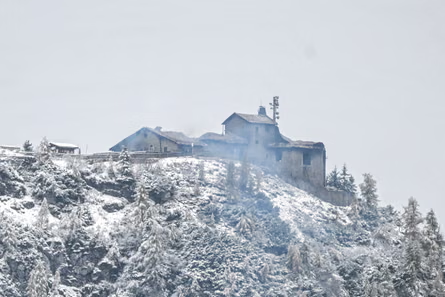
According to reporting from The Guardian, the fire broke out on a Friday night, sending emergency services scrambling up mountain roads to a location that is, by any definition, a logistical nightmare. Getting 200 firefighters and their equipment to a remote Alpine peak in the dark is no small feat, and yet that is precisely what Bavarian emergency services managed. Despite the effort, the structure suffered catastrophic damage.
Who Is the Suspect?
German police confirmed the arrest of a 33-year-old German national in connection with the fire. Beyond age and nationality, authorities have not released identifying information, and the investigation is ongoing. The speed of the arrest, however, suggests that either the suspect was found at or near the scene, or that surveillance and witness accounts pointed quickly in one direction. German law enforcement has a practiced hand at investigating crimes at historically sensitive sites, and this case will almost certainly draw federal-level scrutiny given the site’s significance.
Motives remain unconfirmed. Speculation is inevitable when a structure so loaded with historical symbolism burns under suspicious circumstances, but responsible journalism demands patience. What is known is that a protected cultural building now sits largely destroyed, and a man is in custody answering for it.
The Weight of What Was Lost
Here is where the story gets genuinely complicated. The Eagle’s Nest occupied an unusual position in Germany’s long, painful reckoning with its Nazi past. Unlike many sites associated with the Third Reich, which Germany demolished or repurposed as acts of deliberate historical erasure, the Kehlsteinhaus survived. It was not preserved out of nostalgia or reverence. It survived because it became a tool of education, a physical space where the scale and ambition of Nazi power could be felt rather than merely read about in a textbook.
The building hosted a documentation center and served as a starting point for guided tours that placed the site explicitly within its historical context. Visitors did not arrive to celebrate. They arrived to understand. That function, fragile as it always was, is now gone along with the structure itself.
There is a broader debate embedded in this moment. Some historians and ethicists have long argued that Nazi-era landmarks should be demolished rather than preserved, on the grounds that their continued existence risks glorification regardless of how carefully the framing is managed. Others maintain, with equal conviction, that physical evidence of atrocity is irreplaceable as a pedagogical tool, that photographs and films and written records can never fully replicate the weight of standing somewhere history happened. The fire at Obersalzberg has collapsed that debate into a single, irreversible fact.
Bavaria’s Difficult Heritage Landscape
Bavaria as a region carries an outsized share of Germany’s National Socialist history. Nuremberg, Munich, Dachau, Berchtesgaden: the geography of the Nazi rise to power runs through the state like a dark waterway. Bavarian authorities have invested considerably in managing these sites with care, balancing the tourism economy they generate against the moral weight they carry. The destruction of the Kehlsteinhaus is not just a criminal matter. It is a heritage crisis.
The Bavarian state government will now face difficult decisions. Reconstruction is technically possible but philosophically thorny. A rebuilt Eagle’s Nest would not be the original structure. It would be a replica of a building that was itself a monument to a murderous regime. Whether that serves any educational purpose worth the cost and controversy is a question that historians, ethicists, and politicians will be debating for years.
What Comes Next
The criminal case will move through Germany’s justice system. The 33-year-old suspect faces charges that carry serious consequences under German law, particularly given the protected status of the building and the deliberate nature of the alleged act. Investigations into the precise cause and the suspect’s background will take time, and the full picture of what happened on that Friday night on the Obersalzberg may not emerge for months.
In the meantime, the smoldering remains of a site that drew visitors from across the world sit at the top of a Bavarian mountain, a dramatic and unsettling punctuation mark on a chapter of history that never quite closes. The Eagle’s Nest was always a strange, uncomfortable place to visit. Now it is something else entirely: a crime scene, a ruin, and a reminder that history is never as safely in the past as we might prefer to believe.
Should historically controversial sites like the Kehlsteinhaus be rebuilt after destruction, or does their loss force us into a more honest conversation about how we memorialize dark history? Leave your thoughts below.