








The Trump administration took its fight over mail-in voting restrictions all the way to the nation’s highest court on September 3, 2026, filing an emergency request with the Supreme Court to overturn a federal judge’s order that had put postal voting curbs on ice. The move signals just how aggressively the White House is willing to push its election-related agenda, and how quickly a single district court ruling can escalate into a constitutional standoff.
What the Justice Department Is Asking For
The Justice Department filed an emergency application asking the Supreme Court to lift a temporary block imposed by Judge Indira Talwani. Her order had stopped the United States Postal Service from putting new restrictions into effect, restrictions that critics argue would make it significantly harder for Americans to cast ballots by mail. The administration’s position is essentially that the judge overstepped, and that the policy should be allowed to proceed while legal challenges work their way through the courts.
Emergency applications to the Supreme Court are not everyday occurrences. They carry a sense of urgency that ordinary appeals do not, and they demand that the justices act quickly rather than on the typical months-long timeline. That the administration chose this route tells you everything about how much political weight it is attaching to this particular postal policy.
Who Is Judge Indira Talwani?
Judge Talwani sits on the federal bench and has now found herself at the center of one of the sharpest voting rights disputes of the current political moment. Her order blocking the USPS from implementing the restrictions was temporary, meaning it was designed to preserve the status quo while the broader legal questions get sorted out. That is a standard judicial tool, but it has clearly frustrated an administration that wants its policies in motion now, not after years of litigation.
The fight over mail-in voting has never really cooled since 2020, and the current dispute is the latest chapter in a long-running argument about who gets to vote, how, and under what conditions. You can follow the live coverage of these developments, including the Justice Department’s filing, via The Guardian’s live blog.
Capitol Hill Adds Another Layer: The Leon Black Standoff
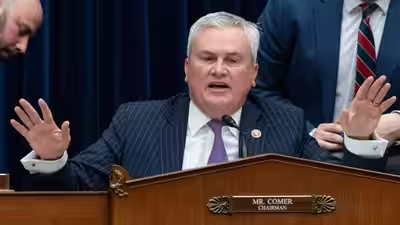
As if the Supreme Court drama were not enough to fill a news cycle, a separate controversy was heating up on Capitol Hill on the same day. James Comer, who chairs the House Oversight Committee, went public with his frustration over billionaire financier Leon Black’s refusal to sit for a deposition tied to the committee’s investigation into Jeffrey Epstein and Ghislaine Maxwell.
Black, who has denied any wrongdoing, filed a lawsuit against the Oversight Committee on Thursday, alleging that the subpoenas issued to compel his testimony were legally improper. Comer did not mince words in his response, accusing Black of hiding behind litigation rather than providing the transparency that, in Comer’s framing, the American public deserves.
What the Epstein Investigation Is Actually About
The Oversight Committee’s inquiry is focused on a broader question: how did federal authorities fail, over decades, to properly hold Epstein and Maxwell accountable, and how did Epstein build relationships with powerful and influential figures that may have helped him avoid scrutiny? Those are serious questions that have lingered since Epstein’s death in 2019, and they have not gone away despite the years that have passed.
Leon Black’s name has surfaced in the context of that investigation, which is why the committee wants him in a deposition chair. Black’s legal team argues the subpoenas cross a line. The committee argues he is simply dodging accountability. The courts will now have to sort out who is right, adding yet another legal battle to an already crowded docket of high-stakes cases.
Two Fights, One Overarching Theme
What is striking about September 3, 2026 in Washington is how neatly these two separate stories reflect the same underlying tension: the push and pull between executive or political power on one side, and judicial or legal checks on the other. The Trump administration wants the Supreme Court to override a district judge’s call on voting policy. A congressional committee wants a court to force a billionaire into a deposition chair. In both cases, the question is whether legal processes will slow down or redirect the exercise of power.
That is not a new tension in American governance. But the speed at which these conflicts are escalating, and the willingness of all sides to go straight to the most powerful courts available, suggests a political climate where compromise feels like a foreign language and litigation is the default mode of operation.
Mail-in voting access, the legacy of Jeffrey Epstein’s network, and the limits of congressional subpoena power are all enormously consequential subjects on their own. Watching them collide in the same news cycle is a reminder of just how much is being litigated, literally and figuratively, in American public life right now.
So here is the question worth sitting with: when courts become the primary arena for resolving every major political disagreement, what does that say about the health of democratic institutions, and who ultimately pays the price when the system runs on legal battles instead of consensus?