






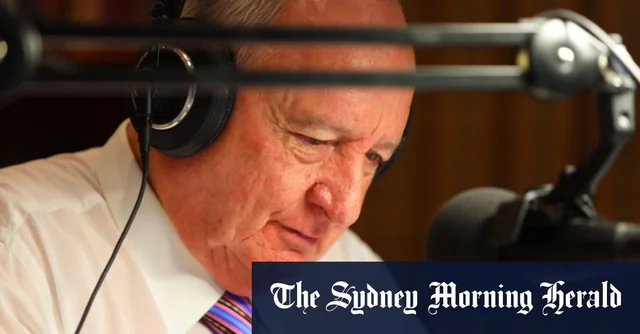
A Sydney court heard this week that veteran broadcaster Ray Hadley used a homophobic slur and other derogatory language when referring to his long-time colleague Alan Jones, a disclosure that has sent shockwaves through Australia’s tightly-knit commercial radio industry. The admission came as Hadley gave evidence in the criminal trial of Jones, who at 85 years old faces 22 charges of indecent assault and sexual touching, to which he has pleaded not guilty.
The courtroom revelations, reported by The Guardian, have done something extraordinary: they have transformed a serious criminal proceeding into a window onto years of professional tension, personal animosity, and the brutal economics of prime-time radio.
The $4 Million Offer That Changed Everything
At the core of Hadley’s testimony is a secret contract offer. According to what emerged in court, radio station 2GB had quietly extended a $4 million deal to Hadley to take over Jones’s coveted breakfast slot. That offer was later withdrawn. What followed, by Hadley’s own admission under cross-examination by defence barrister Gabrielle Bashir SC, was a period of intense personal hostility in which Hadley used language about Jones that he has now been forced to own publicly, in front of a judge.
The breakfast slot at a major commercial radio station is not merely a time block. It is the crown jewel of talk radio, the slot that builds careers, shapes public opinion and commands the most lucrative advertising rates. Being offered it and then watching it disappear would test anyone’s composure. It clearly tested Hadley’s.
What Hadley Told Police in 2019
The court also heard that in 2019, Hadley told police he believed Jones had recruited colleagues at 2GB to dig up damaging information about him. That allegation, made years before this trial began, adds a layer of long-running institutional conflict to what is already a complex picture. Two of Australia’s most recognisable radio voices, colleagues at the same station, apparently engaged in a behind-the-scenes battle that was anything but collegial.
Hadley agreed to these details under cross-examination, which is worth noting. This was not a voluntary confession offered in the spirit of transparency. It was information extracted through the precise, methodical questioning that defence barristers are trained to deploy. Bashir’s line of questioning appears designed to raise questions about the reliability or motivations of a key witness, a standard and legitimate trial strategy.
The Language Problem
Whatever one thinks of the professional rivalry at the centre of this case, the use of a homophobic slur is not a side issue. It matters. Australia’s media landscape has, at least publicly, spent years grappling with questions of inclusion and respect. When prominent figures use slurs, even in private conversations or in statements to police, it reflects something uncomfortable about the culture that produced them.
Hadley’s admission does not make him the subject of this trial. Jones is the defendant. But it does complicate the narrative around Hadley’s role as a witness, and it invites broader questions about the workplace environment inside one of the country’s most listened-to radio stations during that era.
Alan Jones: The Accused at 85
Jones, for his part, has pleaded not guilty to all 22 charges. He is 85 years old and was, for many years, one of the most powerful voices in Australian media. His breakfast program at 2GB drew enormous audiences and enormous controversy in roughly equal measure. The charges against him are serious, and the legal process is ongoing. Nothing in Hadley’s testimony about the contract dispute or the personal animosity between the two men speaks directly to Jones’s guilt or innocence on those charges. Courts exist precisely to make that determination.
What the testimony does is remind us that high-profile trials rarely exist in a vacuum. They arrive carrying years of context, grudges, grievances and competing interests that the law must somehow filter in its pursuit of a fair outcome.
Radio Rivalries and Real Stakes
Australian commercial radio, particularly in Sydney, has always been a ferociously competitive space. Breakfast slots are won and lost over rating points that translate directly into millions of dollars in advertising revenue. The relationships between on-air talent, station management and rivals are rarely simple. They are shaped by ego, money, audience loyalty and the particular pressure of performing publicly every single morning.
A $4 million contract offer being extended and then pulled back is not a minor administrative event. It is a seismic professional moment. Understanding that context does not excuse the language Hadley used, but it does explain why tensions between the two men ran so deep for so long.
As this trial continues, the Australian public is getting an unusually candid look at what happens behind the studio glass. The question now is whether the courtroom revelations will do lasting damage to the reputations of both men, regardless of how the verdict ultimately reads.
What does it say about media culture when two of its most powerful voices cannot be in the same building without allegations of dirt-digging and slurs entering the picture? And more broadly, who do we want holding the microphone, and what standards should we demand of them?