






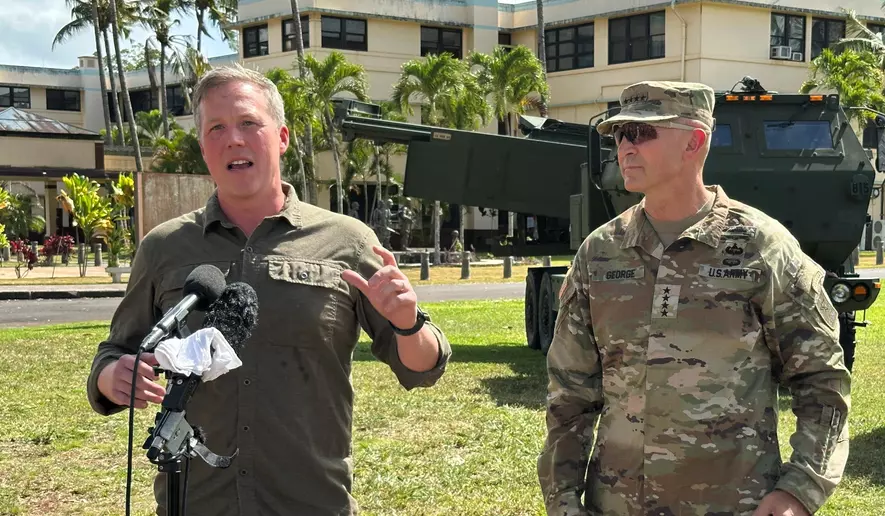
On the first day of September 2026, Washington absorbed another jolt from inside the Pentagon: Army Secretary Daniel Driscoll had resigned. No formal reason was offered. No farewell press conference was scheduled. After eighteen months in one of the most demanding civilian posts in the American defence apparatus, Driscoll was simply gone, and the silence around his departure has since spoken louder than any official statement could.
A Departure Dressed Up as a Success Story
The White House moved quickly to shape the narrative. Spokesperson Anna Kelly released a statement Monday night calling Driscoll “highly effective in advancing President Trump’s agenda,” pointing to his contributions on military readiness, lethality, and his involvement in Russia-Ukraine negotiations. It was the kind of glowing send-off that, in Washington, often signals the opposite of what it says. When an administration rushes to praise someone on the way out the door with no explanation, the instinct to read between the lines is not paranoia. It is experience.
According to reporting from The Guardian, Driscoll’s exit followed months of internal clashes with Pentagon secretary Pete Hegseth. The nature of those disagreements has not been made public, but the backdrop is well-documented: Hegseth has removed senior military officers and blocked promotions during his tenure, moves that critics argue have systematically gutted the experienced leadership the Army relies on to function.
Democrats Raise the Alarm Over ‘Hollowed Out’ Leadership
The political response from the opposition was pointed and immediate. A senior Senate Democrat characterised the situation as Hegseth having “hollowed out” the Army’s senior ranks. That phrase carries real weight. A hollowed-out institution is not merely one that has lost personnel. It is one where institutional knowledge, mentorship networks, and command experience have been stripped away faster than they can be replaced. Think of it like pulling the load-bearing walls out of a building while assuring everyone the roof will hold.
The concern is not abstract. Thousands of U.S. soldiers are currently deployed in the Middle East. Any competent military analyst will tell you that the relationship between civilian leadership at the top and the officer corps below it is not ceremonial. It is operational. When that relationship fractures, the consequences can ripple down through every level of command at exactly the wrong moment.
Hegseth’s Pattern at the Pentagon
Driscoll’s resignation does not exist in isolation. Hegseth’s time leading the Pentagon has been defined, at least in the public record, by a series of personnel decisions that have alarmed military professionals and lawmakers alike. Removing senior officers and blocking promotions are not routine administrative acts. They send signals through the ranks about what kind of loyalty the leadership values, and what kind of independent judgment it tolerates.
Career military officers spend decades building the expertise to advise civilian leaders, manage complex operations across multiple theatres, and execute policy under pressure. When those officers are removed or passed over for reasons that are never made transparent, the institutional loss is not just about the individuals. It is about the knowledge, relationships, and trust they carried with them.
What This Means for the Officer Corps
There is a morale dimension to this story that rarely gets the attention it deserves. Officers watching senior colleagues pushed out or blocked from advancement will draw their own conclusions about whether a long career in uniform is worth the personal sacrifice it demands. Recruitment into service academies, retention of mid-career officers, and the willingness of talented people to accept leadership roles all depend, at least partly, on the perception that the institution rewards merit and protects its own.
When that perception erodes, the damage is slow, quiet, and deeply hard to reverse. You do not notice a hollowed-out military until the moment you need it most, and by then, the time to rebuild has already passed.
Driscoll’s Eighteen Months: A Record Left Unfinished
Driscoll came into the Army Secretary role with the kind of profile the Trump administration favoured: an alignment with the president’s agenda, an emphasis on strength and operational effectiveness, and a willingness to push through the kind of changes that career bureaucrats resist. His work on readiness and his involvement in diplomatic processes around the Russia-Ukraine conflict suggest he was engaged on some of the most complex challenges facing the U.S. military establishment.
What went wrong between him and Hegseth, the precise nature of the friction that made eighteen months the end of the road, remains officially unknown. That lack of transparency is itself part of the problem senators are raising. A defence establishment that cannot or will not explain why its top civilian Army leader has left during an active deployment period is one that is asking the public to trust it on faith alone.
The Bigger Picture: Civilian Control and Military Trust
The principle of civilian control over the military is one of the foundational structures of American democracy. It is supposed to work as a two-way street: civilians set policy and direction, while military professionals provide honest, expert counsel about what is achievable, what is risky, and what the costs of various decisions will be. That relationship depends on mutual respect and a degree of institutional stability.
When civilian leadership at the Pentagon removes officers, blocks promotions, and drives out the Army’s top civilian administrator, the question that follows is whether that two-way street has become a one-way road. And if the answer is yes, whether that serves American security or undermines it.
The warnings coming from Capitol Hill are unlikely to slow the pace of personnel changes at the Pentagon in the short term. But they do mark something: a moment when the cumulative weight of individual decisions becomes visible as a pattern, and when that pattern starts attracting the kind of sustained scrutiny that is very difficult to make disappear with a well-worded White House statement.
As the dust settles on Driscoll’s exit and Washington waits to see who fills the role next, one question sits at the centre of this story: how much institutional knowledge can the U.S. Army afford to lose before the gaps start to show where it matters most?