










Two worlds collided this week in the world of technology coverage. On one side, the gaming universe descended on Germany for Gamescom, the single largest gaming convention on the planet. On the other, a California-based company is quietly pushing ahead with one of the most audacious engineering projects in modern history: building a commercially operated replacement for the International Space Station. Journalist Laura Cress brought highlights from the Cologne showroom floors, while reporter Lily Jamali went behind the scenes at the California firm chasing that orbital dream, as featured in a recent episode of BBC’s Tech Now.
Gamescom 2026: Where the Future of Play Gets a Public Debut
There is nowhere else on Earth quite like Gamescom when it is in full swing. The Koelnmesse exhibition centre in Cologne transforms into a cathedral of controllers, concept art, and crowd noise. This year was no different, drawing hundreds of thousands of attendees from across the globe and functioning as a showcase where studios, developers, and hardware makers come to plant their flags.
What makes Gamescom so culturally significant is that it is not merely an industry trade show. It is a meeting point between the people who build games and the people who live inside them. Cosplayers move through the crowds dressed as characters from titles that have not even launched yet. Teenagers queue for hours to spend three minutes with a demo. It is, in every measurable sense, a phenomenon.
The convention has long served as a bellwether for where consumer technology is heading. When virtual reality headsets first started making serious noise as consumer products, Gamescom was one of the first places the public could actually try them. When cloud gaming moved from theory to product, the exhibition floors were among the first to reflect that shift. In 2026, the buzz is centred on AI-generated content pipelines, next-generation haptics, and graphics fidelity that is beginning to blur the line between rendered imagery and photographic reality.
Laura Cress captured the energy and the announcements from the showroom floor, translating what can be an overwhelming sensory experience into digestible, meaningful reporting. The convention does not just celebrate gaming as entertainment; it positions it as a cultural and economic force that now rivals film and music in terms of global revenue and audience size.
California’s Boldest Bet: Life After the International Space Station
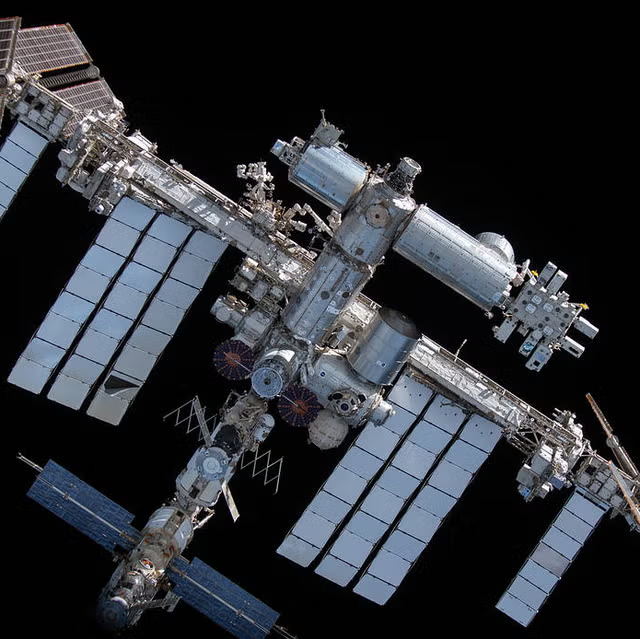
While gaming dominated the headlines at ground level, the more quietly consequential story of the week was unfolding several thousand miles west. A company based in California is racing to develop a commercial space station that could eventually take over from the ISS, which has been continuously inhabited since November 2000 and is expected to be decommissioned before the end of this decade.
The ISS is, by any measure, one of humanity’s great engineering achievements. A joint project involving NASA, Roscosmos, the European Space Agency, JAXA, and the Canadian Space Agency, it has hosted over 270 people from more than 20 countries and produced thousands of scientific studies in microgravity conditions impossible to replicate on Earth. But it is ageing. Its retirement is not a matter of if, but when.
That gap in orbital infrastructure is exactly the opening that private companies have been waiting for. NASA itself has encouraged this transition through its Commercial Low Earth Orbit Destinations programme, essentially signalling to the private sector that the agency wants to become a customer rather than an operator. The logic is straightforward: if commercial firms can run a space station profitably, NASA can redirect its budget toward deeper space exploration, including lunar and eventual Mars missions.
Lily Jamali’s access to the California company offers a rare glimpse into what that transition actually looks like in practice. These are not abstract PowerPoint ambitions. Engineers are making real decisions about module design, life support redundancy, docking compatibility, and the commercial models that will make a private station financially viable, whether through research contracts, space tourism, manufacturing, or media ventures.
The Business of Orbit
What separates this moment from earlier waves of space optimism is the seriousness of the infrastructure being built around it. Rocket costs have dropped dramatically over the past decade. Launch frequency has increased. The supply chain for space hardware is more mature than it has ever been. A private space station is no longer a science fiction premise; it is a business plan with a timeline.
That does not mean it is easy. The engineering challenges of keeping humans alive in low Earth orbit are immense. Radiation shielding, micrometeor protection, air recycling, water recovery, and psychological support for long-duration crews are all problems that require solutions more reliable than anything built to commercial tolerances on Earth. The stakes, quite literally, could not be higher.
Two Stories, One Signal
At first glance, Gamescom and the private space station race seem like separate conversations. But they are both chapters in the same larger story about where human ambition and technological capability are converging in 2026. Gaming is no longer just entertainment; it is a training ground for simulation, AI development, and immersive interface design, technologies that feed directly into aerospace, medicine, and education. And the space race is no longer the exclusive domain of governments; it is increasingly powered by the same entrepreneurial energy that built the consumer tech industry.
The reporters covering these stories are doing something valuable. They are making complex, fast-moving developments accessible to people who deserve to understand how the world is changing around them. Whether it is the texture of a next-generation game controller or the thermal coating on a space station module, the details matter because they shape what comes next.
Both stories are worth your attention. And both raise a question worth sitting with: as private companies take on responsibilities once held exclusively by governments, whether in orbit or in the cultural spaces we inhabit through screens, who ultimately decides what that future looks like, and who gets access to it?