










September 7, 2026. Two stories are dominating the tech conversation this week, and they could not be further apart in setting. One unfolds under the neon glow of Cologne’s Gamescom halls, where the world’s most passionate gamers gather every year to lose themselves in what’s next. The other plays out in a sunlit California facility, where engineers are quietly racing against time to build humanity’s next home in orbit. BBC’s Tech Now brought both stories together, with Laura Cress reporting live from Gamescom and Lily Jamali going behind the scenes at the California company aiming to succeed the International Space Station.
Gamescom 2026: The World’s Biggest Gaming Convention Does It Again
If you want to understand where the global gaming industry is headed, Gamescom is the only place to be. Held annually in Cologne, Germany, this convention has long since outgrown the label of “trade show.” It is a cultural moment, a pressure test for studios, and a fever dream for the millions of fans who descend on the city or follow every announcement from their screens at home.
Laura Cress’s coverage captured the sheer scale of it: the packed halls, the playable demos, the announcements that ripple across social media within seconds of being made. Gaming in 2026 is not a niche hobby. It is a dominant entertainment category, one that regularly outpaces Hollywood in revenue and cultural reach. The studios that show up at Gamescom understand exactly what is at stake.
What makes Gamescom consistently interesting is its dual audience. On one side, you have the hardcore players who track release dates like sports fans track transfer windows. On the other, you have investors, platform executives, and publishers who read the crowd’s reaction as a kind of real-time market research. A lukewarm response to a trailer at Gamescom can move stock prices. An unexpected standing ovation can launch a franchise.
Why Gamescom Matters Beyond the Games
The convention also serves as a barometer for the wider technology sector. Announcements at Gamescom frequently preview hardware innovations, from next-generation graphics processing to new input devices and display technologies, that eventually filter into consumer electronics far beyond gaming. The line between gaming tech and mainstream tech has never been thinner, and Gamescom sits right at that intersection.
Artificial intelligence is increasingly woven into game design now, not just for smarter non-player characters but for procedurally generated worlds, adaptive difficulty systems, and even AI-assisted development pipelines. The studios showing off their work this year were not shy about leaning into those tools. Whether you find that exciting or unnerving probably says something about your relationship with technology in general.
The California Company Racing to Replace the ISS
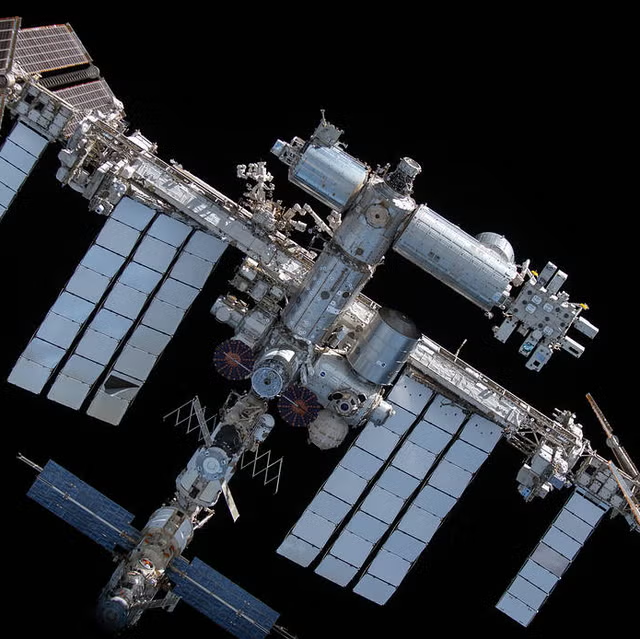
Meanwhile, roughly 8,000 kilometres from Cologne, something arguably more consequential is happening in California. Lily Jamali’s behind-the-scenes reporting for BBC’s Tech Now pulled back the curtain on a private company working to build and operate a commercial space station capable of succeeding the International Space Station.
The ISS, for all its engineering brilliance and its role as a symbol of international scientific cooperation, is aging. NASA and its international partners have acknowledged for years that the station cannot remain operational indefinitely. The current plan involves deorbiting the ISS in the early 2030s, which means the window for a replacement to be ready is uncomfortably tight.
That urgency is precisely what is driving private sector ambition. Several American companies have positioned themselves as contenders to fill the gap, and the one featured in this week’s reporting is operating with a clear sense of competitive pressure. Building a functional, commercially viable space station is not just a matter of engineering excellence. It requires contracts, partnerships with space agencies, and the kind of sustained funding that does not come easily to any organization working at that scale.
What Commercial Space Stations Mean for the Future
The broader shift from government-led to commercially operated space infrastructure is one of the defining technological narratives of this decade. When private companies own and operate the platforms where astronauts live and work, the economics of space change fundamentally. Research conducted in orbit could be sold as a service. Manufacturing processes that benefit from microgravity conditions could become viable commercial products. Even space tourism, long dismissed as a billionaire’s novelty, starts to look more credible when there are multiple destinations to choose from rather than one aging outpost.
Critics of this shift point out the risks. Commercial incentives do not always align with scientific priorities. Safety standards that governments enforce through regulation can come under pressure when profit margins are involved. And the geopolitical dimension of handing critical space infrastructure to private companies raises questions that no amount of optimism about market efficiency can fully answer.
Still, the engineers in that California facility are not waiting for the philosophers to finish their debate. They are building. The clock is ticking, and the ISS is not getting any younger.
Two Stories, One Bigger Picture
On the surface, Gamescom highlights and space station construction have nothing in common. But zoom out a little and a shared theme emerges: the sheer velocity of technological change in 2026 and the private sector’s growing role in shaping it. Whether it is a gaming studio rewriting what interactive entertainment can be or an aerospace company reaching for the stars on a commercial contract, the ambition is recognizable.
Both stories also carry a question about access. Who gets to participate in the future being built? Gaming has democratized significantly over the past two decades, moving from expensive dedicated hardware to smartphones and cloud platforms that reach billions of people. Space has moved in the opposite direction, concentrating capability in fewer hands even as the number of private players grows. Watching those trajectories play out in real time is one of the more fascinating exercises in contemporary technology journalism.
Laura Cress and Lily Jamali are covering two very different beats, but the thread connecting them is unmistakable: the world is changing fast, and the tech sector is the engine driving most of it.
So here is the question worth sitting with: as private companies take over more of the infrastructure that once belonged to governments, from orbital platforms to the digital spaces where millions of people spend their leisure hours, who exactly is responsible for making sure that future works for everyone? Drop your thoughts in the comments below.