










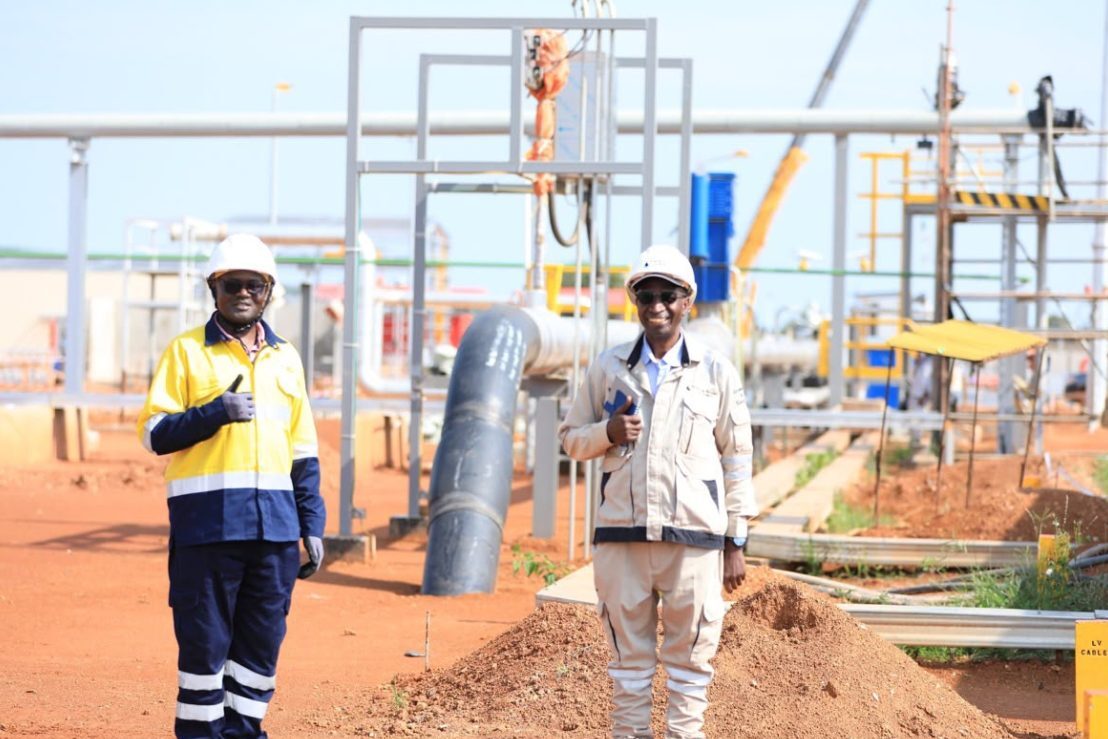
Something significant is happening in the flat, sun-baked terrain around Hoima, Uganda. A pipeline that will carry heat-maintained crude oil across 1,443 kilometres of East African landscape is almost finished, and the people overseeing it are now talking in very specific terms about what comes next.
Ernest Rubondo, the Executive Director of the Petroleum Authority of Uganda, recently conducted a two-day inspection of oil infrastructure across the Albertine Graben, the country’s primary oil-producing region. What he found at Pump Station One in Hoima gave his authority reason to say publicly that the East African Crude Oil Pipeline is 92% complete and remains on course to receive its first crude oil before the close of 2026.
The Two Projects Behind Uganda’s 230,000-Barrel Ambition
Uganda’s planned oil output does not come from a single source. Two distinct upstream projects, operated by two of the world’s major energy companies, will feed into the same pipeline infrastructure and together push production toward a peak of around 230,000 barrels per day.
The larger of the two is Tilenga, operated by TotalEnergies SE. Spread across six fields in the Albertine Graben, Tilenga is designed to produce up to 190,000 barrels daily at full capacity. The second project is Kingfisher, operated by Cnooc Ltd., which will contribute an additional 40,000 barrels per day. Add those numbers together and Uganda’s combined output ceiling lands at approximately 230,000 barrels a day, enough to establish the country as a meaningful, if not dominant, player in African oil production.
Both projects will channel their crude through Pump Station One in Hoima, the entry point into the heated export pipeline that eventually reaches the Indian Ocean coast at Tanga, in Tanzania.
Why a Pipeline Needs to Stay Hot
Here is where Ugandan crude oil gets genuinely unusual. The oil extracted from the Albertine Graben is waxy by nature, meaning it solidifies at relatively modest temperatures. To keep it flowing across more than 1,400 kilometres of buried pipeline, the crude must be kept above 50 degrees Celsius throughout the journey. That is not a minor logistical footnote. It is a core operational requirement that drives some of the most expensive and complex infrastructure decisions in the entire project.
Consistent electricity supply is critical to maintaining that temperature. Which is why Rubondo’s inspection also included the Kabalega Sub-Power Station, a facility being developed specifically to supply power to EACOP operations. Without reliable electricity, the pipeline does not just slow down. It stops working entirely, and the crude inside it begins to congeal.
A Pipeline Built Across Two Nations
The East African Crude Oil Pipeline stretches 1,443 kilometres in total, though the split between the two countries is dramatically uneven. Uganda accounts for only 296 kilometres of the route, while Tanzania carries 1,147 kilometres of pipe before it reaches the port of Tanga on the Indian Ocean. EACOP’s total transport capacity is rated at up to 246,000 barrels per day, slightly above the combined production target, which gives operators some headroom as fields ramp up.
For Tanzania, the pipeline represents a significant infrastructure investment on its territory and a source of transit revenue. For Uganda, it is the only viable export route given that the country is landlocked, hemmed in by neighbours with no direct ocean access. Without EACOP, the oil simply stays in the ground.
What Rubondo’s Inspection Was Really About
Senior officials visiting construction sites can sometimes feel like ceremony rather than substance. But Rubondo’s stated purpose was pointed and practical: to assess whether production infrastructure, power systems, and transportation capacity would all be ready within the government’s stated timeline. That kind of on-the-ground evaluation matters when a project of this scale has multiple interdependent moving parts that all need to work simultaneously on day one.
A pipeline at 92% completion sounds close to the finish line. But the final stretch of any major infrastructure project carries disproportionate risk. Commissioning systems, testing under load, and coordinating across two national governments and multiple corporate operators is where timelines have historically slipped. The Petroleum Authority’s public confidence is notable, though the 2026 deadline still requires everything to hold together across months of final works.
What This Means Beyond Uganda’s Borders
Africa’s energy landscape is shifting. Countries that once relied almost entirely on imported energy are now positioning themselves as exporters, and the geopolitical weight that comes with oil revenue is substantial. Uganda’s entry into the export market, even at a modest scale relative to Nigeria or Angola, changes how the country negotiates on trade, infrastructure finance, and regional influence.
For TotalEnergies and Cnooc, first oil in Uganda represents years of delayed return on investment. Both companies have had to navigate environmental criticism of EACOP, which passes through ecologically sensitive areas and has drawn scrutiny from international NGOs and some European institutional investors. Whether commercial momentum now outpaces that opposition remains an open question.
What is harder to dispute is the engineering reality on the ground in Hoima. At 92% complete, with a named deadline and a regulatory authority willing to stake its credibility on a public timeline, Uganda’s oil journey has entered a phase that is much harder to dismiss than any of the phases that came before it.
As Uganda stands on the edge of becoming an oil-exporting nation, the real question worth sitting with is this: will the revenues flowing from Tanga’s port back to Kampala lift ordinary Ugandans, or will this crude wealth follow the same extractive patterns that have defined oil booms across the continent for decades?