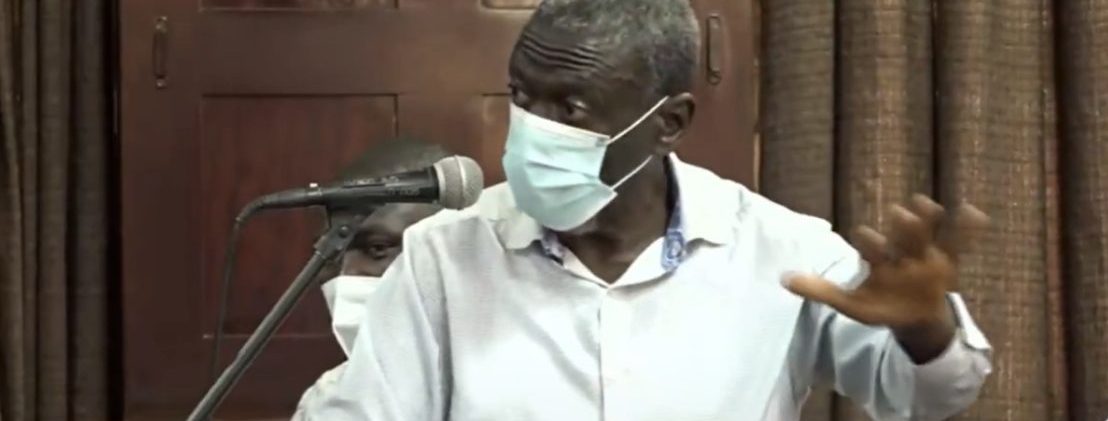
At her home in Kasangati on Saturday, Winnie Byanyima stood before reporters and said out loud what many in Uganda’s opposition circles have whispered for years: that the criminal case against her husband, veteran opposition figure Kizza Besigye, is not really about the law. It is about power, and who is allowed to threaten it.

Besigye, a four-time presidential candidate who has spent decades as one of President Yoweri Museveni’s most persistent challengers, currently faces treason charges. His case has drawn international attention, sparked debate about judicial independence in Uganda, and placed Byanyima, a globally recognised public health advocate, at the centre of a very personal political storm.
“You Cannot Challenge Museveni Democratically”
Byanyima did not mince words. Speaking to journalists at Kasangati, she framed the treason proceedings as one component of a broader, calculated effort to neutralise credible political opposition in the country. As reported by Chimpreports, she told the gathered media that the case goes well beyond her husband as an individual.
“You cannot challenge President Museveni democratically. That’s what this story is about,” she said. “Trying to focus on him and pin him and destroy him is not about him. It’s about opposing President Museveni. You cannot do so democratically.”
It is a statement that carries weight precisely because Byanyima is not a fringe voice. She has spent years leading international institutions and navigating global diplomacy. When she speaks about political persecution, the world tends to listen, whether Kampala wants it to or not.
The Slow Erosion of the FDC
A significant part of Byanyima’s argument on Saturday centred on the Forum for Democratic Change, the political party Besigye helped build from the ground up. The FDC once represented something rare in Uganda: a genuinely organised, nationally spread opposition with parliamentary representation across the country.
Byanyima described what she sees as its deliberate dismantling. “He built it, and it became a powerful democratic opposition with representation from all over the country in the parliament, presenting an alternative to his rule. But over the years, that opposition has been weakened, divided, intimidated, attacked,” she said.
It is a pattern that political analysts watching Central and East Africa will recognise. The tools vary, but the outcome tends to be consistent: fragmentation, demoralisation, and the quiet disappearance of viable alternatives to incumbent power.
Byanyima also made clear that the pressure has not been limited to prominent figures. She said arrests, detentions and disappearances have touched ordinary opposition activists across the country, the kind of people whose names rarely appear in international headlines but whose absence reshapes political life at the grassroots level.
Museveni Pushes Back
President Museveni has offered a sharply different reading of events. He has rejected the notion that Besigye is a political prisoner, arguing instead that Besigye and his legal representatives have themselves dragged out the proceedings through a series of applications and legal challenges, particularly around whether the case belongs before a military or civilian court.
Museveni’s position is essentially this: if Besigye believes he is innocent, he should push for a fast trial rather than seek bail, political intervention, or international sympathy. The president has also addressed questions about Besigye’s health in detention, stating that medical professionals, including private doctors, have been granted access, and dismissing a reported hunger strike by Besigye as what he called “unprincipled blackmail.”
The competing narratives, one of political persecution, one of due process being gamed by the defendant, have made Besigye’s case a kind of Rorschach test for how observers view Uganda’s democratic health in 2026.
A Familiar Playbook, or a Legitimate Prosecution?
Treason charges against opposition politicians are not unique to Uganda. Across the African continent and beyond, governments have reached for the same legal instrument when confronted with figures they find threatening. The charge is serious, the bail terms are typically punishing, and the trials can stretch on indefinitely, achieving the political goal of sidelining someone without ever requiring a conviction.
Critics of the Ugandan government argue this is precisely what is happening. Supporters of Museveni counter that no one is above the law, including those who style themselves as democratic heroes.
What is harder to dispute is the timeline Byanyima outlined. Besigye has contested elections, built a party, attracted mass support, and faced arrest, violence and legal jeopardy across a period spanning decades. Whether one reads that history as evidence of persecution or as the natural consequences of a man who has repeatedly pushed the boundaries of political confrontation depends almost entirely on which side of the argument you start from.
Why This Moment Matters Beyond Uganda
Byanyima’s intervention on Saturday is notable for reasons beyond the immediate family drama. She is not simply a wife defending a husband. She is a figure with her own standing, her own global networks, and her own credibility with international institutions. Her framing of Besigye’s case as a structural attack on democratic opposition, rather than an isolated criminal matter, is the kind of language designed to resonate in the corridors of Geneva and New York as much as in Kampala.
That may well be the point. If the case against Besigye remains a domestic Ugandan story, it is easier to manage. If it becomes a symbol of democratic backsliding watched closely by international partners and donors, the calculus changes.
Uganda goes through cycles of international concern followed by quiet accommodation. Whether Byanyima’s voice can break that cycle, and whether Besigye’s case becomes a genuine inflection point or another chapter in a long, grinding story of opposition survival, remains to be seen.
The question that lingers after Saturday’s address in Kasangati is one that reaches far beyond Uganda’s borders: at what point does a government’s use of criminal law to manage political competition stop being a legal matter and become a democratic emergency?