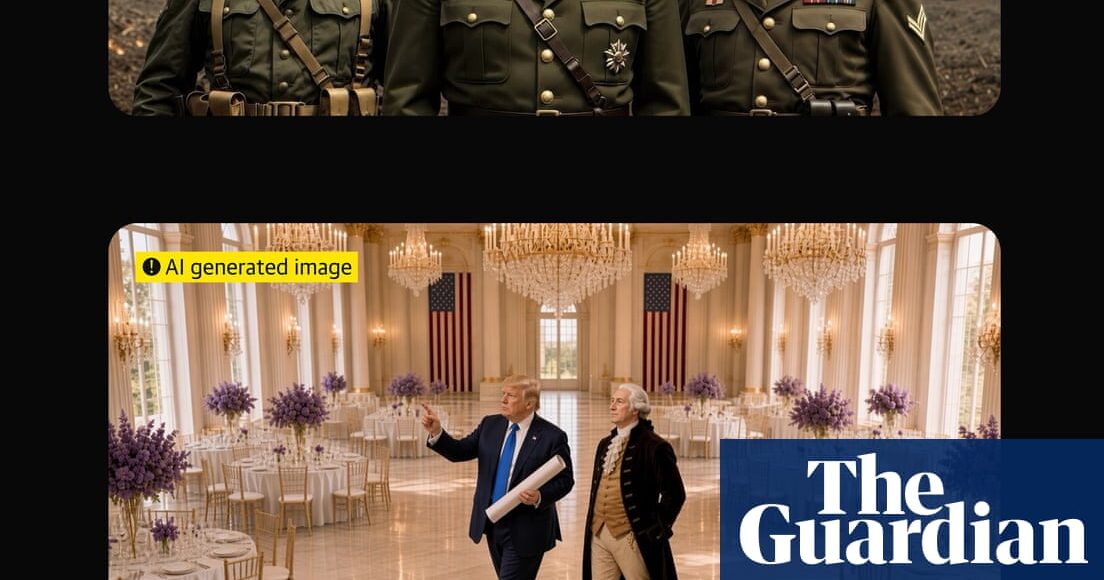
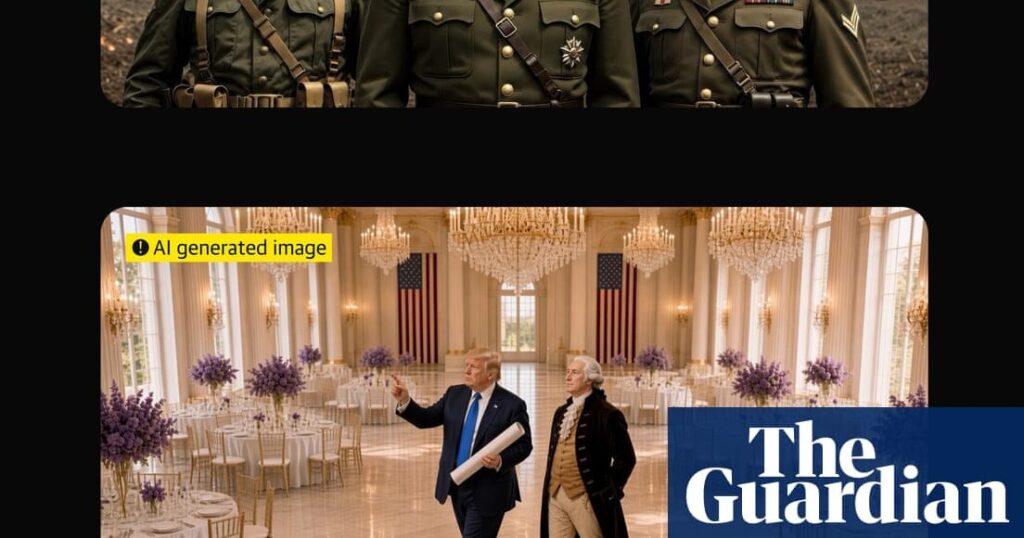
August 27, 2026. The United States is bogged down in a war with Iran, Donald Trump’s approval ratings have sunk to the lowest point of his second term, and the president’s chosen response to the mounting pressure is, apparently, a series of digitally fabricated portraits placing him shoulder to shoulder with the Founding Fathers. If that sounds like a parody, it isn’t. It is the current state of American political communication.
A Familiar Playbook, a New Tool
Trump has always understood something that his critics frequently underestimate: optics move people in ways that policy papers never will. The man who once staged photo moments with Vladimir Putin, Kim Jong-un, and Kim Kardashian has now turned to artificial intelligence to conjure companions he could never actually meet. George Washington, apparently, is the latest addition to that roster.
Over recent weeks, the president has posted multiple AI-generated images of himself alongside prominent historical American figures on Truth Social. The timing is not incidental. With his administration unable to draw the Iran conflict to a close and his poll numbers reflecting public frustration, these images serve a clear purpose: they project strength, legacy, and historical inevitability at precisely the moment when none of those things feel guaranteed.
As The Guardian reports, this pattern of leaning on social media spectacle during periods of political turbulence has become a defining feature of how Trump manages public perception when substantive answers are hard to come by.
What AI Images Actually Say About This Political Moment
There is something worth pausing on here, beyond the easy mockery. Political leaders have always sought to wrap themselves in the authority of the past. Portraits, statues, monuments, these are the traditional tools of legacy-building. What Trump is doing is simply the 2026 version of that same instinct, processed through an algorithm and distributed instantly to millions of followers.
The difference, and it is significant, is the speed and the artificiality. A painted portrait takes time, skill, and commission. An AI image takes seconds. It requires no historical accuracy, no real relationship, no authentic moment. It is impression management stripped down to its most raw and frictionless form.
And in a media environment where the image often matters more than the underlying reality, that frictionlessness is precisely the point. By the time any fact-checker notes that George Washington and Donald Trump never shared a room, the image has already done its work in the algorithm.
The Iran Question Nobody Is Answering
The harder story running beneath all of this is the one the images are designed to distract from. The war with Iran has not ended. Approval ratings for the president have reached their lowest point of this second term. These are the twin pressures that provide the real context for understanding why Truth Social has become such a busy posting ground in recent weeks.
When a leader cannot point to a concrete victory, the next best thing is to manufacture a sense of grandeur. Standing next to Washington, even a digital, fabricated Washington, carries a subconscious message: this presidency belongs to history. It matters. It endures.
Whether that message is landing with anyone beyond the already-converted is another question entirely. Approval ratings suggest it is not doing much heavy lifting with the broader public.
The Attention Economy as Governing Strategy
What Trump has long grasped, and what his political opponents have been slow to fully reckon with, is that governing and performing are no longer separate activities. In the attention economy, the ability to dominate the conversation is itself a form of power. If people are debating AI images of Trump and Washington, they are, at least momentarily, not dwelling on casualty figures or stalled diplomatic negotiations.
This is not cynicism unique to Trump, to be fair. Politicians across the political spectrum use media strategy to shape public perception. What is distinctive here is the scale, the shamelessness, and the technological novelty. Using generative AI to produce flattering historical tableaux and distribute them via a personally-controlled social media platform is a genuinely new twist on an ancient game.
A Reflection of the Times
There is also something telling about the choice of AI specifically. The technology is ubiquitous, controversial, and frequently accused of producing content that looks real but carries no authentic substance. Critics of this administration might argue that the medium and the message have never been better matched.
Supporters, naturally, see it differently. For them, these images are a celebration of American identity and a bold use of modern tools to communicate a straightforward patriotic message. The debate about what the images mean is, in itself, exactly the kind of culture-war engagement that keeps Trump at the center of the national conversation regardless of what is happening on the diplomatic front.
What is undeniable is that the strategy keeps working well enough to keep repeating. Every week that passes without a resolution to the Iran conflict is a week that demands some kind of narrative management. AI-generated history lessons on Truth Social are, for now, filling that gap.
The real question worth sitting with is this: when the images stop working, when the spectacle no longer distracts, what does a presidency built so heavily on performance have left to offer? Drop your thoughts in the comments below.