









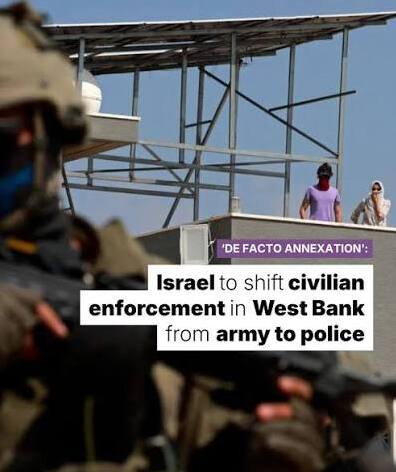
On August 14, 2026, Israel’s defence minister Israel Katz announced he had instructed the military to draft a formal plan for transferring law enforcement responsibilities over Israeli settlers in the occupied West Bank from the army to the police. The move, framed domestically as a practical fix to mounting criticism over the military’s failure to protect Palestinian families from militant settlers, has been met with fierce pushback from Palestinian leadership, who see it as something far more calculated and dangerous.
What the Proposal Actually Says
The core of Katz’s plan is a jurisdictional shift: instead of the Israeli military holding authority over law enforcement in the occupied West Bank, civilian police would take over that role for Israeli settlers living in the territory. On the surface, this might read as an administrative reshuffling. Look a little closer, and the implications become considerably weightier.
The military’s authority in the West Bank is rooted in the legal architecture of military occupation, a framework that at least nominally acknowledges the temporary and contested nature of Israel’s presence in the territory. Handing that same authority to a civilian police force, the kind that operates inside Israel proper, starts to look a lot less like occupation management and a lot more like standard domestic governance. Critics argue that is precisely the point.
Palestine Calls It a Red Line
Palestine’s vice-president did not mince words. The proposal was described as a “flagrant violation of international law” and, more pointedly, as a deliberate step toward full Israeli annexation of the West Bank. That is not a charge thrown around lightly. Annexation would represent a formal absorption of occupied territory into the Israeli state, something that has no sanction under international law and would fundamentally alter the prospects for any future Palestinian state.
The Palestinian response reflects a broader and deepening fear that incremental policy decisions, each one defended on narrow administrative grounds, are collectively reshaping the legal and political reality on the ground in ways that make a two-state outcome structurally impossible. When you change who holds the badge, you change who holds the power, and that shift carries meaning far beyond paperwork.
The Context Behind the Proposal
Katz’s announcement did not emerge in a vacuum. It came amid significant domestic and international criticism directed at the Israeli military over its handling of settler violence, specifically its failure to act against militants who had been besieging three Palestinian families. The army’s inaction drew scrutiny from multiple directions, and the pressure to be seen doing something became impossible to ignore.
According to reporting in The Guardian, the plan is framed partly as a response to that criticism. But for Palestinian officials and many international observers, the remedy offered feels worse than the original problem. Replacing a military that failed to protect Palestinians with a civilian police force whose primary mandate would be settler security does not suggest a course correction toward accountability.
Why the Policing Structure Matters So Much
The question of who polices whom in the West Bank is not merely procedural. Under international humanitarian law, an occupying power has specific obligations toward the civilian population under its control. The military, operating under that legal framework, is at least nominally bound by those rules. A civilian police force operating under Israeli domestic law would not carry the same legal obligations toward Palestinians, creating a governance gap that critics warn could be exploited with few legal safeguards in place.
International law scholars and human rights organizations have long argued that expanding civilian Israeli governance structures into the West Bank, whether through settlement expansion, administrative integration, or now potentially policing, constitutes a form of de facto annexation regardless of what it is formally called. The label matters less than the function, and the function here is the extension of Israeli state authority over occupied land.
The Bigger Picture
This proposal lands at a moment when the West Bank is already under extraordinary strain. Years of settlement expansion, recurring episodes of settler violence, and a Palestinian Authority weakened by years of political fragmentation have left the territory in a precarious condition. Any move that alters the formal legal structure of governance, even in apparently mundane ways, carries outsized consequences in that environment.
For the international community, the challenge is familiar. Individual policy decisions by Israel are often defended as narrow responses to specific security or administrative pressures. But the cumulative effect of those decisions, tracked over years, tells a different story, one of gradual entrenchment that makes withdrawal or compromise progressively harder to imagine.
Whether this particular plan advances beyond the drafting stage remains to be seen. But the fact that it was announced at all, and the manner in which it was framed, signals something about the direction of Israeli policy that Palestinian officials and international observers are not prepared to ignore.
What Comes Next
The military has been ordered to draw up the plans. From there, the proposal would need to navigate Israel’s political and legal machinery before any implementation. But in a political climate where the far right holds considerable influence, there is no guarantee that procedural hurdles will prove insurmountable. The announcement itself has already done political work, signaling intent and testing reactions.
For Palestinians, the response will likely be to escalate their case at international forums, leaning on bodies like the United Nations and the International Court of Justice to reinforce the legal consensus against annexation. Whether those institutions have the leverage to alter Israeli calculations is a question the last several years have done little to answer optimistically.
What is not in question is that the stakes are high, the positions are hardening, and the window for reversible decisions is narrowing. So here is the question worth sitting with: at what point does a series of administrative decisions stop being policy and start being permanence?