



When a teenage swimmer from Uganda steps onto the world stage and outpaces competitors from across the African continent, it is worth paying attention. At the Dakar 2026 Youth Olympic Games, Ugandan swimmer Mark Arthur Mwase delivered exactly that kind of moment, finishing second in his boys’ 200-metre freestyle heat and announcing himself as a name worth remembering in African aquatics.
A Heat That Told a Story
Mwase clocked a time of 2 minutes and 5 seconds in his heat, a performance that placed him behind only Belgium’s Alexander van Hoey Billiet, who dominated proceedings with a swift 1:55.46. But if the clock tells one story, the starting block tells another. Mwase registered a reaction time of 0.56 seconds, the fastest of anyone in the heat. That kind of alertness at the wall is not a fluke. It speaks to a swimmer who is sharp, trained, and ready to compete at the highest levels.
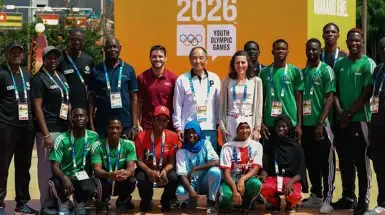
As NTV Uganda reported, Mwase finished ahead of three fellow African swimmers representing Libya, Rwanda, and Tanzania. On a continent still building its competitive swimming infrastructure, that is a meaningful margin.
What This Moment Means for Uganda
Swimming in Uganda is not a sport that commands front-page headlines every week. Football, athletics, and boxing tend to absorb most of the sporting spotlight. But every generation throws up an athlete who quietly changes the conversation, and Mwase has the look of someone who could do exactly that.
Youth Olympics participation carries a weight beyond the immediate result. These Games are designed as a launching pad, a place where athletes between the ages of 14 and 18 get their first real taste of Olympic-level competition, the crowds, the pressure, and the global scale of it all. For a swimmer representing a landlocked nation, arriving in Dakar and holding his own against European talent is the kind of experience that shapes careers.
Uganda has produced world-class athletes across multiple disciplines over the decades, from long-distance runners who have dominated global circuits to boxers who have competed on Olympic podiums. The question now is whether the country’s sporting ecosystem can nurture a swimmer the same way it has nurtured athletes in other disciplines.
The African Swimming Picture
African swimming has traditionally been dominated by South Africa, a nation with deep aquatic infrastructure, year-round training facilities, and a strong competitive domestic league. But the gap between South Africa and the rest of the continent has been slowly closing, with nations like Kenya, Egypt, and Zimbabwe producing swimmers who have made international finals.
Mwase’s performance at Dakar fits into that broader continental trend. Finishing second in a heat and beating swimmers from three other African nations is precisely the kind of result that builds a sport’s credibility at home. Parents see it. Coaches notice it. Sports administrators, if they are paying attention, start thinking about investment.
Reaction Time as a Weapon
It is worth pausing on that 0.56-second reaction time, because in elite swimming, the start is everything. Even fractions of a second off the blocks can mean the difference between a podium and a consolation heat. The fact that Mwase posted the best reaction time in his heat, faster even than the Belgian who ultimately won, tells you something important: his technical preparation is solid. He is not just a natural talent splashing around with raw ability. He has been coached with precision.
At the Youth Olympic level, reaction time often separates those who go on to senior careers from those who plateau. Mwase is trending in the right direction.
What Comes Next
The Dakar 2026 Youth Olympics will wrap up its programme over the coming days, but for Mwase, the real work starts after the Games. The years between Youth Olympics and senior Olympic qualification are where careers are either built or lost. Training load, access to international competition, coaching continuity, and financial support all play their part.
Uganda’s National Council of Sports and the country’s swimming federation will need to look at this performance and ask hard questions about what resources are available to support athletes like Mwase as they transition toward senior competition. Talent without infrastructure is just potential. And potential, without the right conditions, fades fast.
For now, though, this is a moment to celebrate. A young Ugandan swimmer stood in a pool at the Youth Olympics, reacted faster than everyone else in his heat, and finished ahead of his continental rivals. That is not nothing. That is, in fact, the beginning of something.
Could Mark Arthur Mwase be the swimmer who finally puts Uganda on the global aquatics map, and what will it take for his country to give him the support he needs to find out?