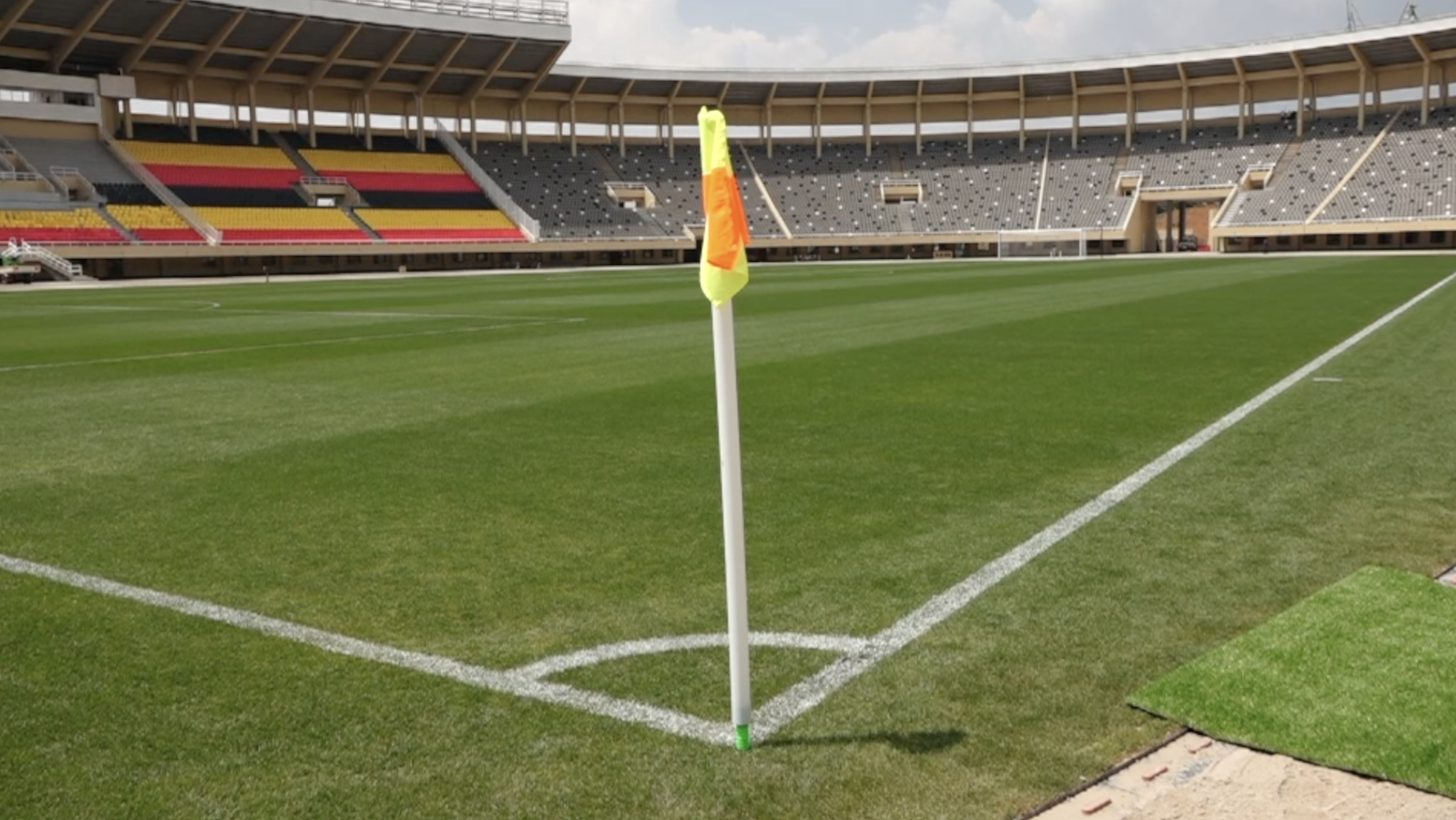
The countdown has officially started. Uganda’s Local Organising Committee for the 2027 Africa Cup of Nations has set December 31, 2026, as the non-negotiable deadline for completing the rehabilitation of the Nelson Mandela National Stadium, the country’s flagship football venue, as pressure from the Confederation of African Football continues to mount ahead of the June 19, 2027 tournament kick-off.
The Deadline That Cannot Be Ignored
December 31 is not a suggestion. It is a statement. With the biennial continental championship set to open on June 19, 2027, organizers need more than enough runway to test the stadium’s facilities, conduct trial events, and satisfy CAF’s rigorous hosting standards. Leaving rehabilitation work bleeding into early 2027 would be reckless, and everyone involved knows it.
A team of CAF inspectors recently completed another site visit to Uganda, a follow-up trip specifically designed to assess how fast the country is moving on its infrastructure commitments. These visits are not ceremonial. CAF uses them to build a clear picture of whether a host nation is on track or quietly sliding toward a crisis.
The fact that inspectors had to return for yet another assessment signals that the confederation is watching Uganda closely. It also signals that there is still work to be done, and that the patience of Africa’s football governing body, while not exhausted, is not infinite either.
Why Mandela Stadium Is Central to Everything
The Nelson Mandela National Stadium, located in Namboole on the outskirts of Kampala, is Uganda’s largest and most prominent football arena. It carries enormous symbolic weight for the country’s sporting identity, hosting the Uganda Cranes for their biggest international fixtures. For AFCON 2027, it is not just a venue. It is the centrepiece of Uganda’s hosting narrative.
When Uganda, Kenya, and Tanzania were awarded the joint hosting rights for the 2027 edition of the tournament, it was celebrated as a landmark moment for East African football. The region had never co-hosted an AFCON before. But landmark moments come with landmark responsibilities, and the Mandela Stadium rehabilitation is perhaps the heaviest of them all for the Ugandan side of the arrangement.
A modern, fully functional stadium sends a message to the continent that Uganda is ready. An incomplete one sends a very different message entirely.
What Rehabilitation Actually Involves
Stadium rehabilitation at this level is not a simple paint job and a fresh coat of turf. For a venue to meet CAF standards for a major tournament, it must satisfy requirements across a wide range of categories: pitch quality, floodlighting capable of meeting broadcast specifications, media and press facilities, dressing rooms, medical infrastructure, security systems, and spectator amenities.
Each of these categories takes time, skilled contractors, and consistent funding. Any gap in the supply chain, whether it is delayed materials, contractor disputes, or budget shortfalls, can push timelines sideways. Uganda has experienced the consequences of such delays before, and the international spotlight of a continental tournament leaves no room for the same story to repeat itself.
The December 31 deadline essentially means that all physical construction and installation work must be wrapped up with months to spare before the tournament opens. That buffer is not luxury. It is necessity, giving time for inspections, FIFA and CAF certification checks, and the kind of operational rehearsals that separate a smooth tournament from a chaotic one.
The Broader Hosting Picture
Uganda is one of three nations sharing the load for AFCON 2027. Kenya and Tanzania are also preparing their own venues and infrastructure. The tournament is expected to be one of the most geographically spread editions in the competition’s history, with matches distributed across three countries, each with their own logistical challenges.
For Uganda specifically, meeting the Mandela Stadium deadline is about more than bricks and mortar. It is about credibility. The East African co-hosting bid was partly built on the promise that the region could deliver world-class football infrastructure. Falling short at the flagship Ugandan venue would cast a long shadow over that promise.
CAF’s decision to continue conducting follow-up inspection visits is standard protocol for a tournament of this scale, but the frequency and urgency of those visits always carries a subtext. The confederation wants to see momentum. It wants to see cranes moving, seats installed, and project managers who can give confident timelines rather than vague assurances.
What Happens If the Deadline Is Missed?
Tournament hosting rights have been stripped from nations before, and Africa’s football history has its share of cautionary tales. While no one in Kampala is publicly entertaining that scenario, the risk is real enough that organizers felt it necessary to set a firm internal deadline and publicize it. Transparency, in this context, also functions as accountability.
If the stadium is not ready by December 31, CAF would likely reassess Uganda’s match allocations. In a three-country setup, matches could theoretically be redistributed to Nairobi or Dar es Salaam venues if Kampala cannot guarantee readiness. That outcome would be deeply embarrassing for Uganda and would significantly reduce its share of the economic and reputational gains that come with hosting.
The tournament is expected to attract thousands of fans from across Africa and beyond, generating revenue for hotels, transport, restaurants, and local businesses. For Kampala to fully benefit from that economic wave, its stadium needs to be in the game.
A City Ready to Show the Continent What It Can Do
There is genuine excitement about AFCON 2027 across Uganda. The Africa Cup of Nations is the continent’s biggest football event, a spectacle that draws in nations, cultures, and rivalries in a way that few sporting tournaments can match. For a country that has waited decades to co-host something of this magnitude, the stakes feel personal.
Kampala has the energy, the football culture, and the fan base to make its portion of the tournament truly memorable. The city’s football faithful are passionate, knowledgeable, and hungry for the kind of world stage moment that a home AFCON brings. All of that potential, however, is contingent on the work being done at Namboole between now and the end of the year.
December 31 is less than four months away. The bulldozers, the contractors, and the project managers now hold Uganda’s AFCON dream in their hands. Will they deliver it in time?