










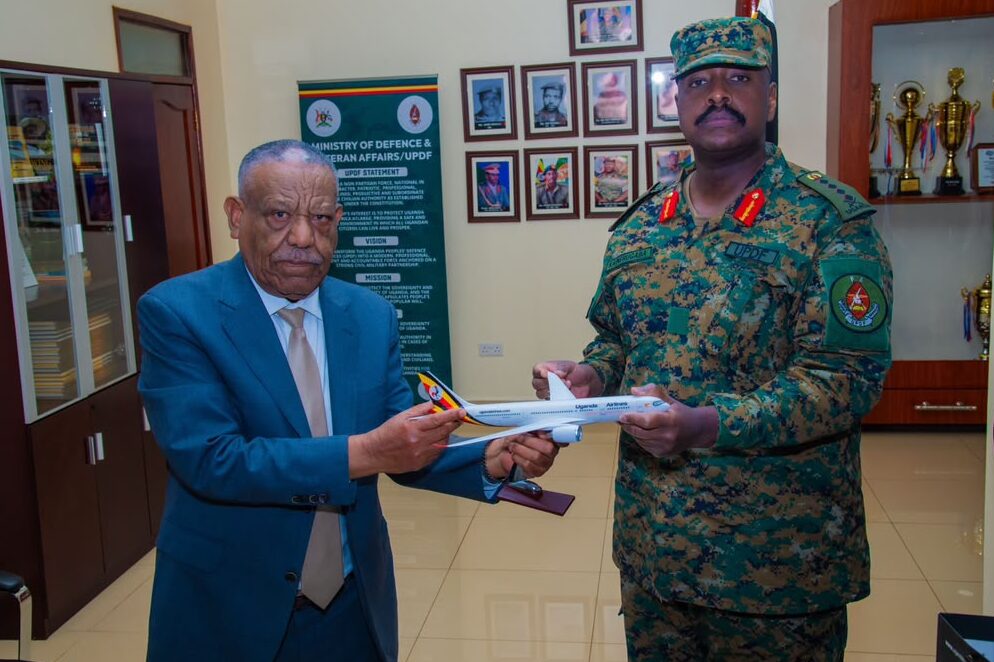
Uganda Airlines executives walked into the Special Forces Command headquarters in Entebbe on Monday with a message that was anything but modest: the national carrier is ready to grow, and it needs powerful allies in its corner. The delegation, led by Acting Chief Executive Officer Girma Wake, sat down with Chief of Defence Forces Gen. Muhoozi Kainerugaba to lay out a strategy that stretches from domestic airstrips to intercontinental routes across Africa, Asia, Europe and the Middle East.

Who Was in the Room
The Uganda Airlines contingent was a cross-section of the airline’s senior management. Alongside Wake, the group included Chief Finance Officer Allan Joel Kyeyune, Acting Manager for Human Resource and Administration Anne Apio, and Acting Chief Commercial Officer Shakila Lamar Rahim. The composition of the team told its own story: this was not a courtesy call. Finance, HR, and commercial leadership all present at once signals a conversation about real numbers, real hiring, and real market capture.
Kainerugaba, for his part, backed the plans without hesitation, noting that a stronger national carrier would help advance Uganda’s trade relationships, regional integration goals, and wider economic interests. That kind of high-level endorsement matters. Airlines are capital-hungry, politically sensitive operations, and having the ear of top government figures can smooth the path on everything from landing rights to budget allocations.
Routes, Reach, and the Bigger Picture
The expansion plan Wake’s team outlined is broad. New international services from Entebbe are being targeted across four major global regions, while domestic route development would address travel demand within Uganda itself. That two-track approach, growing outward while solidifying the home base, reflects the kind of thinking that separates airlines with a genuine long-term plan from those chasing headlines with flashy announcements.
According to details from the briefing, executives stressed that government and industry support would be essential to executing the strategy. That is a diplomatic way of saying: the vision is solid, but it cannot land without political will and financial backing behind it.
The Boeing Order That Changed the Conversation
Uganda Airlines recently placed its first-ever Boeing order, covering four 737-8 MAX aircraft and four 787-9 Dreamliners. It is a significant moment for an airline that only restarted operations in 2019 after years of dormancy. The 737-8 MAX is a workhorse of the modern short-to-medium haul market, fuel-efficient and operationally flexible. The 787-9 Dreamliner is a different beast entirely, a wide-body jet built for long-haul routes that can carry hundreds of passengers across oceans in relative comfort. Ordering both types at once signals that Uganda Airlines is not just thinking about the region. It is thinking about the world.
Fleet expansion of this scale is rare for African carriers. It puts Uganda Airlines in a small group of continental airlines with the hardware to compete seriously on intercontinental routes, and it raises the stakes for everything else on the strategy list.
Building Skills, Not Just Buying Jets
One of the more quietly significant parts of Monday’s briefing was the discussion around internalising aircraft maintenance and ground-handling services. Right now, like many African carriers, Uganda Airlines relies on third-party providers for these critical functions. Every outsourced maintenance contract or handling agreement is money leaving the country, and it creates dependency on external providers whose priorities do not always align with the airline’s schedule or budget.
Bringing those services in-house would reduce operating costs, improve turnaround reliability, and, perhaps most importantly for Uganda’s long-term aviation picture, build a pool of skilled local technicians and ground crew. That is not a small thing. Aviation skills take years to develop and are the foundation of any genuinely self-sufficient national airline.
Wake has spoken candidly about this philosophy before. In a previous note from the CEO’s desk, he put it plainly: “Aircraft alone do not build a great airline. Great airlines are built by people.” That line is worth sitting with. Airlines that treat their human capital as seriously as their fleet orders tend to outlast those that do not.
What This Means for Uganda’s Aviation Future
Uganda Airlines restarting in 2019 was a political statement as much as a commercial one. Many questioned whether the economics would ever work, whether a small landlocked country could sustain a competitive flag carrier in one of the world’s most challenging industries. Seven years on, the airline is ordering Boeing widebodies, briefing military commanders on continental expansion, and talking seriously about building its own maintenance capability.
That is not the story of a vanity project running out of road. It reads more like an airline finding its feet and, slowly, its confidence. The route from Entebbe to anywhere in Asia or Europe is long, and the competition along those corridors is fierce. Ethiopian Airlines alone has spent decades building the infrastructure, reputation, and network density that makes it the continent’s dominant carrier. Uganda Airlines would need years of disciplined execution to get anywhere close.
But the direction is clear, the fleet is growing, and the conversations with power are happening at the highest levels. What remains is the harder work: delivering on time, building loyalty among passengers, and turning a strategic plan into an airline that East Africans and international travelers actually choose to fly.
As Uganda Airlines enters what is shaping up to be its most consequential growth chapter since reopening, here is the question worth asking: can a national carrier with the right jets, the right leadership, and the right political backing finally break through and claim the kind of regional and global presence that Uganda’s economy increasingly demands?