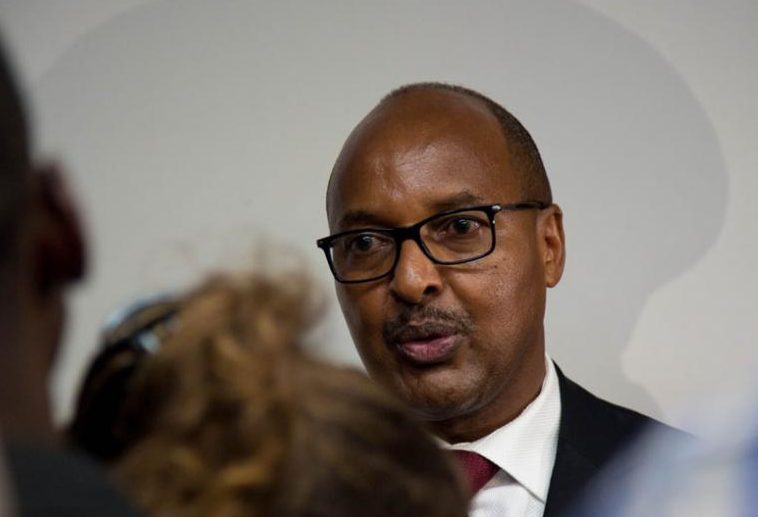
Rwanda’s High Commissioner to Uganda, Col. Joseph Rutabana, has come out swinging against allegations that link him, and the Rwandan Embassy in Kampala, to a young Ugandan man named Stephen Nuwagaba, whose claims of torture have ignited one of the more uncomfortable political conversations the country has had in recent memory.
Speaking to journalists before Uganda’s President Yoweri Museveni issued a formal statement on the matter, Rutabana was unequivocal. He said he does not know Nuwagaba, has never met him, and was only made aware of the story through social media. For the full account of Rutabana’s remarks, ChimpReports has the detailed interview that broke the denial publicly.
A Denial That Leaves More Questions Than Answers
When asked whether he had met Nuwagaba at a hotel in Entebbe, Rutabana’s response was direct: “I don’t know him. Who told you those allegations?” He went further, describing the subject as “irrelevant” to the Rwandan High Commission, and insisting that nothing of the sort alleged by Nuwagaba had occurred at the embassy premises.
“This has never happened and it can never happen,” Rutabana said, addressing claims circulating online that the Rwandan Embassy in Kampala was a site where Nuwagaba’s alleged torture continued after an initial ordeal at the hands of Ugandan security operatives.
On the surface, it reads like a routine diplomatic denial. But the political context in which it sits is anything but routine.
What Nuwagaba Allegedly Said and to Whom
The story gained significant traction after a publication by journalist Andrew Mwenda in The Independent, which detailed claims from unnamed sources. According to that reporting, Nuwagaba met General Salim Saleh in Gulu on March 17, 2025, following a referral by human rights lawyer Nicholas Opiyo.
In that meeting, Nuwagaba allegedly told Saleh that officers from the Chieftaincy of Defence Intelligence and Security, known as CDIS, had tortured him. He reportedly named Maj. Gen. James Birungi and Brig. Abdul Rugumayo as being responsible. He further alleged that after that ordeal, he was taken to the Rwandan High Commission in Kampala, where the abuse reportedly continued.
Those are serious claims. And they come with serious names attached, which is precisely why the story has not stayed contained to the pages of a single publication.
Museveni Steps Into the Frame
President Museveni’s decision to weigh in publicly was a significant escalation. In a lengthy statement, Museveni confirmed that Nuwagaba had come under his personal protection. He also acknowledged that the young man had allegedly been tortured and maimed by what he described as “elements in the security services.” Museveni stated he had ordered a quiet investigation into the matter.
The president’s statement effectively validated the core of Nuwagaba’s claims, at least enough to warrant a formal inquiry. That is a remarkable position for a sitting head of state to take, particularly when the alleged perpetrators are drawn from within his own security apparatus.
A photograph published alongside news coverage shows Museveni alongside Nuwagaba and DFC Commander Maj. Gen. David Mugisha, an image that underlines the seriousness with which the presidency is treating the situation.
Why the Rwanda Connection Matters
The suggestion that the Rwandan High Commission was involved in the torture of a Ugandan citizen is not a small allegation. Uganda and Rwanda have had a complicated, at times openly hostile, diplomatic relationship in recent years. Relations between Kampala and Kigali went through a visible cold period that included border closures and mutual accusations of espionage and political interference.
Against that backdrop, any claim tying a Rwandan diplomatic facility to violence against a Ugandan national lands with enormous political weight. It is the kind of accusation that could easily spiral into a full bilateral incident if substantiated, or, if proven false, could be weaponised to further strain relations between the two neighbors.
Rutabana’s flat denial is therefore not just about protecting an individual diplomat’s reputation. It is about protecting the mission and the bilateral relationship from a claim that, true or false, has already made waves on social media across both countries.
The Social Media Factor
Both Rutabana and the broader public conversation around this case have been shaped significantly by how quickly it spread online. Rutabana himself acknowledged that the embassy first learned of the allegations through social media, not through any formal diplomatic channel or legal process.
That detail says something important about how information, verified or not, moves in 2026. Before any journalist could formally put questions to a high commissioner, the story had already taken on a life of its own in timelines, WhatsApp groups, and comment sections. By the time official responses followed, public opinion had already formed around competing narratives.
This is the environment in which Ugandan political stories now live, where a young man’s torture allegations can become a matter of presidential statements and diplomatic denials within what appears to be a relatively short window of time.
Where This Goes Next
Museveni has said an investigation is underway. That investigation, quiet or otherwise, will need to address the CDIS allegations, the specific officers named by Nuwagaba, and the question of what, if anything, happened at the Rwandan High Commission. Rutabana has denied everything. The named Ugandan security officials have not yet issued public statements based on available information.
What is clear is that the Nuwagaba case is no longer a fringe story. It has drawn in a head of state, a foreign diplomat, a prominent general, a respected human rights lawyer, and one of Uganda’s most prominent journalists. That is a considerable cluster of significant figures orbiting a single young man’s account of what was done to him.
Whether the investigation Museveni promised is truly thorough, or whether it follows the pattern of similar probes in the region that quietly disappear from the public agenda, remains to be seen.
As the details continue to surface and denials stack up against allegations, one question sits at the centre of all of this: who actually has the power to ensure that the full truth about what happened to Stephen Nuwagaba is told publicly, and held accountable, regardless of whose name it implicates?