








With the United States midterm elections just days away, the last place most European corporate chiefs would want to be seen is on a campaign stage beside Donald Trump. Yet that is exactly where Audi CEO Gernot Döllner chose to stand, joining the US president at a rally in Georgia to announce a multi-billion dollar investment in the battleground state. The reaction back home in Germany has been fierce, swift, and anything but diplomatic.
The Moment That Set Off the Firestorm
The scene itself was straightforward enough in its mechanics: an American president at a campaign rally, a European executive on stage, a big investment announcement designed to generate applause and headlines. Georgia, a state that has swung politically in recent cycles, was the backdrop. The dollars involved were significant. The timing, however, was the problem.
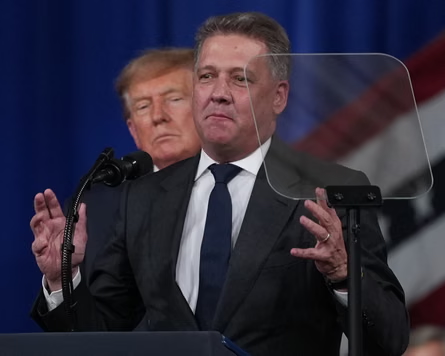
Döllner’s appearance came just days before the 2026 US midterm elections, placing him squarely at the centre of an intensely polarised political moment. Trump delivered a speech before the Audi boss took the stage, and that speech quickly became the focal point of the controversy. Leaders of Audi’s works council, the elected employee representative body that operates under the umbrella of parent company Volkswagen, did not hold back in their assessment of what was said from that podium.
The head of that works council described Trump’s speech as being filled with, in their words, racism, sexism, transphobia and contempt for democracy. That is a serious set of accusations to level at any public address, and the fact that a senior Audi executive chose to appear immediately after it, on the same stage, has drawn immediate and pointed criticism.
Why Georgia, and Why Now
The strategic logic behind the investment announcement is not hard to follow. Georgia has evolved into a fiercely contested political territory, and any major jobs announcement in that state carries enormous political weight heading into an election. For a company like Audi, which along with its Volkswagen parent has faced significant headwinds in both European and North American markets in recent years, currying favour with the sitting US administration could seem like pragmatic business sense.
American tariff policy, trade relations, and regulatory frameworks all have a direct bearing on how European automakers operate in the United States. An investment pledge of the scale reportedly involved here is the kind of gesture that tends to ease those conversations considerably. From a pure business calculus, the move has its own internal logic.
But business calculus and political optics are two very different things, and Döllner is now navigating the gap between them under a very public spotlight.
The Works Council Factor: A Uniquely German Dynamic
To understand why this controversy carries so much weight inside Germany, it helps to understand how German corporate governance actually works. The works council system, enshrined in German labour law, gives elected employee representatives significant formal power within major companies. These are not just advisory voices. They sit on supervisory boards and carry genuine institutional weight.
When the head of Volkswagen’s works council speaks publicly about a senior executive’s behaviour, that is not background noise. It is a formal, credible challenge from within the corporate structure itself. The language used, accusing Trump’s speech of embodying racism, sexism, transphobia and contempt for democracy, reflects just how seriously the employee leadership is treating this episode.
For Döllner, the challenge is not simply a matter of managing a news cycle. He now faces scrutiny from within the very governance structure that has formal influence over his company’s direction.
The Wider Problem for European Executives in the Trump Era
This is not the first time a European business leader has found themselves singed by proximity to American political theatre. The Trump era, both in its first chapter and its current return, has consistently created awkward situations for global executives trying to balance access to the US market with the sensitivities of their home constituencies and workforces.
Europe, and Germany in particular, has a political culture that tends to view open alignment with figures like Trump with considerable scepticism. The values that Trump’s critics point to, on immigration, gender, democratic norms, resonate very differently in a German context than they might in certain American states. A German audience watching their country’s flagship luxury car brand appear at a Trump rally is going to process that image through a very different lens than the one the investment announcement was designed to project.
Audi and Volkswagen have not been immune to difficulty in recent years. Plant closures, cost-cutting pressures, and the painful transition to electric vehicles have already put labour relations under strain. The last thing either brand needed was a controversy that unites critics from the political left, employee representatives, and anyone broadly uncomfortable with the spectacle of a German industrial heavyweight lending its name to a politically charged American event days before a national vote.
What Comes Next for Döllner
At this stage, no formal disciplinary action has been reported, and it remains to be seen how Volkswagen’s supervisory board responds to the pressure building around this episode. Döllner has not, based on available information, issued a detailed public statement distancing himself from the speech that preceded his appearance.
The investment in Georgia, whatever its ultimate scope, will likely proceed. That side of the equation is relatively uncomplicated. What is considerably more uncertain is how Döllner manages his standing inside Germany, where the criticism is not coming from anonymous commentators but from people with formal institutional roles inside his own corporate family.
Corporate leaders who step into political arenas, even with the best of commercial intentions, rarely get to control how that step is interpreted once the cameras are rolling. Döllner is now living that reality, and the distance between a German boardroom and a Georgia campaign rally has never felt quite so wide.
Is there a workable line between strategic investment diplomacy and political endorsement, or does sharing a stage always carry an implicit message regardless of intent? That is the question Döllner, and plenty of other global executives watching this closely, will need to answer.