






The Patriotic League of Uganda has stepped into one of the country’s more charged political disputes, calling on government agencies to freeze what it describes as an imminent Ushs52 billion payment connected to Odrek Rwabwogo, the man who chairs Uganda’s Presidential Advisory Committee on Exports and Industrial Development, known as PACEID. The demand, made publicly in Kampala on Thursday, puts a spotlight on money, contracts, and the blurry lines between state institutions and private business interests.
What PLU Is Actually Asking For
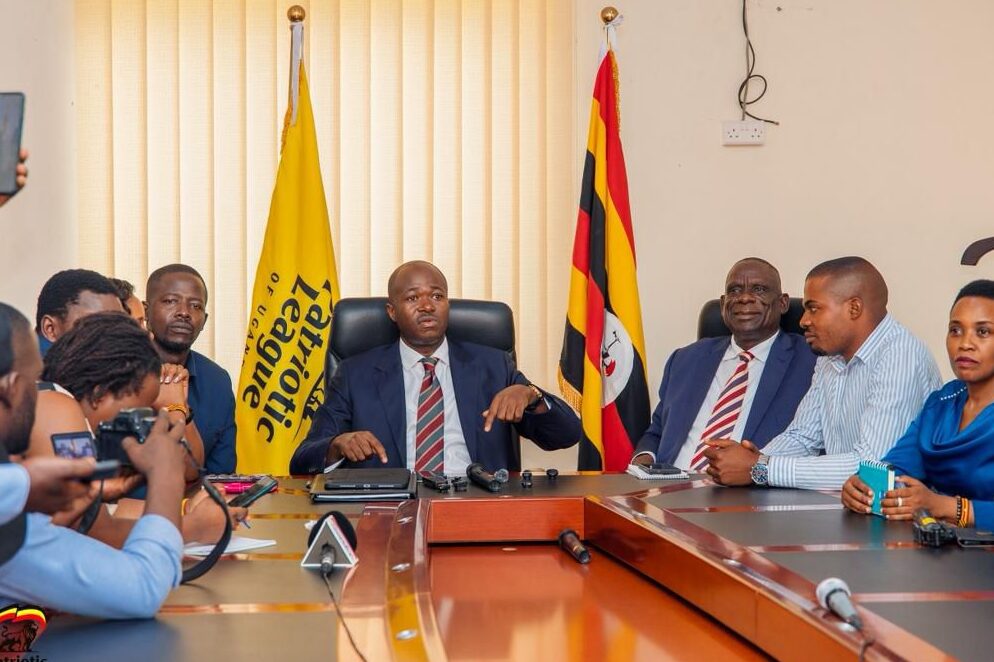
David Kabanda, the executive secretary of the Patriotic League of Uganda, a political organisation led by Gen. Muhoozi Kainerugaba, delivered the organisation’s position at a press conference that left little room for diplomatic ambiguity. Speaking on behalf of the general, Kabanda directed the Finance Ministry and other relevant state bodies to immediately suspend any dealings with PACEID until a series of fundamental questions are answered: Was the committee legally constituted? Who exactly staffs it? Where does its funding come from, and to whom does it account?
The payment in question, equivalent to roughly $14 million, allegedly relates to a claim filed by Tomosi Group Ltd., a company associated with Rwabwogo. According to the PLU’s account, Tomosi Group supplied helicopters, spare parts, and other equipment, with the delivery reportedly destined for South Sudan. The PLU alleges that Uganda’s Treasury was on the verge of settling this claim, and it wants that process halted pending a thorough investigation.
Kabanda’s own words cut to the chase. “If you supplied the government of South Sudan and you are not in the original agreement, why don’t you go to South Sudan and ask them to pay you?” he said, framing the core legal puzzle: why would Uganda’s government be settling a bill for goods allegedly delivered to a neighbouring country by a private company that reportedly had no direct contractual relationship with Kampala?
As reported by Chimpreports, neither the Finance Ministry nor Tomosi Group had publicly addressed the specific allegations at the time of writing. The contractual documents, delivery records, and any legal basis for the payment have not been made available for independent review, which means the full picture remains contested.
Rwabwogo Fires Back
Odrek Rwabwogo, who is married to President Yoweri Museveni’s daughter, is not the kind of figure who absorbs political pressure quietly. He has pushed back against the broader narrative being built around PACEID, insisting the committee is entirely legitimate and properly established under presidential authority.
His account of PACEID’s origins is specific. The committee was created on March 16, 2022, with a clear mandate: to open international markets for Ugandan products. It was subsequently placed under the Office of the President on May 25 of the same year. Rwabwogo has also been direct about who holds the authority to shut it down. Only President Museveni can terminate the committee’s mandate, he says, and he has confirmed that no such instruction has come from State House.
PACEID itself issued a statement that sits somewhere between a defence and an invitation. The committee said it remained fully operational and that it welcomed what it called “constructive criticism and legitimate scrutiny.” The phrasing is careful enough to acknowledge public concern while signalling that the committee does not view the PLU’s intervention as particularly threatening to its day-to-day operations.
The Bigger Picture Behind the Dispute
Strip away the specific figures and allegations for a moment, and what remains is a revealing snapshot of how political power operates in Uganda right now. On one side, you have an organisation aligned with Gen. Muhoozi Kainerugaba, Museveni’s son and a figure with considerable military and political weight of his own. On the other side, you have Rwabwogo, who sits in the family orbit through marriage and has built a profile around agricultural exports and international trade development.
These are not obscure figures trading blows in the margins. This is a dispute playing out among people who are, by any reasonable measure, close to the centre of Ugandan power. That proximity makes the public nature of the confrontation all the more striking. Political disagreements within elite circles in Uganda, as in many countries, tend to get resolved behind closed doors. When they spill into press conferences with specific figures attached, it usually means the informal channels have broken down, or that someone has decided the public forum serves their interests better.
The question of PACEID’s legal grounding is also worth examining on its own terms, separate from the payment dispute. A presidential advisory committee that operates with funding questions and accountability gaps is a governance concern regardless of who runs it. If public money is flowing through or toward an institution whose mandate, staffing, and financial oversight are unclear, that is precisely the kind of arrangement that parliamentary and audit institutions exist to examine.
What Happens Next
For now, the Finance Ministry’s silence is doing a lot of the political heavy lifting. Until officials confirm or deny whether the payment was being processed, and on what legal basis, both sides are essentially arguing in a vacuum. The PLU has made its demand publicly, which creates a certain kind of pressure. Rwabwogo has staked his position on presidential backing, which creates a different kind of pressure. Neither position resolves the underlying question of whether Uganda’s taxpayers should be settling a bill for helicopter supplies reportedly made to South Sudan.
Uganda has seen its share of procurement controversies over the years, and the pattern tends to be consistent: allegations surface, investigations are promised, and accountability arrives slowly if at all. Whether this case follows that trajectory or breaks from it will likely depend on how much political appetite exists within state institutions to probe a matter involving people this close to the presidency.
The Ushs52 billion may or may not move. But the political temperature around PACEID, Rwabwogo, and the PLU has clearly shifted. Uganda’s power circles are rarely this publicly fractured, and when they are, the reverberations tend to last longer than any single payment.
Should Uganda establish an independent, fully transparent mechanism for reviewing all presidential advisory committees and their financial dealings? Drop your thoughts below.