









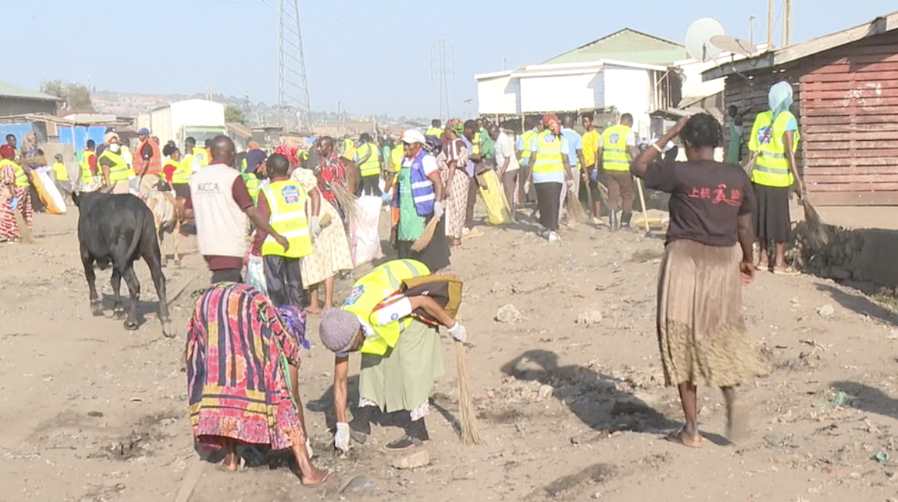
Uganda’s second mandatory National Cleaning Day brought thousands of Seventh-day Adventist Church members into the streets, armed with brooms and a clear sense of civic duty. But even as the faithful swept, scrubbed, and sorted, a senior church voice was making a pointed appeal to the government: put down the stick, and pick up the megaphone instead.
A Church That Shows Up, and Speaks Up
The turnout from the Seventh-day Adventist community was impossible to ignore. Members participated in large numbers across the country, visibly committed to the national initiative. Yet participation alone wasn’t the story their leadership wanted to tell.
Pastor Samuel Kajoba, who serves the Uganda Union Mission of the Seventh-day Adventist Church, stepped forward with a message that went beyond brooms and bin bags. Speaking to authorities, he urged that resources and effort be channelled into genuine public sensitisation rather than relying on enforcement and force to get citizens to comply with cleaning mandates. As reported by NTV Uganda, church leaders believe that lasting behavioural change comes from understanding, not fear.
It’s a distinction that matters enormously. A citizen who participates in a cleaning exercise because they fear punishment will stop the moment the threat disappears. A citizen who genuinely understands why clean public spaces matter to their health, their children’s futures, and their community’s dignity will keep going long after the cameras have packed up and gone home.
The Infrastructure Problem Nobody Wants to Talk About
Beyond the question of enforcement versus education, SDA leaders raised a practical concern that cuts to the heart of whether any national cleaning initiative can actually work long-term. They called on the government to provide adequate and properly designated waste disposal areas, ones that make it easy and practical for citizens to sort their garbage correctly.
This is not a trivial ask. Across many Ugandan neighbourhoods, the absence of organised waste collection points means that even well-intentioned residents struggle to dispose of rubbish responsibly. When there are no bins, no sorting facilities, and no regular collection schedules, telling people to keep their surroundings clean can feel like a hollow instruction. The behaviour being demanded of citizens simply cannot be sustained without the physical infrastructure to support it.
Garbage sorting, in particular, represents a more sophisticated level of waste management than most communities currently practice. Glass, plastics, organic waste, and hazardous materials all require different handling. When sorted correctly, recyclable materials can be recovered, organic waste can be composted, and the overall burden on landfills decreases significantly. Public health benefits follow naturally: fewer breeding grounds for disease-carrying mosquitoes, less contamination of water sources, and cleaner air in residential areas.
Why Sensitisation Produces Better Results Than Enforcement
The science of behaviour change backs Pastor Kajoba’s position firmly. Coercive approaches to public health compliance tend to generate short-term results at best. Studies and practical experience across multiple countries show that when communities are educated about the real consequences of poor sanitation, and when they are given the tools and infrastructure to act on that knowledge, compliance rates improve and hold over time.
Think about how attitudes toward indoor smoking shifted in countries that combined public information campaigns with clear, well-communicated regulations. The change wasn’t achieved purely through fines and arrests. It came through years of sustained messaging that reshaped how people thought about the issue at a personal level. Uganda’s cleaning initiative could benefit from the same philosophy.
Mandatory programmes are not inherently wrong. There is a legitimate argument that some baseline level of compulsion is necessary to get a new habit off the ground, particularly in communities where sanitation norms have been deprioritised for generations due to poverty, infrastructure gaps, or simple lack of awareness. But compulsion without education creates resentment, not responsibility.
What Uganda’s Second Cleaning Day Reveals About the Journey Ahead
The fact that this is Uganda’s second mandatory National Cleaning Day suggests the government is serious about making this a regular feature of civic life. That’s encouraging. Consistency matters when you’re trying to build new national habits. The first time an initiative runs, it’s a novelty. The second time, it starts to feel like a pattern. By the fifth or tenth time, it can become normalised behaviour.
But the SDA Church’s intervention signals that good intentions alone won’t carry this forward. If citizens are turning up because they feel they have no choice, rather than because they understand and embrace the purpose of the exercise, the programme risks becoming another bureaucratic ritual that people endure rather than own.
The church’s call for proper waste disposal infrastructure also points to a coordination challenge that government departments will need to address urgently. A National Cleaning Day that generates mountains of collected rubbish but has nowhere suitable to take it creates its own set of problems. Waste that is gathered but not properly managed simply relocates the problem rather than solving it.
The Role of Faith Communities in Public Health Advocacy
There is something worth noticing in the fact that a major religious institution is using its platform not just to mobilise members for a civic exercise, but to hold authorities accountable for creating the conditions that make civic participation meaningful. Faith communities in Uganda command enormous trust and reach. When church leaders speak, congregations listen, and so do policymakers who understand the political weight of organised religious voices.
The SDA Church’s dual message, show up and participate, but also demand better from the systems that are supposed to serve you, is exactly the kind of engaged citizenship that makes national initiatives sustainable. Cleaning up your street is one thing. Insisting that the government provide the bins, the trucks, and the public education campaigns needed to keep it clean is another level of civic engagement entirely.
Uganda’s National Cleaning Day has the potential to become one of the country’s most meaningful public health habits, if the infrastructure and the education catch up with the ambition. The SDA Church has pointed clearly at what still needs to be done. The question now is whether the relevant authorities are listening closely enough to act on it.
Would you participate more enthusiastically in a national cleaning programme if your community had better waste disposal infrastructure and clearer public education about why it matters? Share your thoughts below.