


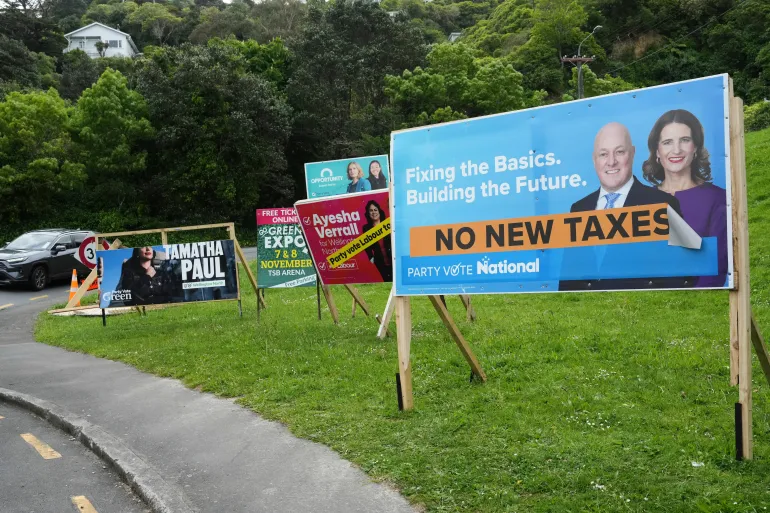
Wellington, New Zealand, November 7, 2026. With ballot boxes barely cracked open and the country’s political future hanging by a thread, New Zealand’s general election is shaping up to be one of the most gripping nights in the nation’s modern political history. Early vote tallies show National and Labour virtually inseparable, while smaller parties gather on the margins ready to determine who actually governs this island nation of five million people.
The Numbers So Far: Too Close to Comfort
With approximately 8% of the vote counted, the picture is tense rather than clear. National sits at 31.2%, Labour trails at 28.4%, and the Greens have claimed 12.9% of the early tally. Act is at 11.2%, NZ First at 9.6%, and the newer Opportunity party has pulled 5.7%. Te Pāti Māori registers at 0.4% at this stage. These are early figures, and New Zealand’s counting process means the full story will take considerably longer to tell.
What those numbers do suggest, at least for now, is that a right-leaning bloc anchored by National, Act, and potentially NZ First could have a narrow path back to power. But with such slim margins and so many votes still outstanding, any confident prediction would be reckless. Live results coverage confirms what analysts have been saying for weeks: no coalition was expected to secure a majority going into election night.
The Kingmaker Question
Perhaps the most fascinating subplot of election night 2026 is not who is leading, but who gets to decide the leader. When two major parties are neck-and-neck and neither can command a majority on its own, the minor parties stop being footnotes and become the main event.
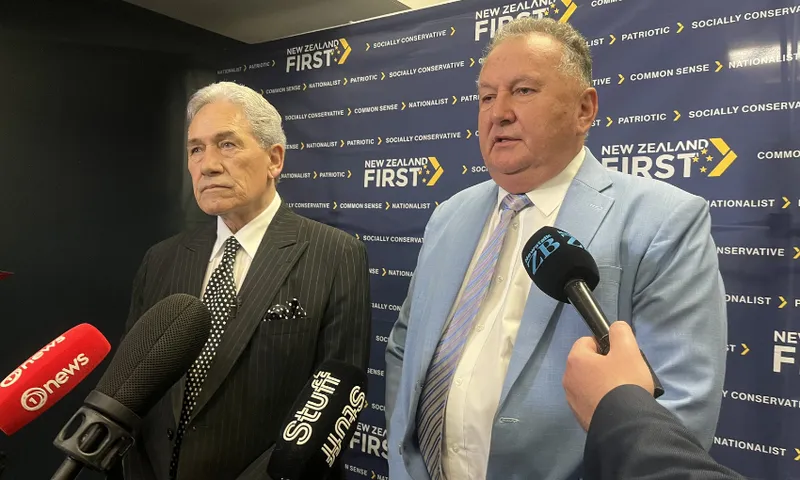
NZ First, sitting at 9.6% in early returns, has played this role before in New Zealand’s political history. The party’s history of dealmaking is well documented, and political observers across the country are watching its numbers closely tonight. The Opportunity party, a newer entrant at 5.7%, adds another variable to what is already an extremely complex post-election arithmetic puzzle.
New Zealand uses a mixed-member proportional representation system, which means seat allocations are tied closely to party vote percentages. Under this system, parties that clear a certain threshold earn seats even without winning individual electorates outright. That design was built to give smaller parties a genuine voice, and on a night like tonight, it means that voice could be decisive.
What This Means for the Country
For everyday New Zealanders, the uncertainty of election night is more than a political curiosity. Coalition negotiations in a close race can drag on for weeks, leaving the country in a kind of governmental limbo where policy decisions stall and markets watch nervously. The last time New Zealand saw negotiations stretch this long, the eventual coalition agreement reshaped significant policy areas from housing to foreign investment.
The Greens at 12.9% give the left bloc potential breathing room, but whether that breathing room translates into seats and then into a workable coalition depends on a chain of outcomes that is still very much unresolved. Labour would need the Greens and potentially at least one other partner to form a government, and each additional coalition partner brings its own demands and policy priorities to the table.
Act and the Right Bloc’s Calculations
On the right, Act’s 11.2% is a strong showing for a party that has built its identity around free-market principles and a smaller state. If National can consolidate support with Act and bring NZ First into the fold, the mathematics could just about work. But NZ First has historically been unpredictable, and its leader has shown a willingness to negotiate with either side of the political divide, making any assumption about its allegiances premature at best.
A Long Night Ahead
New Zealand’s electoral commission is methodical and thorough, which is a virtue that comes at the cost of patience on election night. Special votes, including those cast overseas and by people who enrolled on election day, are counted separately and can shift results meaningfully. In close races, those special votes have been known to change the outcome of individual electorates and, by extension, the final composition of parliament.
With only 8% of votes counted as of the latest update, tonight is far from over. The coming hours will tell whether National can hold its lead, whether Labour can close the gap, and critically, whether any bloc can stitch together enough of the minor party vote to form something resembling a stable government.
A Democracy at Its Most Honest
There is something quietly admirable about an election this competitive. It reflects a genuinely divided electorate, one that has not handed a mandate to any single political vision. New Zealanders have long prided themselves on pragmatic, consensus-driven politics, and a hung parliament, while frustrating in the short term, often produces governments that must negotiate, compromise, and govern with broader buy-in than a majority government ever needs to.
Whatever the final result, the 2026 election will be studied and debated for years. The role of minor parties, the performance of newer entrants like Opportunity, and the durability of the two-party competition between National and Labour will all be dissected by political scientists and commentators alike.
For now, though, New Zealand waits. The votes are being counted, the calculators are running, and the phones in every political party’s campaign headquarters are ringing with people doing the same math over and over again, hoping the answer changes.
So here is the question worth sitting with tonight: in an era when political certainty feels increasingly rare, is a close, contested election that forces coalition-building actually better for democracy than a landslide that gives one party unchecked power?