





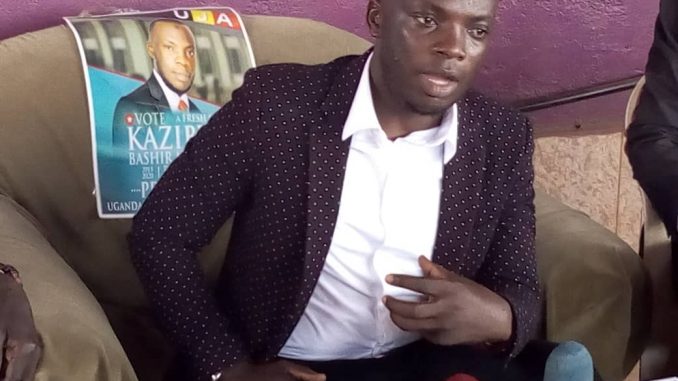
There is something quietly thrilling about a familiar voice returning to the radio. No fanfare needed. Just a microphone, a clock ticking to noon, and a man who knows exactly what to do with both. On Sunday, September 6, 2026, Kazibwe Bashir Mbaziira walked back into a radio studio after nearly six years away from Ugandan airwaves, and the moment landed with the weight of someone who was never truly absent, just temporarily reassigned.
A New Home, A Familiar Mission
Mbaziira has signed on with 96.3 Beat FM, where he now hosts a political talk show called Alipoota Olutagajjo. The programme airs every Sunday between 12 PM and 2 PM, a two-hour window that gives the broadcaster and his guests enough room to go beyond the headlines and actually interrogate the ideas behind them. The show’s focus is broad yet pointed: political affairs in Uganda and the larger world, discussed with the kind of depth that Sunday afternoon audiences tend to crave.

For anyone who followed his earlier career, the format will feel immediately recognisable. Mbaziira built his reputation as a broadcaster on Bukedde FM, where he became known for arriving at the studio prepared. Not just with talking points, but with context, history, and the ability to turn a dense political story into something a listener stuck in Sunday traffic could actually follow. That combination of research and delivery is a rare thing in broadcasting, and it is apparently not something you lose after six years in the corridors of political power.
From the Studio to the Legislature and Back Again
Before politics pulled him away from broadcasting, Mbaziira was a household name in Uganda’s Luganda-language media space. His transition into active politics meant swapping the microphone for a very different kind of public platform, one governed by procedural debate rather than open-ended conversation. He served as a lawmaker representing Kawempe South, a role that kept him visible in public life even as the radio years receded into the background.
Now, with that chapter closed, he is choosing to return not to a quiet private life but to the very medium that shaped his public identity. That choice says something. Radio, especially political talk radio, demands a certain stamina. You cannot hide behind a press release or a carefully worded statement. The listener is right there with you, and they will notice if your thinking is lazy or your facts are soft. Mbaziira, by all accounts, has never had that problem.
Why Radio Still Matters in Uganda
It would be tempting to frame this as a nostalgic comeback story, a man returning to simpler times. But that framing misses the point entirely. Radio in Uganda is not a relic. It remains one of the most powerful tools for reaching audiences across the country, particularly in local languages that connect with communities that digital platforms often overlook. A sharp political talk show in Luganda, broadcast on a Sunday afternoon, is not a small thing. It is infrastructure for public conversation.
The timing is also worth noting. Uganda’s political landscape continues to shift in ways that demand serious, sustained analysis rather than quick-hit commentary. A show with a two-hour format, anchored by someone with both legislative experience and broadcasting instincts, fits a genuine gap in the media environment.
As reported by Mbu, Mbaziira’s return has already generated significant buzz, which is exactly what you would expect when someone with genuine credibility re-enters a space they once owned.
What Listeners Can Expect
The name Alipoota Olutagajjo carries its own promise. It positions the show as something more than a weekly roundup. The structure of a dedicated two-hour slot every Sunday suggests a programme built around sustained conversation, the kind where a topic gets the space it deserves rather than being squeezed between commercial breaks and quick transitions.
Mbaziira’s years in politics also give him something most radio hosts simply do not have: he has sat in the rooms where decisions get made. He has watched how policy is shaped, argued, diluted, and sometimes quietly buried. When he talks about political affairs now, he does so from the inside out, and that perspective tends to make for far more interesting radio than commentary from a purely external vantage point.
His audience on Bukedde FM knew that about him, and that reputation is almost certainly what is driving the early excitement around the new show. Trust, in broadcasting, is built slowly and lost quickly. Mbaziira arrives at 96.3 Beat FM with a reserve of it already in place.
More Than a Comeback
Six years is a long time. Long enough for the media landscape to shift, for new voices to emerge, and for audiences to recalibrate their loyalties. Yet Mbaziira’s return does not feel like someone desperately chasing relevance. It feels more like a considered decision to re-engage with a form of public service that suits him particularly well.
Broadcasting and politics share more than most people acknowledge. Both require the ability to read a room, to know when to press and when to listen, and to communicate complex realities to people who have limited time and patience for jargon. The skills transfer in both directions. And someone who has practised both for years at a serious level brings a dimension to the airwaves that is genuinely hard to manufacture.
Uganda’s Sunday radio schedule just got a great deal more interesting. Whether you are a politics obsessive or simply someone who wants to understand the world a little better over lunch, Alipoota Olutagajjo on 96.3 Beat FM is now the place to be between 12 PM and 2 PM.
So here is the question worth sitting with: in an age of viral clips and fragmented attention, can a two-hour Sunday political talk show become the anchor that Uganda’s public discourse has been quietly missing? Tune in and decide for yourself.