







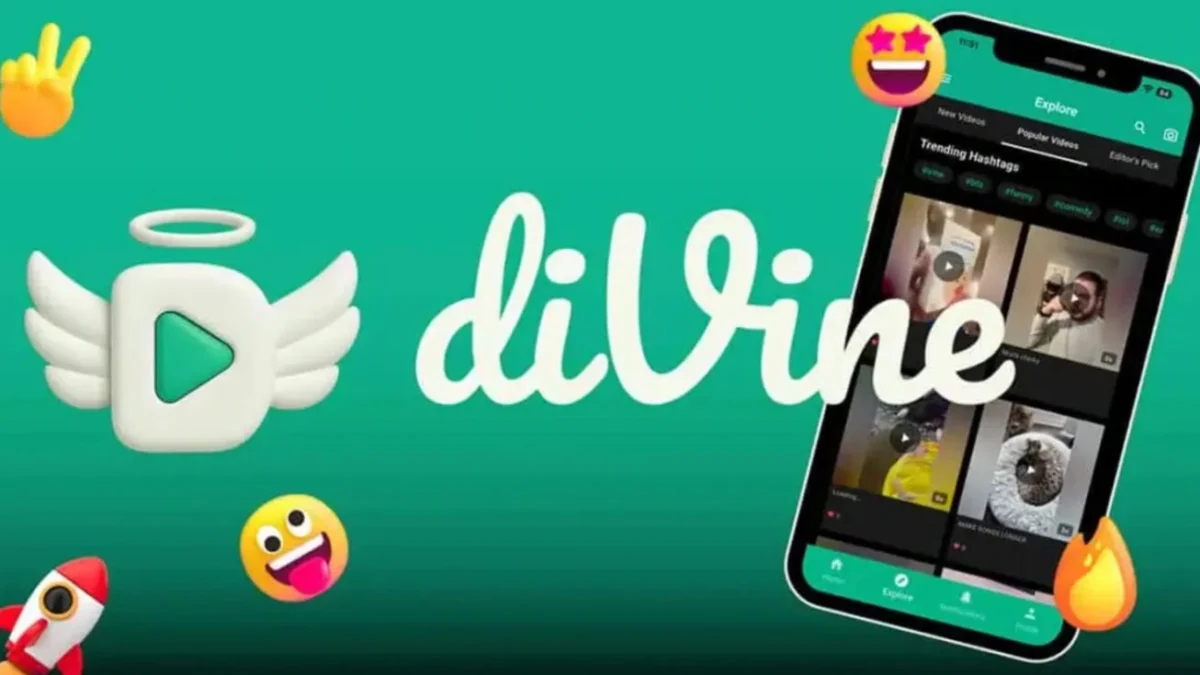
It has been nearly a decade since Twitter pulled the plug on Vine, and the internet has never quite got over it. Now, a new short-form video app called Divine has officially opened its doors to the public, positioning itself as the spiritual heir to a platform that once had more than 200 million monthly active users and turned ordinary people into household names. Six seconds. A loop. No AI. It sounds almost stubbornly simple, and that is entirely the point.
What Exactly Is Divine?
Divine operates on a format that will feel instantly familiar to anyone who spent time on Vine. Users record and share videos that are exactly six seconds long and play on a continuous loop. The mechanics are almost identical to the original app, and that is no accident. The platform was built by Evan Henshaw-Plath, a former Twitter employee who told the BBC that his motivation was a belief that social media had fundamentally lost its way and needed what he called “a reset.”
Henshaw-Plath has also made one of the boldest editorial decisions in recent social media history: Divine bans all AI-generated content outright. In a landscape where synthetic videos, deepfakes, and algorithmically produced imagery flood every major platform, that stance is as rare as it is deliberate. “I’m sick and tired of seeing videos and not knowing whether it was real,” he said ahead of the public launch. “I want to be able to have fun and not have to second guess these things.”
A Vault of Vine History
Beyond the format, Divine has another card to play that no competitor can easily replicate. The app hosts more than two million original Vine videos, preserving a cultural archive that many feared was lost forever. For anyone who grew up watching comedy sketches, musical moments, and sheer chaos compressed into six-second bursts, that alone is worth paying attention to.
This is not just nostalgia for its own sake. Those archived videos represent a specific era of internet creativity, one that predated the hyper-polished production values of TikTok and the algorithm-driven content machines that followed. Vine was scrappy, spontaneous, and genuinely funny. Divine is betting that enough people are hungry for that energy again.
Jack Dorsey’s Fingerprints Are All Over This
The financial backing behind Divine adds another layer of intrigue. Twitter co-founder Jack Dorsey is among the app’s investors, and his connection to Vine goes back further than most people remember. Twitter purchased Vine back in 2012, and Dorsey held a senior position at the company during that acquisition. The platform was eventually shut down in 2017, a decision that still draws criticism from the creator community.
Having Dorsey involved in a project that is essentially trying to correct one of social media’s most lamented mistakes is either poetic or ironic, depending on your perspective. Either way, it brings serious credibility and resources to what might otherwise be dismissed as a nostalgia project.
The Stars Vine Made, and What Comes Next
Part of what made Vine so culturally significant was its role as a genuine launchpad for talent. Jake Paul and Lele Pons are among the creators who built their early audiences on the platform before moving to other channels after its closure. At its height, Vine was not just an app, it was a career accelerator, producing a generation of digital creators who went on to dominate YouTube, Instagram, and beyond.
Whether Divine can replicate that pipeline is the real question. The short-form video space looks very different in 2026 than it did in Vine’s heyday. TikTok, Instagram Reels, and YouTube Shorts have carved up the market with sophisticated recommendation engines and massive advertising budgets. Divine is walking into that room with a six-second time limit and a no-AI policy, essentially daring those platforms to match its commitment to authenticity.
Why the Anti-AI Stance Could Be Its Biggest Selling Point
The decision to ban AI-generated content is not just a philosophical position, it is a calculated differentiator. Trust on social media platforms has eroded significantly as synthetic media becomes harder to detect. Users increasingly scroll with a low-level suspicion about what they are actually watching. Divine’s founder understands this fatigue intimately and has built the app’s identity around resolving it.
If the platform can enforce that ban credibly and consistently, it stands to attract the kind of audience that has grown disillusioned with content farms and AI-generated noise. That is a smaller audience than TikTok commands, but it may be a far more engaged one.
A Reset, Not a Revolution
Henshaw-Plath’s language about wanting social media to “reset” is worth sitting with. He is not claiming Divine will reinvent the internet. He is arguing that the internet lost something specific when it moved away from short, human, unpolished creativity, and that getting it back might require rebuilding from a format that worked before the algorithms took over.
Whether Divine becomes a genuine rival to the established giants or remains a beloved niche platform for creators who crave simplicity, its arrival signals something real: a growing appetite for social media that feels human again. Six seconds at a time, it is making a case that less can still be more.
So here is the question worth asking yourself: in a world of endless scroll, infinite content, and AI-generated everything, would you trade algorithmic abundance for six raw, real, human seconds?