









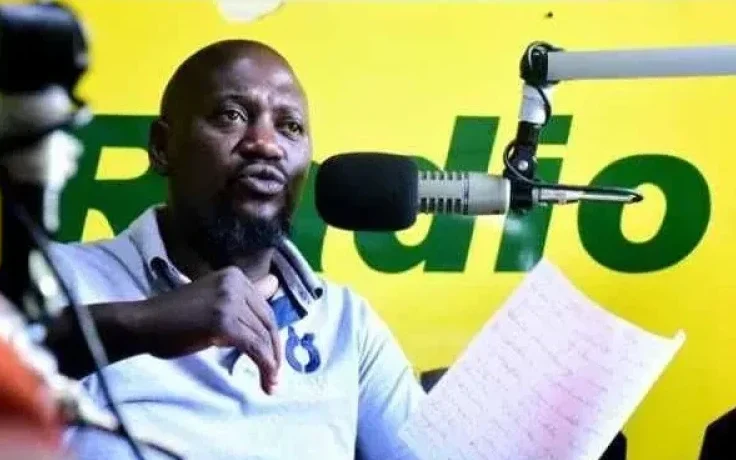
There are a thousand ways people try to quit smoking. Nicotine patches, cold turkey, hypnotherapy, sheer willpower, the works. For veteran Ugandan media personality Omulangira Ndausi, none of those grand strategies did the trick. What finally got through to him was a small boy with a very big question, and the courage to ask it straight.
The Habit He Couldn’t Explain
Ndausi has been candid about the fact that smoking was not a casual phase for him. It was a well-established part of his daily life, one of those rituals that becomes so woven into a person’s routine that they stop questioning it altogether. He smoked heavily, consistently, and for years. Like many long-term smokers, he had probably fielded enough concerned looks and gentle nudges from people around him to have built up an immunity to them.
Then came the moment he did not see coming.
According to Ndausi’s own account of the incident, one of his boss’s children pulled him aside during what must have seemed like an ordinary day. The child greeted him politely, checked in on how he was doing, and then, without a shred of pretence, asked him a question that stopped him cold: “What do you get from smoking?”
When a Child Asks the Question Adults Are Too Polite to Pose
Think about that for a second. Adults, when they disapprove of a habit, tend to package their concern in layers of tact, medical terminology, or passive-aggressive suggestion. Children do not have that filter. They go straight for the logical centre of the thing. What do you actually get from this?
Ndausi has described standing there, completely stumped. How do you explain nicotine dependency, stress relief, social habit, or the deeply irrational comfort of a cigarette to someone who has not yet learned to accept illogical behaviour as a normal part of adult life? You can’t. Not really. And in that speechless moment, the absurdity of the habit became impossible to ignore.
Before he could gather himself, the child pushed further with a remark so blunt it left a lasting impression on the media personality. The specifics of that final line clearly hit home, because Ndausi credits that short exchange as his genuine turning point.
Why Children Cut Through Where Adults Fail
There is actual psychological grounding to why this kind of encounter can be so transformative. Children ask questions from a place of pure curiosity, not judgment. That absence of judgment, paradoxically, makes the question hit harder. When a peer or a doctor questions your smoking, your brain’s defence mechanisms fire up immediately. You justify, deflect, or dismiss. When a child asks the same thing with wide, genuinely puzzled eyes, those defences have nothing to push against.
Research into behaviour change consistently points to the power of unexpected social moments over structured intervention. A stranger’s offhand comment, a child’s honest confusion, or a sudden shift in perspective can accomplish in thirty seconds what months of willpower cannot. Ndausi’s story is a vivid real-world example of exactly that phenomenon.
The Underrated Power of Perspective Shifts
What the child gave Ndausi was not a lecture on lung disease or a statistic about life expectancy. The child gave him a mirror. Suddenly, Ndausi was looking at his own habit through eyes that had no framework for it, no tolerance for it, and no reason to accommodate it. It looked, in that light, completely pointless.
That kind of radical perspective shift is extraordinarily difficult to manufacture deliberately. It tends to arrive uninvited, in the most ordinary of circumstances, which is perhaps why so many people who successfully quit smoking or change a deep-seated behaviour point to one very specific, seemingly small moment rather than a gradual accumulation of reasons.
Ndausi’s Story in the Context of Uganda’s Smoking Culture
Uganda, like many countries across sub-Saharan Africa, continues to grapple with the health and social costs of tobacco use. While global smoking rates have been declining in wealthier nations, tobacco companies have historically targeted emerging markets aggressively, and the cultural visibility of smoking in entertainment and media circles can normalise the habit for younger audiences.
A public figure like Ndausi speaking openly about quitting carries weight beyond the personal. When someone with visibility and cultural currency admits not just that they smoked heavily, but that they struggled to defend the habit to a child, it chips away at the cool factor that tobacco marketing has spent decades constructing. That is the kind of influence no public health campaign can easily buy.
The Quiet Legacy of One Honest Conversation
Ndausi did not quit because someone threatened him. He did not quit because a doctor showed him a scan. He quit because a child, in the most uncomplicated way possible, asked him to account for himself, and he found he had nothing credible to say. That is a story worth sitting with.
It raises something uncomfortable for anyone carrying a habit they know is not serving them. If a child who loves you asked you right now, with complete sincerity and zero agenda, why you do the thing you do that you know you shouldn’t, what would your answer be? And more importantly, could you say it out loud without flinching?
Ndausi couldn’t. And that honest reckoning, sparked by the most unlikely of counsellors, changed the course of his life. Sometimes the most powerful intervention comes not from a clinic or a campaign, but from someone small enough to still believe the obvious answer is the right one.
What moment, conversation, or unexpected question has ever made you reconsider something you thought was fixed? Share your story in the comments below.