












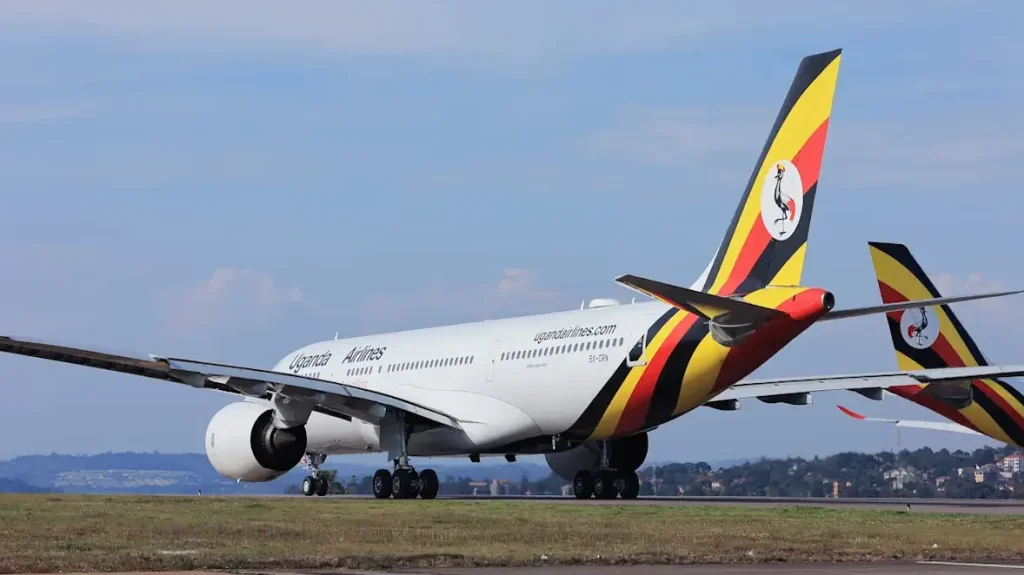
Uganda Airlines is preparing to launch direct flights to Kigali, Rwanda and Accra, Ghana later this year, marking one of the most consequential route expansions the state-owned carrier has made since its return to the skies in 2019. The announcement, confirmed by Acting Chief Executive Officer Ato Girma Wake on Wednesday morning, lands at a moment when the airline is also mid-stride through a sweeping fleet overhaul backed by serious financial muscle.
Two Cities, One Clear Strategy
On paper, Kigali and Accra might look like two dots on a map. In practice, they represent something far more deliberate. Kigali slots neatly into Uganda Airlines’ East African Community story, linking Kampala with one of the region’s most talked-about economic success cases. The two capitals share not just a border region but also a growing web of trade, investment and tourism traffic that has long outpaced the available flight options between them. A direct connection via Entebbe gives both business and leisure travellers a faster, simpler route without the layovers that currently eat into productivity and patience alike.
Accra is a different kind of win. Ghana’s commercial capital has quietly become one of West Africa’s most dynamic financial and creative hubs, attracting multinational investment alongside a thriving tech and entertainment scene. For Uganda Airlines, landing in Accra means it now has two footholds in West Africa, with Lagos already on the network. That dual presence gives the carrier genuine coverage across a region of more than 400 million people and positions Entebbe as a plausible transit point for travellers moving between East and West Africa without routing through the Middle East or Europe.
The Boeing Deal Looming in the Background
None of this ambition would carry much weight without the hardware to back it up. Uganda Airlines recently signed a Shs3.7 trillion agreement, equivalent to roughly $982 million, with Boeing to acquire 10 new aircraft. The order covers both Boeing 737 MAX jets for shorter and medium-haul routes and 787 Dreamliner aircraft for longer intercontinental flying. It is the kind of commitment that signals a carrier moving beyond survival mode and into genuine growth territory.
The timing matters. Adding Kigali and Accra now, ahead of the new aircraft arriving, sets the commercial foundation for routes that the Dreamliners and MAX jets will eventually serve at greater frequency and capacity. Building passenger demand and brand recognition in these markets before the bigger planes land is smart sequencing, not impatience. As Chimpreports reported, the airline frames these launches as part of a broader strategy to reinforce Entebbe’s standing as a regional hub connecting East, West and Southern Africa.
Cargo: The Quiet Engine of the Expansion
Passenger seats generate the headlines, but cargo often generates the margins. Uganda Airlines has made a point of noting that the Kigali and Accra routes will also expand its freight network, giving exporters faster access to markets across the continent. Fresh produce, which spoils on long ground journeys, stands to benefit most. So do manufactured goods and any time-sensitive shipment that currently loses competitiveness to slower surface transport. For a country like Uganda, where agriculture still forms the backbone of export earnings, reliable air cargo links into West Africa open up commercial channels that simply did not exist at this speed before.
Rwanda, too, is a major exporter of high-value goods including cut flowers and specialty coffee, categories where airfreight is not a luxury but a necessity. The cargo dimension of this route is arguably as commercially significant as the passenger side, and it is the kind of detail that tends to get buried under flashier travel announcements.
Where Uganda Airlines Stands Right Now
The airline currently flies to a network that spans East, Central, Southern and West Africa, plus international routes to London, Dubai and Mumbai. That is a reasonably varied footprint for a carrier that was relaunched only seven years ago and spent a significant chunk of that time navigating the disruptions that grounded global aviation between 2020 and 2022. The addition of Kigali and Accra stretches that network further while reinforcing the hub logic at Entebbe, where connecting traffic from multiple African sub-regions can funnel through to intercontinental routes.
Acting CEO Girma Wake put it plainly: the new routes are about giving passengers greater convenience and more travel choices while supporting regional integration. That is the diplomatic version. The commercial version is that Uganda Airlines is racing to claim meaningful African market share before the window narrows, and it is doing so with a clarity of purpose that its earlier years did not always project.
What Travellers Can Expect
Exact launch dates and schedules for the Kigali and Accra services have not yet been confirmed publicly, but the airline has indicated the flights will begin later this year. Travellers planning cross-continental itineraries that pass through Entebbe will want to watch the schedule announcements closely, particularly those routing between East Africa and West Africa who currently face connecting through hubs outside the continent entirely. A direct or single-stop Entebbe routing could cut hours off those journeys while keeping more of the ticket revenue within African aviation ecosystems.
For Uganda, a country that has invested heavily in positioning Entebbe as a serious international gateway, every new route adds commercial weight to that argument. Infrastructure is not enough on its own. You need the flights to fill it, and right now, Uganda Airlines is providing exactly that.
So as the Boeing jets roll off the production line and the new routes begin boarding, the bigger question hanging over all of this is: can Uganda Airlines sustain the operational discipline and service quality needed to turn these ambitious route launches into loyal, repeat-flying customers? What do you think, does Uganda have what it takes to build a truly competitive African carrier? Drop your thoughts below.