






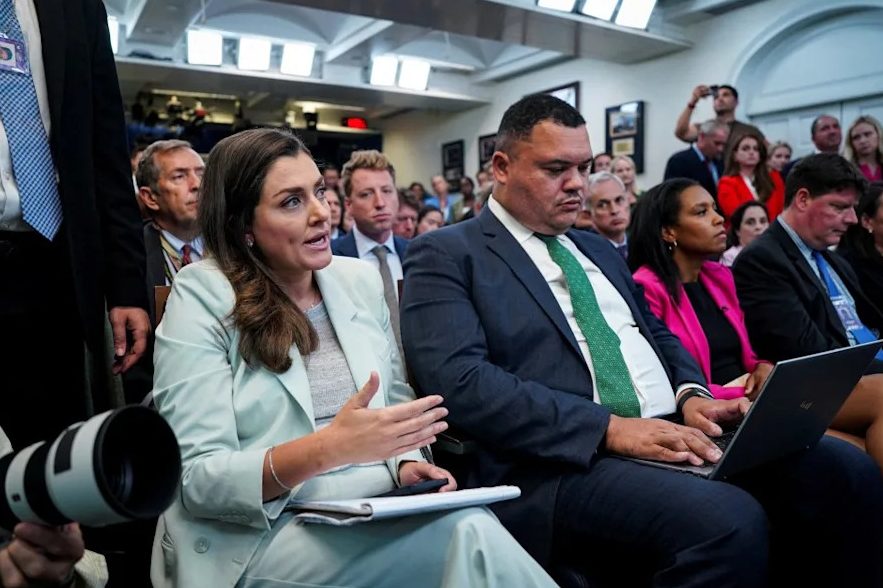
On Monday, August 17, 2026, the White House did something that most administrations would consider unthinkable: it published a social media post that took aim not just at a journalist’s question, but at the journalist herself, mentioning her children in a broadside that CNN swiftly condemned as “beneath the office.” The target was Kristen Holmes, a senior White House correspondent for CNN, whose apparent offense was asking President Donald Trump to respond to remarks made by Democratic Senator Jon Ossoff.
A Question That Lit a Fuse
Holmes had asked Trump about comments Ossoff made in a widely circulated speech on Sunday, comments that touched on a key White House aide. It was the kind of question that correspondents ask every single day in the rough-and-tumble arena of political journalism. Pointed, yes. Adversarial, arguably. But well within the bounds of what reporters are not only permitted but professionally obligated to do.
The White House did not see it that way. The official post called it a “disgusting and inhumane question” and, in a move that crossed a line most observers thought was still firmly in place, brought Holmes’s children into the conversation. There was no ambiguity about the intention. This was not a rebuttal of CNN’s editorial standards or a dispute about journalistic accuracy. It was a personal attack, directed at a named individual, amplified through official government channels.
CNN Fires Back
The network’s response was measured but firm. CNN said the White House post was “beneath the office,” three words that carry considerable weight when directed at an institution that many Americans still regard as the most powerful in the world. The phrasing was deliberate. It didn’t accuse the White House of illegality or even bad faith, exactly. It simply pointed out that whoever wrote and approved that post had decided that the dignity of the presidency was a reasonable price to pay for scoring a point against a reporter.
That calculation, if you follow it to its logical conclusion, is what makes this moment genuinely alarming. The Guardian’s account of the episode lays out the sequence of events clearly: question asked, post published, children mentioned, network responds. The facts alone are damning enough without any editorial embellishment.
The Line Between Criticism and Intimidation
Governments have always had complicated relationships with the press. That tension is not inherently unhealthy. A press corps that never makes officials uncomfortable is not doing its job, and officials who never push back against coverage they believe is unfair are probably not doing theirs either. The friction is supposed to be there. It is part of the design.
What is not part of the design, by any democratic standard, is using official government platforms to bring a journalist’s family into a dispute over a question. That move does not just target one correspondent. It sends a signal to every reporter with a press credential who might be considering whether to ask something uncomfortable: think about what you have to lose before you open your mouth.
That is, by the textbook definition used by press freedom organizations, a form of intimidation. It may not involve a subpoena or a late-night raid on a newsroom, but the mechanism is the same. Make the cost of asking questions feel personal, and some people will stop asking them.
What This Means for the Press Corps
For journalists covering the White House, Monday’s episode will land differently depending on who you ask. Some veterans of political reporting will shrug and say this is the environment they operate in now, that they have adapted, that they carry on. Others, particularly those earlier in their careers, may feel something closer to dread. The idea that doing your job well enough to ask the question that annoys the people in power could result in your kids being name-checked in an official post is not a comfortable thought to sit with.
Holmes, for her part, was doing exactly what a senior White House correspondent is supposed to do. Jon Ossoff’s remarks were widely shared. They were newsworthy. Asking a sitting president to respond to a Democratic senator’s public comments about his administration is not a provocation. It is journalism.
The Broader Pattern
It would be a mistake to treat this as an isolated incident, a one-off moment of frustration that got out of hand. The tension between this administration and certain media organizations has been a sustained feature of the political landscape, not a temporary flare-up. Each escalation raises the question of where the ceiling is, and Monday’s post suggested the ceiling is higher than many people assumed.
Bringing a journalist’s children into an official government communication is a qualitative shift, not just a quantitative one. It is not merely “more aggressive” than what came before. It is different in kind. And that difference matters, both for how the press corps responds and for how the public understands what is happening to the institutions that are supposed to hold power accountable.
Where Do We Go From Here
CNN’s response was dignified and pointed. But a three-word statement, however well-chosen, only goes so far. The harder question is what accountability looks like in this context. There is no referee, no formal mechanism for sanctioning a White House that uses its platforms to attack individual reporters by name and bring their families into the dispute. The public is, in many ways, the only available check on this kind of behavior.
Which raises the question worth sitting with: if official government accounts can be used to run personal attacks on journalists who ask inconvenient questions, and the consequence is nothing more than a network’s statement that it is “beneath the office,” what exactly is the deterrent? And more urgently, who is next?