




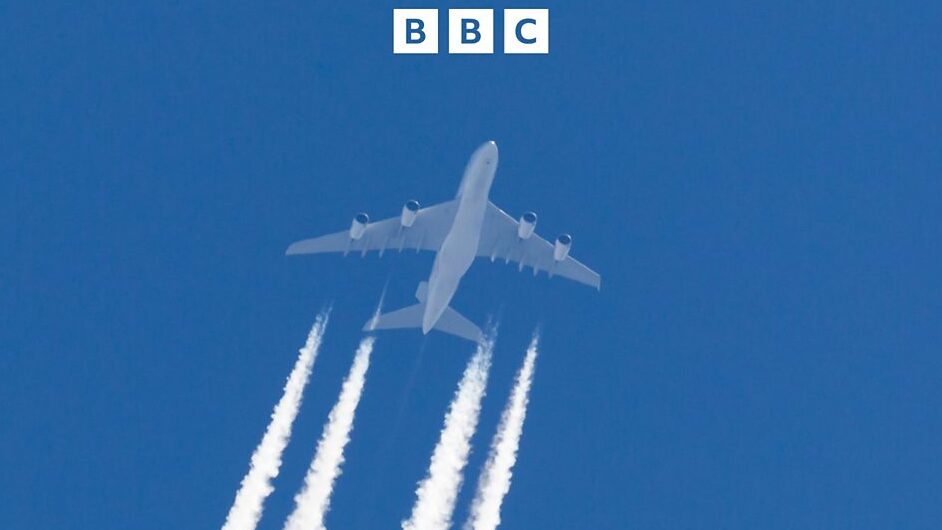
Look up on a clear day almost anywhere in the world and you will likely spot them: thin white lines drawn across the sky by passing aircraft, lingering long after the plane has disappeared from view. Most of us barely register them. But those streaks, known as condensation trails or contrails, are drawing serious attention from climate scientists who argue that their warming effect on the atmosphere is a problem the aviation industry can no longer afford to ignore.
What Are Contrails, Exactly?
Contrails form when hot, humid exhaust gases from jet engines mix with the cold, low-pressure air at cruising altitude. The moisture freezes almost instantly into tiny ice crystals, creating the visible white trails that can persist for anywhere from a few seconds to several hours, depending on atmospheric conditions. When the air at altitude is dry, contrails evaporate quickly. When humidity is high, they spread outward and merge with existing cirrus cloud cover, sometimes blanketing large sections of sky.
That spreading is where the problem begins. Unlike the carbon dioxide released by burning jet fuel, which stays in the atmosphere for centuries and is well-studied, contrails are a shorter-lived but potentially more immediate warming agent. They trap outgoing heat from the Earth’s surface, acting like a thin insulating blanket pulled across the upper atmosphere. Research into the climate effects of vapour trails has been gaining momentum as scientists try to pin down exactly how much warming they are responsible for.
The Scale of the Problem
Aviation already accounts for a meaningful share of global carbon emissions, but the non-CO2 effects of flying, contrails chief among them, may be responsible for an even larger proportion of the industry’s total warming contribution. Some estimates suggest that contrail cirrus clouds could account for more than half of aviation’s net climate impact when measured over shorter timeframes. That is a striking figure, particularly given how little public conversation exists around it compared to fuel burn and carbon offsets.
The challenge is that the science is genuinely complicated. Contrails do not warm the atmosphere uniformly. Night flights, for instance, tend to have a greater warming effect because there is no incoming solar radiation to partially offset the heat-trapping. Flights over certain latitudes and during particular seasons generate contrails that persist longer and spread wider. A flight from London to New York on a humid winter evening may contribute far more to atmospheric warming through its contrail than a shorter flight on a dry summer afternoon.
Why This Has Been Overlooked
Part of the reason contrails have historically taken a back seat in climate discussions is that they are harder to measure and model than carbon dioxide. CO2 is a well-understood gas with a predictable warming trajectory. Contrails are dynamic, variable, and dependent on meteorological conditions that change hour by hour. Attributing a specific temperature rise to them requires sophisticated atmospheric modelling, and the results carry wider uncertainty bands than emissions calculations.
There is also a political dimension. Aviation enjoys a certain cultural immunity from the harshest climate criticism, partly because it connects families across continents and drives enormous economic activity. Telling people that the white lines in the sky are a climate problem on top of the carbon guilt most frequent flyers already carry is not an easy message to land.
What Could Actually Be Done?
Here is where the conversation gets genuinely interesting, because unlike carbon dioxide, which once emitted stays in the atmosphere for generations, contrail formation can potentially be reduced with relatively modest operational changes. If pilots can identify and avoid the narrow atmospheric corridors where persistent contrails are most likely to form, they could dramatically cut the warming impact of a given flight with only a small increase in fuel burn.
Early trials of contrail-avoidance routing have shown real promise. By using detailed weather data to predict where persistent contrail formation is likely, airlines can reroute flights to stay out of those zones. The detours are often small, sometimes just a few hundred feet of altitude adjustment, but the reduction in contrail formation can be significant. Google and American Airlines ran a trial of this approach a few years ago and found meaningful reductions in persistent contrail formation along adjusted routes.
The aviation industry is also looking at longer-term solutions. Sustainable aviation fuels, which burn more cleanly than conventional jet fuel, produce fewer of the soot particles that act as seeds for ice crystal formation. Hydrogen-powered aircraft, still years from commercial operation at scale, would produce water vapour rather than the complex mixture of exhaust gases that today’s engines emit, potentially changing the contrail picture entirely.
The Urgency Underneath the Beauty
There is something almost poetic about one of aviation’s most visible byproducts being one of its least-discussed climate problems. Contrails are, in their way, beautiful. They catch the light at sunset, they trace the invisible highways of global commerce, they give children something to point at and wonder about. But that beauty has a cost that we are only beginning to properly account for.
The good news is that contrails are a solvable problem in ways that decarbonising the entire global economy is not. The technology to avoid them largely exists. The data to predict them is improving rapidly. The cost of avoidance, at least in many cases, is manageable. What is missing, mostly, is the regulatory will and the public awareness to push the industry toward meaningful action.
As climate targets tighten through the late 2020s and aviation faces growing pressure to clean up its act, those white lines in the sky are going to demand a lot more attention than they have received so far. The question is whether airlines, regulators, and passengers are ready to take them seriously before the cost of ignoring them becomes impossible to write off.
So next time you look up and see a contrail spreading slowly across a blue sky, ask yourself: should the aviation industry be moving faster to make those disappear?