











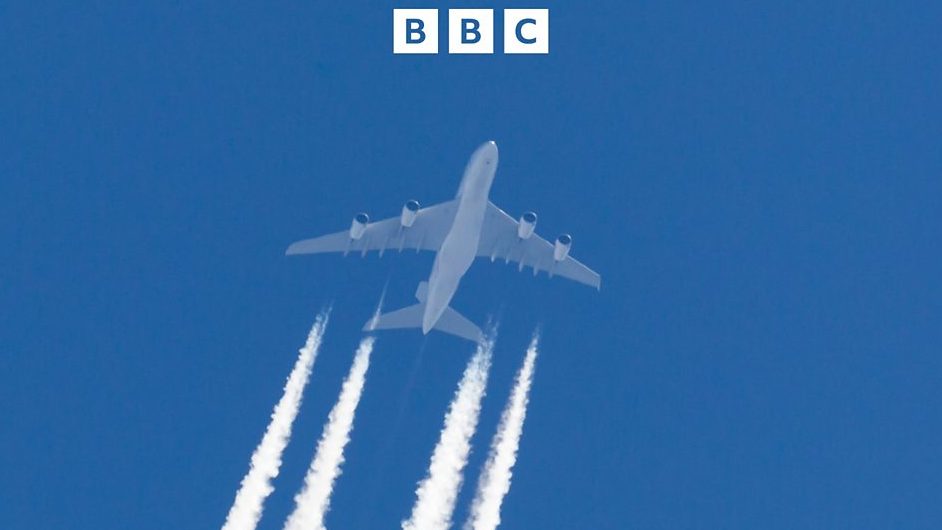
Look up on any clear day near a busy flight path and you will almost certainly see them: those long white lines etched across the blue, slowly spreading, softening, and eventually dissolving into a faint haze. They look harmless enough. Poetic, even. But according to growing scientific attention and recent reporting on aviation’s climate footprint, the vapour trails left behind by aircraft are contributing to warming in the atmosphere in ways that the public rarely hears about.
What Exactly Are Vapour Trails?
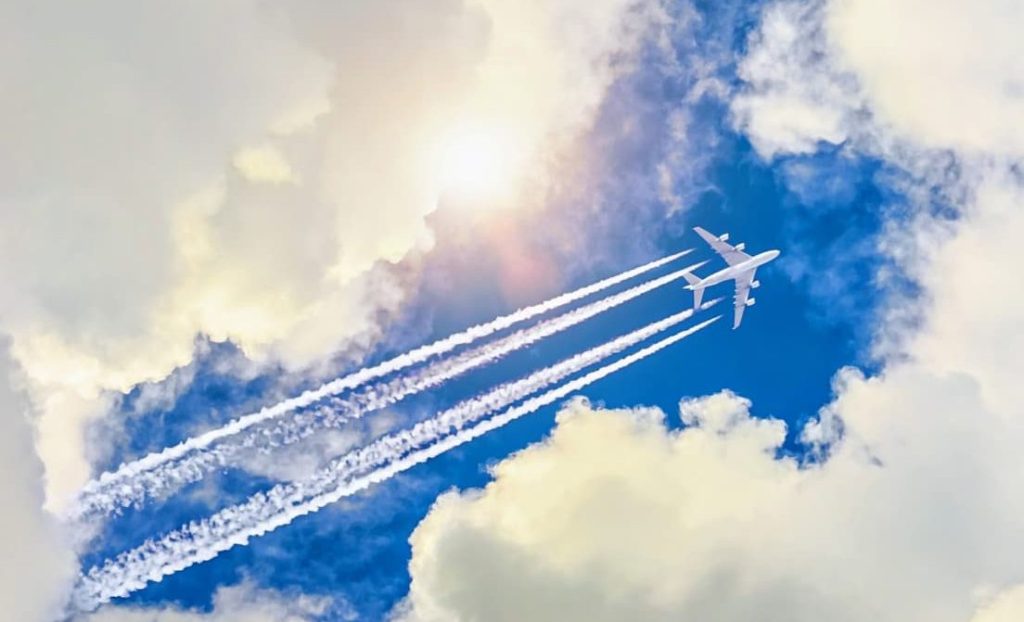
Vapour trails, formally known as contrails, form when hot, humid exhaust from jet engines meets the cold, low-pressure air at cruising altitude. Water vapour condenses and freezes almost instantly around tiny soot particles emitted by the engines, creating those characteristic white streaks. When the surrounding air is dry, they vanish within seconds. When the air is moist and already close to saturation, they can persist for hours, spreading out into thin cirrus-like clouds that cover large swathes of sky.
It is that second scenario that concerns atmospheric scientists the most. Persistent contrails behave much like natural cirrus clouds, they trap outgoing infrared radiation from the Earth’s surface while also reflecting some incoming solar radiation. The net effect, according to multiple research bodies, is a warming one. The heat that gets trapped outweighs the cooling from reflected sunlight, particularly during night flights when there is no incoming solar radiation to offset the warming at all.
A Problem Hiding in Plain Sight
The aviation industry’s carbon dioxide emissions have long dominated public conversation about the sector’s environmental impact. CO2 is, after all, the most widely understood greenhouse gas, and it lingers in the atmosphere for centuries. But contrails tell a different kind of story. Their warming effect is short-lived, lasting hours to days rather than decades, but because aircraft produce them so consistently and in such volume across heavily trafficked corridors, the cumulative atmospheric impact is substantial.
Some researchers have argued that the non-CO2 warming effects of aviation, of which contrail formation is a major component, could account for roughly two-thirds of the sector’s total climate impact when measured over shorter timeframes. That is a striking figure, especially given that it receives a fraction of the policy attention directed at fuel emissions.
Night Flights and the Compounding Problem
One of the more counterintuitive findings in contrail research is that night flights may be disproportionately warming. During the day, contrails both trap heat and reflect sunlight, so the effects partially cancel each other out. At night, with no sun to reflect, they only trap heat. This has prompted some researchers to suggest that rerouting flights to avoid humidity-sensitive altitudes, or scheduling fewer overnight long-haul services, could reduce contrail-driven warming without requiring any change to fuel or aircraft technology.
It sounds almost too simple. Adjust the flight path by a few thousand feet, change the timing of a departure, and you could meaningfully reduce the warming effect of that particular journey. The challenge, of course, is that airlines operate on razor-thin margins and precise scheduling. Any deviation from optimal fuel-efficient altitudes carries its own cost, both financial and in terms of additional CO2 burned. Finding that balance is the central tension in current aviation climate research.
What the Aviation Industry Is Doing About It
Awareness has been growing steadily. Several airlines and aviation technology companies have begun experimenting with contrail forecasting tools that predict which flight paths, altitudes, and times are most likely to generate persistent trails. The idea is to give pilots and dispatchers enough information to make small, strategic adjustments that prevent the worst contrail formation events without drastically increasing fuel burn.
Initiatives like this are still relatively early-stage, and scaling them across the thousands of commercial flights operating daily worldwide remains a significant logistical challenge. Regulatory frameworks have not yet caught up with the science either. Most aviation climate policy focuses on carbon accounting, with contrail impact sitting in an awkward, harder-to-quantify space that policymakers have been slow to address formally.
Sustainable aviation fuels, which are already being pushed as a solution to CO2 emissions, may also help with contrails indirectly. These fuels burn with less soot, which means fewer particles for ice crystals to form around, potentially reducing the persistence and spread of contrails. It is not a complete solution, but it suggests that some of the industry’s existing decarbonisation efforts could carry secondary benefits for non-CO2 warming too.
The Bigger Picture for Travellers
For the average person boarding a flight in 2026, contrails probably rank somewhere near the bottom of their list of concerns. Carbon offset programmes, the environmental guilt of frequent flying, and the price of sustainable fuel options tend to dominate any climate-related conversation about aviation. But understanding the full picture of how air travel affects the atmosphere matters if the goal is genuine progress rather than selective accounting.
The science here is not alarmist speculation. It is grounded, peer-reviewed, and increasingly accepted within the atmospheric research community. The warming contribution of aircraft vapour trails is real, measurable, and underappreciated in mainstream climate discourse. As the global aviation network continues to expand, particularly with rising demand across Asia and Africa, the cumulative volume of contrail formation will only increase unless deliberate action is taken.
A Sky Full of Questions
The image of a clear blue sky criss-crossed with white lines has become so familiar it barely registers anymore. But each one of those lines represents a thermal process with real consequences for the energy balance of the atmosphere. The good news is that unlike CO2, the warming effect of contrails is short-lived and theoretically manageable with the right tools and the right will.
The harder question is whether the aviation industry, governments, and the flying public are prepared to take non-CO2 climate impacts seriously enough to act on them, even when those impacts are invisible to the naked eye and absent from most emissions reporting frameworks.
Next time you spot a vapour trail spreading lazily across the sky, it is worth asking: how much are we truly willing to change about the way we fly, and how soon does that conversation need to happen?