








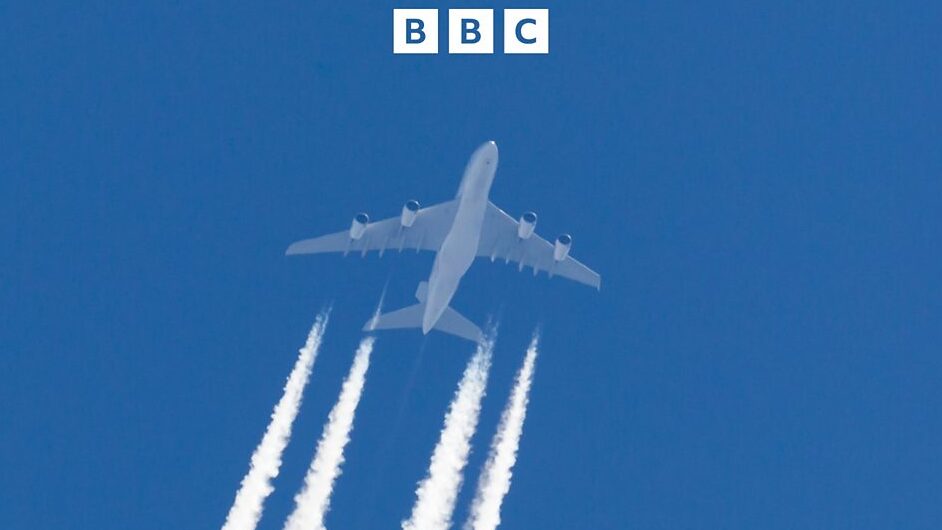
Look up on a clear day almost anywhere in the world and you will likely spot them: those long, white streaks stretching across the sky in the wake of a passing aircraft. They look harmless enough, almost decorative. But scientists have been increasingly vocal about a fact that the aviation industry has been slow to put front and centre: vapour trails from aircraft contribute to warming in the atmosphere, and the scale of that contribution deserves serious public attention.
What Exactly Are Vapour Trails?
Known formally as contrails, short for condensation trails, these white lines form when the hot, humid exhaust gases from a jet engine meet the cold air at cruising altitude. The water vapour in the exhaust rapidly condenses and freezes around tiny soot particles, creating ice crystals that linger in the sky. In certain atmospheric conditions, those crystals spread out and persist for hours, forming thin, wispy clouds known as cirrus clouds.
It is this spreading and lingering that creates the climate problem. These man-made cirrus clouds trap outgoing heat from the Earth’s surface, much like a blanket pulled over the planet at night. The result is a localised warming effect that operates independently of the carbon dioxide released during the same flight.
Why This Is Bigger Than Most People Realise
Carbon dioxide gets almost all the attention when we talk about aviation’s environmental impact, and that is understandable. CO2 is a long-lived greenhouse gas that accumulates in the atmosphere over decades. But the warming influence of contrail cirrus clouds, while shorter-lived, can be significant in the near term. Some researchers have argued that the total warming effect of contrails could, on certain measures, rival or even exceed that of aviation’s cumulative CO2 output over a given period.
This is not a fringe theory. A growing body of scientific research, including discussions explored on BBC Science programming, has been pushing this issue further into mainstream awareness. The conversation is no longer confined to academic journals or climate conferences. It is reaching everyday listeners and readers who fly regularly and have no idea their holiday jet is doing double duty as a sky-level heater.
The Altitude and Route Factor
Not all flights create equally persistent contrails. The atmospheric conditions at any given altitude and latitude determine whether a contrail will dissolve within seconds or spread into a cirrus sheet that covers hundreds of square kilometres. Flights at certain altitudes in humid air masses are far more likely to produce long-lasting, warming contrails than flights at slightly different altitudes where the air is drier.
This opens up a genuinely interesting possibility: if airlines and air traffic controllers could identify the atmospheric conditions most likely to produce persistent contrails, they could reroute flights to avoid those conditions. The fuel penalty for such diversions is estimated to be relatively small, potentially just one or two percent of additional fuel burn per flight, and yet the climate benefit could be substantial.
The Aviation Industry’s Response
Airlines and aviation authorities are not entirely ignoring the issue. There are active research programmes in Europe, the United States, and parts of Asia looking at contrail forecasting tools that would allow real-time route adjustments. Some airlines have already run limited trial programmes, working with meteorological data to identify contrail-forming zones and adjust flight paths accordingly.
The challenge is systemic. Air traffic management is an enormously complex, internationally coordinated system. Introducing new variables into flight planning requires regulatory frameworks, technology investment, and cross-border cooperation. Progress, while real, remains slow relative to the scale of the problem.
What About Alternative Fuels?
Sustainable aviation fuels, commonly called SAF, have long been touted as a path to reducing aviation’s carbon footprint. Interestingly, SAF may also help with the contrail problem. Because these fuels burn cleaner with fewer soot particles in the exhaust, the ice crystals that do form may be fewer in number and less persistent. Early research suggests that SAF-powered flights could produce contrails that are less optically thick and therefore less effective at trapping heat.
This would mean that the transition to cleaner fuels delivers a two-pronged climate benefit: lower CO2 emissions and reduced contrail warming. That is a genuinely encouraging prospect, though SAF remains expensive and in short supply globally, with production capacity nowhere near the levels needed to meaningfully replace conventional jet fuel at scale.
What Passengers Can Do Right Now
Awareness is the first step. Most frequent flyers have never considered contrails as part of their environmental calculation. Choosing to fly less is the most direct lever any individual has, but for those who must fly, supporting airlines that are actively investing in contrail research and SAF adoption sends a market signal that matters.
Daytime flights in certain conditions tend to produce contrails with a stronger warming effect than night flights, partly because sunlight interacts with the ice crystals to reflect solar radiation back to Earth during the day while the heat-trapping effect continues around the clock. Choosing flights thoughtfully, where possible, is a small act that adds up across millions of journeys.
The bigger picture here is that aviation’s climate impact has always been more complex than a simple carbon count. Contrails are a vivid illustration of how the science of atmospheric warming involves feedback loops, interaction effects, and variables that resist easy measurement. Getting serious about fixing them will require the same blend of technological creativity, political will, and public pressure that has begun, however fitfully, to reshape ground-level transportation.
The white lines in the sky are beautiful. What they are doing to the atmosphere is far less so. So the question is worth sitting with: the next time you book a flight, will you think differently about what gets left behind in that blue sky above you?