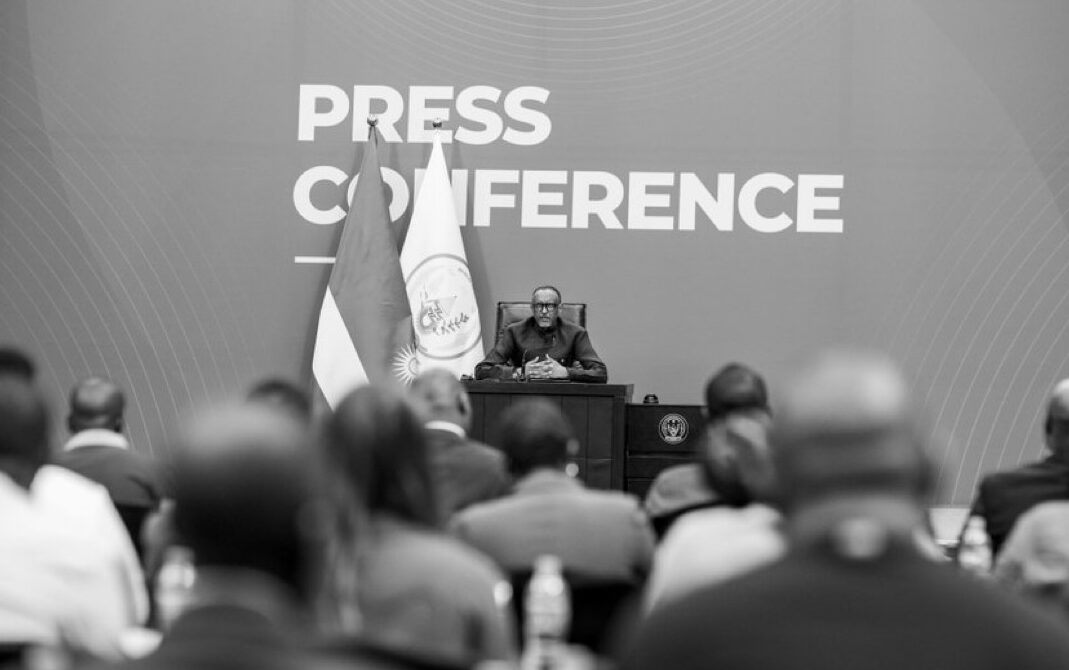
On Monday, August 24, at the Kigali Convention Centre, Rwandan President Paul Kagame did something that political observers rarely witness from a sitting head of state: he publicly dressed down one of his own senior ministers, by name, in front of the press. The minister in question was Foreign Affairs Minister Olivier Nduhungirehe, and the offence, at least in Kagame’s eyes, was that the minister had chosen to wage a social-media war against a journalist rather than let the matter pass.
The Dispute That Started It All
The controversy traces back to a disagreement over what happened at a regional meeting, specifically whether officials from the Democratic Republic of Congo had attended or not. Nduhungirehe stated publicly that Congolese representatives were absent. Congolese authorities pushed back, saying their side had indeed been present at the gathering.
Journalist Scovia Mutesi then entered the picture during a television discussion, where she suggested that another attendee of the meeting could be consulted to independently verify the facts. It was a reasonable editorial instinct, when two parties give conflicting accounts, you find a third source. That is journalism 101.
What followed, however, was anything but routine. Nduhungirehe took to social media and accused Mutesi of misrepresenting his original comments. He also implied that she had not properly understood the French in which those comments were made, a swipe that many observers found condescending.
Kagame Steps In, and He Is Not Impressed
By the time Kagame held his wide-ranging press conference on August 24, Mutesi had already issued a public apology for her role in the dispute. That apology, it turns out, did not sit well with the president at all.
“I saw her apologising, and I thought she didn’t have to apologise. Apologise for what?” Kagame said, according to a detailed account of the press conference. The question landed like a verdict.
He went further, rejecting any notion that being foreign minister granted Nduhungirehe some exclusive claim to the truth. “Olivier does not have a monopoly of facts,” Kagame said plainly, questioning why the minister had carried himself as though the facts belonged to him alone.
Then came the line that will likely follow Nduhungirehe for some time: “Olivier, the minister, should have apologised for even himself going into an exchange with a journalist over this nonsense. This is absolute nonsense.”
Why This Moment Matters Beyond Rwanda
It is worth pausing here because presidential rebukes of serving ministers are not exactly common currency in African politics, or anywhere else for that matter. Leaders tend to manage these things quietly, behind closed doors, to avoid the optics of internal disarray. Kagame chose the opposite approach, and that choice sends a message that extends well beyond Nduhungirehe personally.
The relationship between government officials and the press is a tension point across the continent. Ministers who hold powerful positions sometimes treat their authority as a shield against scrutiny, and social media has handed them a new weapon to fight back directly against reporters who ask inconvenient questions or challenge official narratives. What Kagame signalled on Monday is that this kind of behaviour, at least from members of his cabinet, is not acceptable.
Whether that signal translates into a broader cultural shift in how Rwandan officials interact with journalists remains to be seen. Presidential statements are one thing. Institutional practice is another.
The Language Question: A Detail Worth Examining
One of the more pointed dimensions of this episode is Nduhungirehe’s suggestion that Mutesi had misunderstood his comments because they were delivered in French. It was an argument that, intentionally or not, carried an air of linguistic gatekeeping, the implication being that the journalist lacked the linguistic competence to report on what he had said.
That kind of deflection is not new in political circles. When officials find their statements challenged, questioning the competence of the person doing the challenging is a time-tested tactic. But it is also one that can backfire badly, particularly when the president himself is watching and apparently unconvinced.
Kagame’s response made no reference to language barriers. His concern was simpler and more direct: a minister should not be brawling with journalists on social media, full stop.
What Comes Next for Nduhungirehe
A public rebuke from a president of Kagame’s stature is not a small thing. Rwanda’s political environment is one where the president’s public statements carry enormous weight, and being singled out in this manner is the kind of moment that defines a minister’s standing within government circles.
At the time of writing, Nduhungirehe had not issued a public response to the president’s comments. Whether he follows through with the apology Kagame suggested he owes, or whether the matter quietly fades, will say a great deal about how this administration navigates accountability within its own ranks.
For Scovia Mutesi, the sequence of events offers a strange kind of vindication. She apologised, and then the president of her country effectively told her she had nothing to apologise for. In the often-grinding world of journalism, particularly when covering powerful government figures, that is a rare outcome.
The broader question this episode leaves on the table is one that every government communicator, press freedom advocate, and working journalist should be thinking about: when a senior official uses their platform to intimidate or belittle a journalist for doing their job, who is responsible for drawing the line, and how quickly should that line be drawn?