









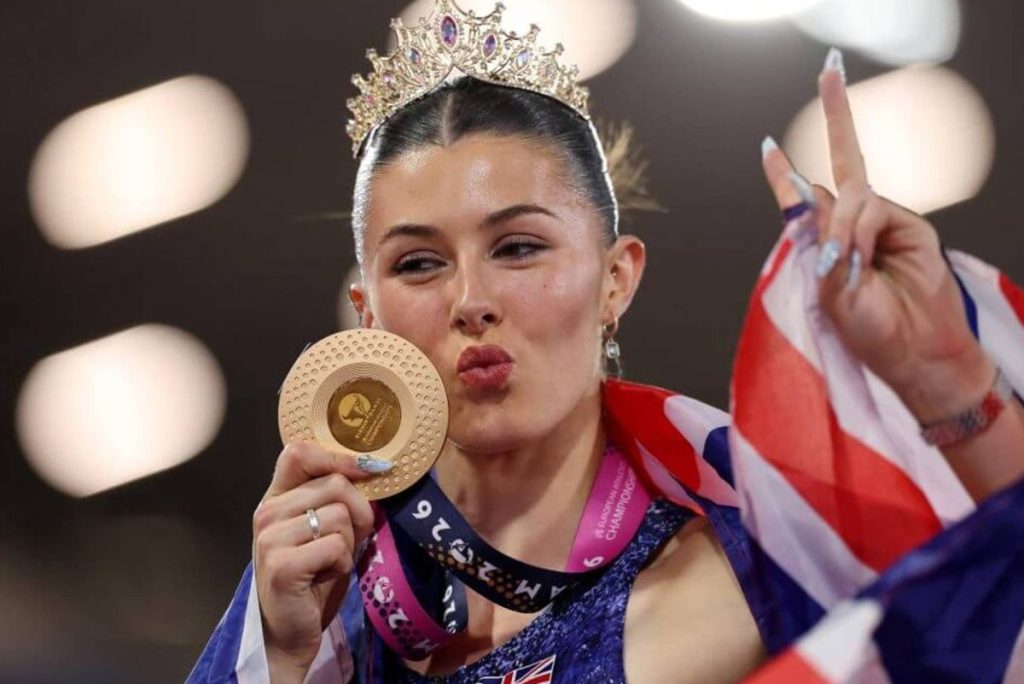
There are performances that win medals, and then there are performances that shift the entire conversation about what a sprinter can do. Amy Hunt delivered the latter at the European Championships, collecting four gold medals across four events and cementing herself as one of the most electrifying figures in British athletic history.
A Championship Like No Other
Hunt’s campaign at the European Championships was, by any measure, extraordinary. She crossed the finish line first in the women’s 100m, a race that demands absolute precision and nerve in equal measure. Then she came back and did it again in the women’s 200m, a discipline that separates the technically gifted from the truly elite. Two individual titles at a single major championship would have been enough to make headlines. Hunt wasn’t done.
She then anchored Great Britain to gold in the women’s 4x100m relay, and followed that with another relay triumph in the mixed 4x100m. Four races. Four victories. No dropped batons, no near misses, just clean, dominant, gold-medal performances stacked one on top of the other. You can relive the full glory of Hunt’s iconic championship run and understand exactly why the athletics world has been buzzing ever since.
What Makes This Achievement Stand Apart
Winning four gold medals at a single European Championships is not simply a matter of running fast. It requires peaking physically across multiple rounds, managing fatigue that accumulates through heats and semi-finals, and then performing at your absolute ceiling when it counts most. The relay events add another layer entirely: synchronised baton exchanges, team chemistry, and the weight of collective expectation.
Hunt navigated all of it. The 100m and 200m are biomechanically different enough that athletes frequently specialise in one or the other. Sprinters who excel at both are rare creatures, and those who then compete in two relay disciplines at the same meet are rarer still. The fact that she delivered across all four is the detail that lifts this achievement from impressive to genuinely historic.
The Individual Events: Power and Precision
The 100m is sport distilled to its purest form. Ten seconds, give or take. There is no room for tactical error, no chance to recover if your start is off. Hunt produced a performance described as sensational, combining sharp acceleration out of the blocks with the kind of top-end velocity that separates continental champions from the rest of the field.
The 200m adds a curve, and curves reward athletes who can carry speed through the bend without losing mechanical efficiency. Hunt showed she possesses that quality in abundance. Her victory in the 200m was not a lucky escape but a commanding performance that underlined her credentials as a complete sprinter.
The Relays: Collective Glory, Individual Brilliance
Relay gold at a major championship is always a team achievement, but it does not happen without individuals who can be trusted to deliver under pressure. Hunt was that person for Great Britain twice over. In the women’s 4x100m and the mixed 4x100m relay, she contributed not just speed but composure, the kind that spreads through a squad and lifts everyone around her.
Why British Athletics Should Feel the Weight of This Moment
Great Britain has produced world-class sprinters over the decades, but four gold medals in four events at a single European Championships is a benchmark that very few athletes anywhere in the world have reached. Hunt’s achievement deserves to be placed alongside the landmark moments in British track history, because that is precisely where it belongs.
Beyond the medals themselves, what stands out is the manner of these victories. There was no grinding survival or photo-finish drama across the board. Hunt ran with the authority of someone who belonged at the very top of European sprinting, which is exactly where she now sits.
What Comes Next for Hunt?
The European Championships are a prestigious stage, but they are also, for the very best athletes, a step toward larger ambitions. World Championships. Olympic Games. Hunt has now announced herself on the biggest possible European stage, and the question that follows naturally is how she translates this form to the global arena.
British fans and athletics observers will be watching closely. A sprinter who can deliver four gold medals in a single European campaign is not someone who fades quietly after the closing ceremony. She is someone who arrives.
So here is the question worth sitting with: if Amy Hunt has already rewritten the British sprint record books at this level, what does her ceiling actually look like on the world stage?