











This summer, southern Europe has burned. France, Spain, and Portugal have all watched helplessly as wildfires ripped through forests and countryside, forcing hundreds of thousands of people from their homes in one of the most punishing fire seasons the continent has seen. In France’s Gironde region alone, four firefighters have lost their lives and more than 150 others have been injured battling blazes that seem to grow faster than any crew can chase them.
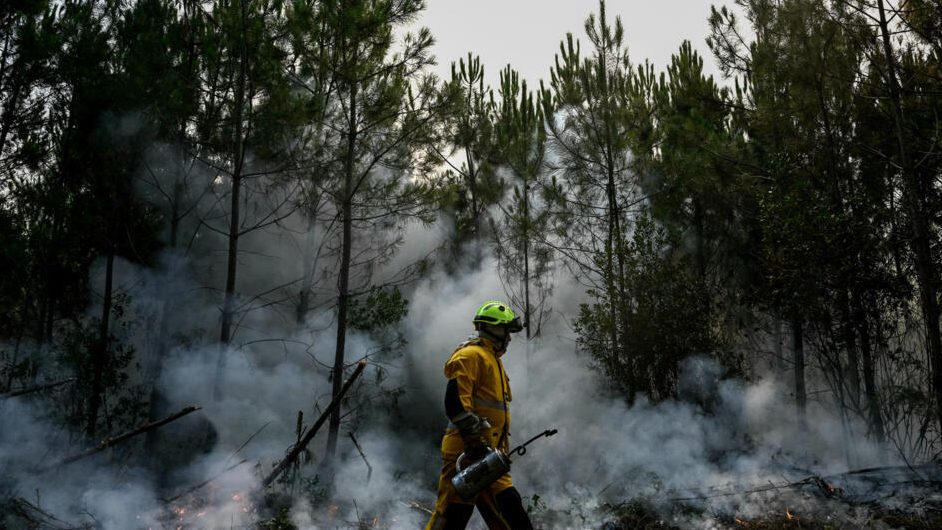
The images are gut-wrenching and, for many Europeans, disturbingly familiar. Planes circle overhead. Firefighters in heavy gear work the flanks of roaring walls of flame. It looks, frankly, like a battle being fought with yesterday’s weapons. Which raises an uncomfortable question: in a world where drones now perform complex military operations in active conflict zones, why are human beings still the primary eyes watching for the first wisps of smoke in a forest?
The Human Cost of a Very Old Problem
The scale of this summer’s destruction has been staggering. Across France, Spain, and Portugal, communities have been uprooted, ecosystems scorched, and families left with nothing but ash where their homes once stood. The Gironde department in southwestern France has borne the worst of it, becoming a symbol of just how catastrophically wildfires can behave when conditions are dry enough and the wind is willing.
Chief Sergeant Guillaume Millet knows this territory better than most. A firefighter with 24 years of experience, he leads the Fire and Rescue Service branch of the CFDT union in the Gironde. He has seen the landscape of his region change with his own eyes, and he is clear-eyed about what has and has not evolved in his profession. The physical techniques for fighting fires, he says, have remained largely consistent over the decades. What has shifted, and significantly so, is how those fires are first spotted.
Swapping Students for Sensors
Not long ago, the Gironde relied on a very human solution to the problem of early fire detection. Watch towers dotted the region throughout the summer months, each staffed by lookouts, often university students earning seasonal income, whose job was simply to watch the forest and report anything suspicious. It was a system with a long pedigree but also an obvious limitation: human eyes get tired, human attention wanders, and a plume of dust kicked up by a tractor in a distant field can look, from a tower, an awful lot like the early stages of a wildfire.
Those student lookouts have now been replaced. As Millet explained in a recent interview, cameras assisted by artificial intelligence now monitor the forests in their place. The change has been consequential. “An AI-assisted camera can distinguish with almost total certainty between smoke and dust thrown up by a tractor in a field,” Millet says, noting that the switch has led to a meaningful reduction in false alarms.
That might sound like a minor administrative convenience. It is anything but. Every false alarm wastes resources, pulls crews away from genuine emergencies, and adds to the fatigue of firefighters already stretched thin across a brutal season. Fewer false alarms means faster, more decisive responses when a real fire ignites, and in wildfire suppression, minutes are the difference between a manageable incident and a catastrophe that consumes thousands of hectares.
What the Technology Actually Does
The AI systems being deployed in the Gironde are not performing magic. They are doing something more interesting: pattern recognition at scale, continuously and without flagging. A camera trained on a stretch of forest can process what it sees against a library of visual data, learning to distinguish the specific quality of rising smoke from other atmospheric disturbances. It does not get distracted. It does not take a coffee break. And unlike a student in a watch tower squinting at the horizon on a hazy afternoon, it does not second-guess itself.
This is a classic application of computer vision, a branch of AI that has matured considerably over the past decade. In other contexts, similar technology identifies defects on factory production lines or flags security threats in urban environments. Pointing it at a forest and asking it to spot the difference between smoke and dust is, in computational terms, a relatively tractable problem. The results, at least in the Gironde, appear to back that up.
The Broader Picture: Tech and Fire Season Across Europe
France is not alone in looking to technology to supplement human firefighting capacity. Across Europe, agencies have been exploring a range of tools to get ahead of fire behavior, from satellite monitoring systems that track heat signatures across large areas, to predictive modelling software that estimates how a fire might spread given current wind and humidity data. The challenge has always been integration: getting the right information to the right people fast enough to act on it.
The persistence of older aircraft in fire suppression fleets, including planes that have been in service for three decades, points to a gap between what technology can theoretically offer and what fire services can practically deploy at scale. Detection is one thing. Response is another. AI cameras can sound the alarm faster than any human lookout, but the water still has to be delivered by aircraft and the firebreaks still have to be cut by people on the ground.
A Smarter Forest, But the Same Fire
There is something worth sitting with in Millet’s observation that the techniques for fighting fires have not changed dramatically even as detection has improved. Fire behavior is governed by physics: fuel, heat, and oxygen. No algorithm changes that. What technology can do is compress the time between ignition and response, which in a dry Gironde summer can be the margin between a contained incident and a regional disaster.
The firefighters in the Gironde, the ones who have buried four colleagues this summer and treated 150 more for injuries, are still doing an extraordinarily dangerous job with relatively traditional tools. AI cameras watching the tree line are a genuine improvement. But they are the beginning of a technological story, not the end of one.
As climate patterns continue to push fire seasons earlier, hotter, and longer across southern Europe, the pressure to innovate will only grow. The question facing governments, fire services, and technology developers alike is not whether AI has a role in fighting wildfires. It clearly does. The real question is how quickly that role can expand from the watch tower to the front line, and whether the political will and funding exist to make it happen before the next devastating summer arrives.
What do you think: should governments be investing far more aggressively in wildfire technology, or is the answer ultimately about land management and climate policy? Leave your thoughts below.