





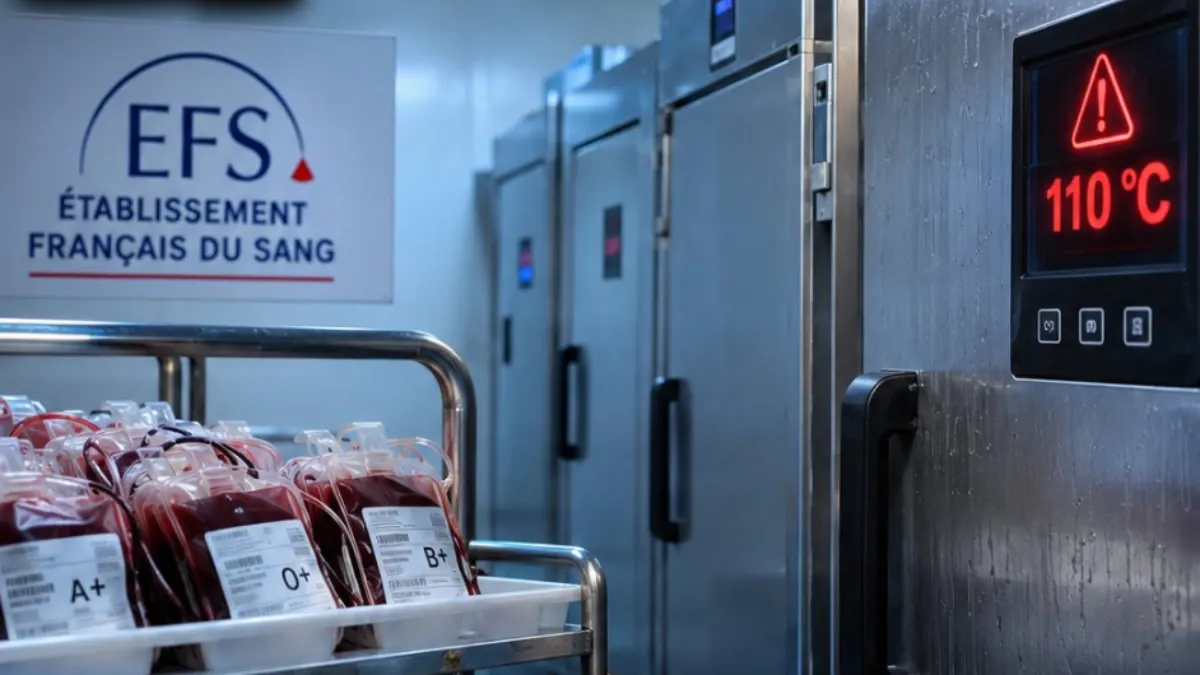


French authorities confirmed this week that a wave of cyber-attacks targeting refrigeration systems has moved well beyond the supermarket aisle, reaching into the cold storage rooms where donated blood is kept. The French Blood Establishment, known by its French acronym EFS, disclosed that hackers managed to interfere with the temperature controls of cold rooms used to preserve blood products at medical facilities across the country. Staff responded quickly enough to prevent any loss of product, but the incident has escalated what was already a deeply unsettling pattern into something with direct implications for public health.
From Grocery Shelves to Life-Saving Supplies
Until this latest revelation, the freezer hacking campaign had been understood primarily as an attack on commercial infrastructure. European supermarkets reported that their refrigeration units had been remotely compromised, raising temperatures and threatening food stocks. Alarming, certainly, but widely seen as a nuisance-level disruption. The involvement of blood storage facilities changes that calculus entirely.
The EFS was careful to reassure the public. “No health impact has been identified and no loss of blood products is to be reported,” the organisation stated, crediting the swift response of on-site staff. That human intervention made all the difference this time. But cyber-security professionals are asking an uncomfortable question: what happens the next time, if no one catches it in time?
Blood products, particularly platelets, have an extremely short shelf life and require precise temperature conditions to remain viable. A sustained breach of cold storage systems, even for a matter of hours, could render entire batches unusable. In a country with routine blood shortages, that is not a theoretical problem. It is a potential crisis.
Who Is Pulling the Strings?
The identity of those responsible remains genuinely uncertain, and the online rumour mill has been spinning hard. Two groups with ties to Russia, Noname057(16) and the Z-Pentest Alliance, posted claims online that they had successfully hacked Danfoss, a company whose industrial control software is widely used in refrigeration systems across Europe. That boast set off a wave of speculation that these groups were behind the broader supermarket freezer attacks.
Analysts, however, are urging caution. Hacking a specific vendor’s platform does not automatically mean the group orchestrated every downstream attack that followed. Cyber-security researchers are now carefully reviewing the evidence to determine whether the Danfoss breach was a cause, a contributing factor, or simply a coincidence that two groups happened to publicise at the wrong moment. As reporting on the incident makes clear, Russian groups are not being ruled out, but neither are they confirmed.
The suspect list, as experts describe it, is genuinely wide. Iranian hacktivists with a track record of targeting Western infrastructure are considered a credible possibility. So are state-sponsored Iranian operatives working under a looser mandate. And then there is the scenario that security professionals find both plausible and maddening in equal measure: opportunistic teenagers who discovered a vulnerability and ran with it, with no geopolitical motive whatsoever.
Honeypots and the Hunt for Clues
Three separate cyber-security firms have deployed what researchers call honeypots, fake versions of freezer management software designed to lure hackers in and observe their methods. It is the digital equivalent of leaving a bait car on the street and watching through binoculars. By studying how attackers interact with these decoy systems, researchers hope to identify signatures, tools, or behavioural patterns that point toward a specific group or nation state.
It is painstaking work, and results are rarely clean. Sophisticated actors deliberately obscure their trails. Less sophisticated ones sometimes leave obvious fingerprints but claim credit for things they did not do. Sorting genuine intelligence from online bluster is one of the core challenges in modern threat attribution, and the freezer hacking campaign has proven to be a particularly murky case.
A Vulnerability the World Underestimated
What this episode has exposed, perhaps more than anything else, is the degree to which industrial control systems for refrigeration have been connected to the internet without adequate security in place. These systems were designed for efficiency and remote monitoring. They were not designed with the assumption that someone, somewhere, would want to sabotage a blood bank by adjusting a thermostat from thousands of kilometres away.
The broader category of attacks on operational technology, the hardware and software that controls physical processes like heating, cooling, water treatment and power generation, has been a growing concern in security circles for years. But the gap between expert warnings and actual infrastructure upgrades remains vast. Hospitals, blood banks and food retailers all rely on third-party vendors for refrigeration management, and the security standards applied across that supply chain vary enormously.
This is not a niche technical problem. It is a supply-chain vulnerability with real-world consequences, and the people most affected by a failure are patients waiting for surgery, not executives watching dashboards.
What Comes Next
French authorities and European cybersecurity agencies are now working to understand the full scope of the attacks and identify whether other sensitive facilities, beyond supermarkets and blood banks, may have been targeted without their knowledge. The possibility that cold storage in pharmaceutical facilities, organ preservation units or laboratory environments could also be at risk is not being dismissed.
For the EFS, the immediate response has been to verify the integrity of blood supplies and reinforce manual monitoring protocols. For the broader healthcare system, the message is starker: physical resilience, meaning staff who know what to watch for and how to respond without relying on digital alerts, may be the most reliable line of defence until the underlying vulnerabilities are addressed.
Cyber-attacks on hospitals and health infrastructure have become more frequent over the past several years, but most of those incidents involved ransomware locking clinicians out of records. An attack that physically manipulates storage conditions is a different category of threat, one that is harder to detect, harder to attribute, and in some respects harder to defend against.
The freezer hacking story is still unfolding, and the full picture of who did this and why may take months to emerge. In the meantime, one question deserves an honest answer from every facility that relies on networked refrigeration: if someone adjusted your temperatures tonight, how long would it take you to find out?