



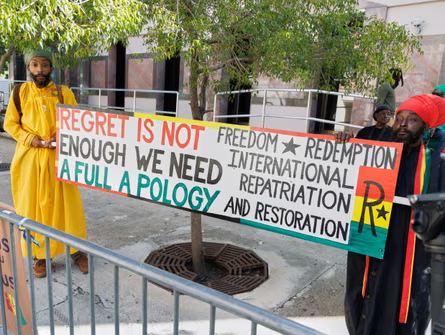
It was a gesture that the British government clearly hoped would open a door. Instead, it has cracked one wide open. After UK Prime Minister Andy Burnham announced on Friday that he was willing to begin a structured dialogue on slavery and reparations, and even expressed openness to an apology, leading voices in the Caribbean reparatory justice movement fired back with a pointed message: aid packages and debt relief are not reparations, and they never will be.
The Announcement That Fell Short
Burnham’s statement represented one of the more significant public positions a sitting British prime minister has taken on the subject of colonial-era slavery. He spoke of structured dialogue, of openness, of wanting to acknowledge the past. But the moment he ruled out direct reparations payments, the response from the Caribbean was swift and unambiguous.
Advocates who have spent years, in many cases decades, pushing for formal reparatory justice said the offer of infrastructure funding and debt relief, while not unwelcome in isolation, fundamentally misunderstands what reparations are meant to represent. As leading Caribbean reparatory justice figures told The Guardian, these measures cannot serve as a substitute for confronting the actual moral and financial debt owed for centuries of enslavement.
Why the Distinction Matters
To understand why Caribbean leaders reject the framing so firmly, it helps to understand what reparations actually mean to those who have campaigned for them. This is not simply about money changing hands. The reparations argument is rooted in a demand for formal acknowledgment of a specific, calculated harm: the forced transportation and enslavement of millions of Africans, the extraction of their labour without compensation, and the generational poverty and underdevelopment that followed in formerly colonised territories.
Debt relief, by contrast, still positions Caribbean nations as debtors. It frames the relationship as one of financial generosity from a wealthier nation to a struggling one, rather than as a correction of a historic wrong. Development aid carries a similar dynamic. It can be withdrawn, reduced, or made conditional. Reparations, as advocates argue, would be an acknowledgment that the wealth gap between the UK and much of the Caribbean is not coincidental but causal.
A Long Road to This Moment
The movement for Caribbean reparations has been building momentum for years, gaining significant institutional backing from the Caribbean Community, known as CARICOM, which established a reparations commission over a decade ago. That body has long argued that European nations owe a specific and calculable debt to their former colonies, one that cannot be offset by conventional foreign aid arrangements.
Britain’s historical role in the transatlantic slave trade is well documented. British merchants and plantation owners profited enormously from enslaved labour across the Caribbean. When slavery was formally abolished in the British Empire in 1833, it was the enslavers, not the enslaved, who received financial compensation from the British government. That debt was only fully repaid by British taxpayers in 2015, a fact that resurfaced in public consciousness and added fresh fuel to demands that the descendants of enslaved people also receive formal recognition and redress.
The Apology Question
Burnham’s openness to an apology is not nothing. Formal apologies from governments carry symbolic weight, and the Caribbean reparatory justice movement has consistently called for one. But advocates are equally clear that words without structural follow-through ring hollow. An apology paired with a refusal to pay reparations, they argue, is essentially a form of acknowledgment without accountability.
This puts the UK in a complicated position. If Burnham is genuinely open to dialogue, the conversation that follows will need to grapple with questions his government appears not yet ready to answer directly. What does accountability look like? Who decides the scope and form of any redress? And how does Britain square its self-image as a modern, rights-respecting democracy with its ongoing reluctance to confront the financial dimensions of its colonial past?
The Wider Global Context
Britain is not the only country watching this space nervously. The reparations debate has gained traction across Europe, with the Netherlands, Belgium, and France all facing increasing pressure to address their own colonial histories. In the United States, the debate over domestic reparations for the descendants of enslaved people has similarly resisted resolution for generations.
What makes the Caribbean case particularly pointed is the degree of organisation and legal sophistication behind it. These are not vague moral demands but structured arguments, backed by historical records, economic analyses, and international legal frameworks. The Caribbean community has laid the groundwork; now they are waiting to see whether any European government has the political will to genuinely engage with what that groundwork implies.
What Comes Next
The structured dialogue Burnham has proposed could, in theory, become a meaningful process. But Caribbean leaders have made clear they will not enter any conversation that begins with reparations already taken off the table. That is not dialogue, they argue. That is theatre.
The coming months will test whether the UK government is prepared to move beyond symbolic gestures toward something more substantive. The reparatory justice movement has the history, the arguments, and the moral weight on its side. What remains to be seen is whether it also has a willing partner in London.
As this debate intensifies, one question lingers over every diplomatic meeting and public statement: if Britain acknowledges the harm, acknowledges the ongoing impact, and acknowledges the debt in moral terms, what exactly is it protecting by refusing to acknowledge it in financial ones?