











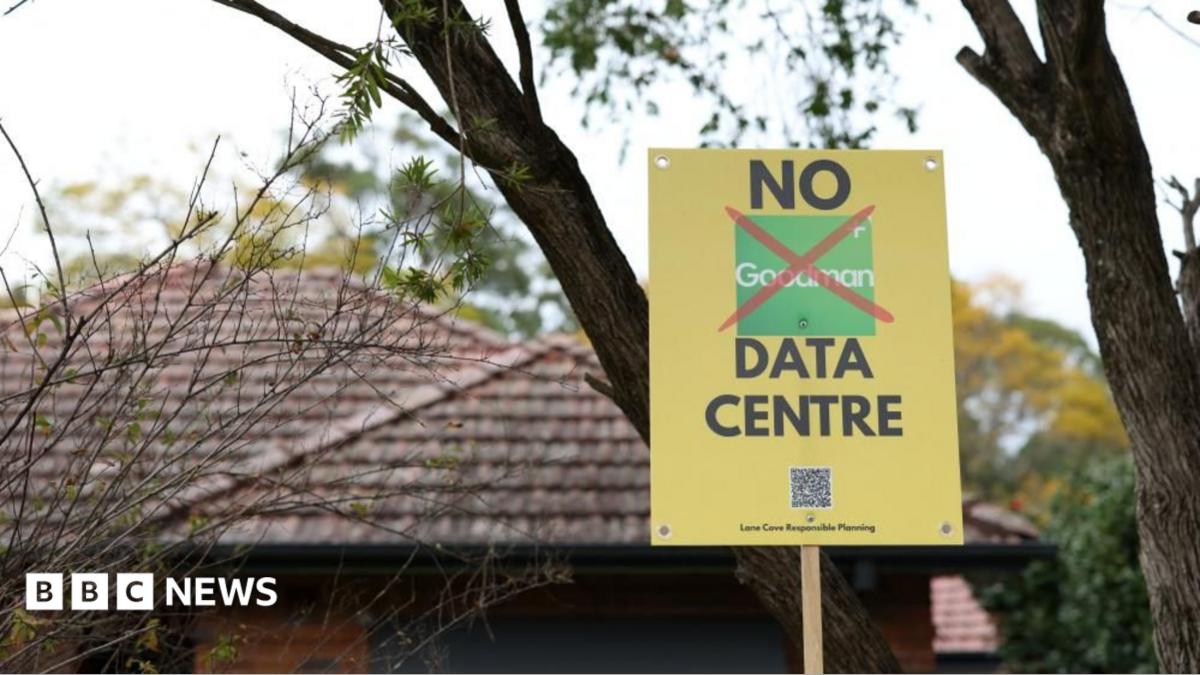
In the quiet, tree-lined suburb of Lane Cove on Sydney’s lower north shore, a mother puts her child to bed each night to the sound of something she can’t quite shake. A low, persistent hum. The kind that burrows into your skull and makes you question whether the world outside has quietly gone wrong. It hasn’t. What she’s hearing is a data centre, sitting just 350 metres from her front door, and according to a detailed report on Australia’s data centre expansion, four more are already planned for the local industrial park nearby.
This is what the AI revolution sounds like up close. Not a triumphant fanfare, but an unending mechanical drone that neighbours compare to a jet engine idling on a runway. And it’s getting louder across the country.
Australia: The World’s Next Data Centre Capital?
Earlier this year, OpenAI chief executive Sam Altman floated an idea that turned heads across the Pacific: Australia, he suggested, could become a data centre capital of the world, if it chose to go down that path. It seems the country has already made its choice. There are currently 162 data centres operating across Australia, with plans approved or in progress for 90 more. The investment pipeline stands at an estimated A$155 billion, which converts to roughly £80 billion, a figure that would have seemed like science fiction not long ago.
The appeal is not hard to understand. Australia offers a combination that global tech giants find almost irresistible: vast tracts of available land, significant natural gas reserves, and a growing portfolio of clean energy infrastructure. For companies racing to build the backbone of artificial intelligence, it checks every box on the wishlist.
The ambitions don’t stop at modest. If planning approvals come through, one of the largest data centres ever constructed anywhere on the planet will rise in western Sydney, with a capacity of one gigawatt. To put that in perspective, it would become the single largest energy consumer in the entire country. Meanwhile, in Marsden Park, also in western Sydney, construction is already underway on what is set to be the biggest data centre in the Southern Hemisphere, positioned just 100 metres from a residential community.
The Neighbours Nobody Asked
Numbers this large can feel abstract until you’re the person who lives 100 metres away from the construction site, or the mother in Lane Cove lying awake listening to the hum. The residents experiencing life next to these facilities describe it in visceral, physical terms. Some say the noise resembles a high-pitched whine that cuts through walls. Others reach for the image of a plane permanently poised for takeoff, never quite leaving.
What makes this particularly charged is the location. Lane Cove is not a forgotten industrial corridor. It is a desirable, established suburb where people chose to live precisely because of its relative quiet and liveability. The arrival of data centre infrastructure in areas like this represents a collision between two very different visions of what Australian cities should look like and who they should serve.
Water, Energy and the Environmental Ledger
Noise is only the most immediately noticeable concern. Residents and community advocates are also raising harder, longer-term questions about water consumption, energy demand, and environmental impact. Data centres are notoriously thirsty operations. Cooling the thousands of servers that power AI workloads requires enormous volumes of water, and in a continent that has historically battled drought, that is not a trivial issue to wave away with economic projections.
The energy dimension is equally pointed. Australia’s clean energy credentials are part of the sales pitch used to attract these investments, but a one-gigawatt data centre does not run on good intentions. The grid pressure created by facilities of this scale is real, and communities want to know whether the national energy infrastructure can absorb this demand without consequences for ordinary households.
Progress at What Speed, and Whose Expense?
There is a legitimate argument to be made for Australia positioning itself as a global hub for AI infrastructure. The economic benefits, in jobs, tax revenue, and technological capability, are not imaginary. A country that builds the pipes through which AI flows will not be a peripheral player in the decades ahead.
But the speed of this expansion, and the apparent gap between corporate ambition and community consultation, is where the friction lives. When residents of a suburb learn that four new data centres are being added to an already humming industrial park nearby, and when those residents feel that their concerns about noise, water, and energy are being processed as nuisances rather than legitimate democratic objections, something important breaks down in the social contract around development.
Other countries navigating the same tension are discovering that the backlash from communities can slow or derail projects far more effectively than any regulatory hurdle. Ireland, which became a European data centre magnet, is now grappling with grid constraints so severe that new projects have been paused in certain regions. The lesson from those experiences is that scale without planning creates problems that are far more expensive to fix than they were to prevent.
The Sound of the Future, Ready or Not
Back in Lane Cove, the hum continues. The mother who hears it every night when she settles her child has not moved, and the data centre has not gone anywhere either. What she represents, beyond one individual’s disruption, is a growing population of Australians who are being asked to absorb the physical costs of a technological transition they had little say in designing.
Australia’s clean energy resources and geographic position make it a genuinely compelling destination for data infrastructure investment. That is real. But the communities living next to these facilities are also real, and their concerns about sleep, water, and a neighbourhood transformed overnight deserve more than a cost-benefit footnote in a corporate feasibility study.
The AI race is being run at full speed. The question that lingers, somewhere between a low hum and a high-pitched whine, is whether the people who live along the track were ever given the option to flag the route.
If you live near a planned or existing data centre in Australia, are your local authorities genuinely listening to community concerns, or is the investment pipeline already too large to redirect? Tell us what you think in the comments below.