



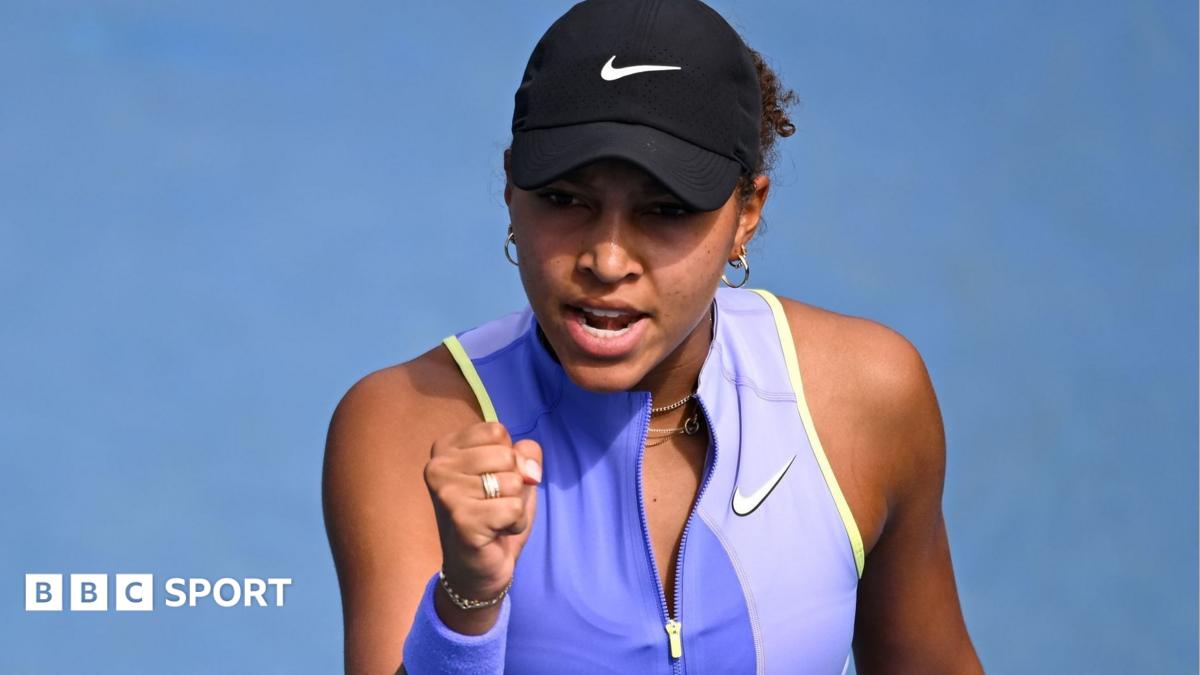
There are origin stories, and then there is Thea Frodin’s origin story. The American teenager stepping onto the US Open main draw for the very first time in 2026 did not simply grow up watching Serena Williams like millions of other young players did. At twelve years old, she became her, at least on screen, serving as a tennis-playing body double in the Oscar-nominated film King Richard, the biopic charting the Williams sisters’ extraordinary rise from Compton to global dominance.
Now, a handful of years and a rapidly rising WTA ranking later, Frodin is ready to write the next chapter of her own story. And the universe, in its most dramatic fashion, has arranged a first-round main-draw singles debut against world number two Elena Rybakina, a two-time major champion and the reigning Australian Open title holder. If you were scripting this for Hollywood, they would probably tell you to dial it back a little.
The Film That Shaped a Career
When casting for King Richard required a young player who could convincingly portray Serena Williams’ tennis on screen, the production landed on a twelve-year-old Frodin. The role put her on set alongside Will Smith, who portrayed the Williams patriarch Richard Williams, and placed her squarely inside a story about the very player she had grown up idolising.
“Being able to play the role of somebody that I looked up to for my whole life was super special,” Frodin told the WTA website. “I was honoured. She was one of the players that I looked up to most, just when I was starting to play. She’s such an inspiration to me.”
Those words carry weight when you consider what followed. The experience did not simply become a footnote in a young athlete’s scrapbook. If anything, it seems to have sharpened Frodin’s focus and crystallised her sense of purpose on the court. When your childhood idol’s story becomes, briefly, your own story to tell, the connection to that legacy runs deeper than a poster on a bedroom wall.
Building the Game to Match the Dream
Frodin’s trajectory from film set to Grand Slam main draw has not been overnight. The teenager has put in the hours, the travel, and the grinding junior-circuit matches that most fans never see. In 2025, she reached the final of the Wimbledon girls’ doubles alongside fellow American Julieta Pareja, a result that signalled she was ready to compete at the sport’s highest levels.
Wimbledon doubles finals do not appear on résumés by accident. They require not only raw talent but also composure under pressure, tactical awareness, and the ability to feed off a partner while managing nerves on one of sport’s most scrutinised stages. Frodin passed that particular test with considerable conviction.
The natural next step was always going to be pushing deeper into the senior professional tour. A US Open main-draw debut at her home Grand Slam, competing in front of what will likely be a raucous and deeply invested home crowd at Flushing Meadows, is about as significant a step as a young American player can take.
A Draw That Reads Like Destiny
If the US Open draw committee wanted to test Frodin’s nerve immediately, they could not have done a much better job. Elena Rybakina, the Kazakh powerhouse ranked second in the world, is among the most formidable servers in women’s tennis and a player who has already collected two major titles. She is not a kind opening opponent for anyone, let alone a teenager making her first appearance in a Grand Slam singles main draw.
And yet, there is something almost poetic about it. Frodin grew up watching Serena Williams, a player who built her entire career on refusing to be intimidated by the occasion or the opponent. Now, facing the world number two in round one of the US Open, Frodin has a chance to show whether those lessons in fearlessness have truly taken root.
“I’m trying to stay in the moment as much as possible,” Frodin said, which is precisely the right answer and, frankly, the only answer that makes sense. Over-thinking a match against Rybakina would be a short route to a very difficult afternoon. Staying present, playing her own game, and trusting her preparation is the only approach that gives her a fighting chance.
Williams Energy Fills the Air at Flushing Meadows
The occasion carries an added layer of meaning this year because Serena and Venus Williams are scheduled to compete together in the doubles draw at the same tournament. That means the player who once portrayed a young Serena on screen could theoretically share the same Grand Slam grounds as the icon herself.
For tennis lovers, the symmetry is almost too much to resist. Serena’s presence in the doubles, Venus alongside her, while a teenager who once embodied Serena’s story makes her singles debut in the same draw, it is the kind of sporting narrative that transcends the scoreline.
American tennis has been hungry for the next generation of players to own the big stages. The sport has produced compelling characters and serious talents in recent years, but a story like Frodin’s, with its cinematic backstory and its clear sense of hunger, has the makings of something genuinely captivating for fans on both sides of the Atlantic.
What Comes Next
A first-round match against the world number two at a Grand Slam debut is not expected to be a smooth afternoon. Rybakina will arrive at Flushing Meadows with vastly more experience, a more complete arsenal, and the kind of big-match temperament that two major titles tends to produce. The result on paper looks straightforward enough.
But sport rarely unfolds strictly on paper. And the best thing that could happen to Frodin, regardless of the scoreline in round one, is that she walks off the court having learned something she could not have learned anywhere else. Grand Slam main-draw tennis has a different rhythm, a different weight, and a different kind of electricity running through it. Once you know what it feels like, you spend the rest of your career chasing it.
Frodin already knows what it feels like to stand inside a story bigger than herself and perform under pressure. She learned that on a film set in Los Angeles, playing the young version of the greatest women’s player the sport has ever seen. That, if nothing else, is a foundation most teenagers simply do not have.
The question worth sitting with as the US Open gets underway: how long before Thea Frodin stops being the girl who played Serena Williams and starts being simply, unmistakably, herself?