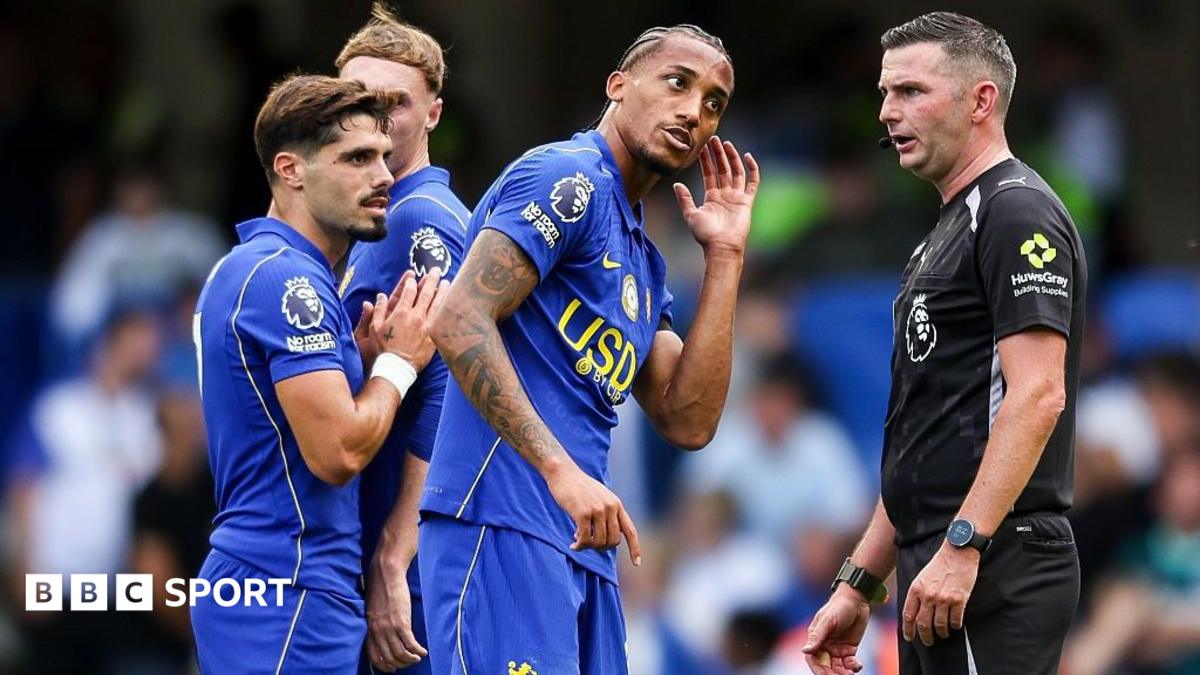
Stamford Bridge, Sunday afternoon. Chelsea and Brighton are trading goals in a match that ends 4-3, the kind of breathless fixture that usually has commentators reaching for superlatives. But the most extraordinary subplot had nothing to do with the scoreline. Referee Michael Oliver spent the entire second half without a working radio communications system, unable to speak clearly with his assistants, his fourth official, or the VAR team watching on screens miles away at Stockley Park. According to BBC Sport, this may be the first time in approximately 20 years that a full set of Premier League match officials has been forced to operate without radio contact for an entire half.
What Actually Went Wrong
The root cause was something deceptively mundane: crowd noise was bleeding through the communication system and could not be filtered out. Anyone who has stood inside a packed Premier League ground knows what that sounds like, a wall of sound that swallows everything in its path. Normally, the referee’s communication pack is sophisticated enough to suppress ambient noise, letting officials hear each other clearly above the roar of tens of thousands of fans. On Sunday, that suppression failed.
With Oliver, assistants Stuart Burt and James Mainwaring, and fourth official Tom Bramall all unable to communicate clearly with each other or with VAR official Andrew Kitchen at Stockley Park, a decision was taken. Rather than delay the second half while technicians attempted repairs, the officials simply put the headsets down and got on with it.
It sounds almost romantic, a throwback to an older, purer era of officiating. In reality, it raised immediate and serious questions about how modern football’s most scrutinised layer of decision-making, the VAR system, could possibly function without a direct line to the on-field referee.
A Brief History of Referee Radio Technology
Referees in English football first wore microphones and earpieces at the start of the 1999-2000 season. It was not an overnight revolution, the technology was introduced gradually and did not become a permanent fixture immediately. The real leap forward came ahead of the 2006-07 campaign, when a more advanced radio system was rolled out across the Premier League, offering cleaner, more reliable communication between the referee and his assistants.
For roughly two decades since, the system has been mostly invisible to fans watching at home or in the ground. The occasional hiccup, a battery pack failing, a technician briefly stepping onto the pitch to fiddle with a device strapped to an official’s arm, has happened before. What had not happened, until Sunday, was a decision that the situation was genuinely unrecoverable and that the match should continue under pre-technology conditions.
The VAR Problem Nobody Talked About Enough
Here is where things get genuinely complicated. The VAR system, introduced to the Premier League in 2019 and still one of the most debated additions to the sport anywhere in the world, is entirely dependent on communication. Andrew Kitchen, the VAR official based at Stockley Park in west London, watches footage and relays information to the on-field referee. The referee, in turn, can be advised to visit the pitchside monitor or can simply accept the VAR’s recommendation. The whole process lives and dies on a clear, fast radio link.
Without that link on Sunday, Kitchen was effectively watching a match he could influence only in the most indirect ways. The structured review process that VAR demands could not function as designed. Whether any pivotal moments in a 4-3 game went unreviewed, or were reviewed differently because of the outage, is a question worth asking.
What This Tells Us About Football’s Tech Dependency
Premier League football has built extraordinary layers of technology into its officiating infrastructure over the past quarter century. Semi-automated offside lines, goal-line technology, pitchside monitors, and constant radio chatter between officials have all become load-bearing pillars of the modern match-day experience. Sunday’s failure was a reminder that the more complex a system becomes, the more points of failure it carries.
There is no suggestion of negligence here. Equipment fails. Crowd noise at a packed Stamford Bridge is among the loudest environments in English football, and audio filtration systems can be pushed beyond their limits. But the fact that no workable contingency existed, short of simply switching everything off and hoping for the best, should prompt a hard conversation inside the Premier League and at the Professional Game Match Officials Limited, the body that governs refereeing in England.
Oliver’s Performance Under the Circumstances
Whatever the technological chaos happening around him, Oliver completed his job. The match finished. Goals were given and, presumably, not given. The game moved forward. That speaks to the experience of a referee who has been at the top of the English game for years and knows how to read a match without needing a voice in his ear at every moment.
Officials managed matches at the highest level for well over a century before radio technology arrived. The craft of positioning, communication through eye contact and hand signals, and reading player behaviour without digital assistance is not lost. Sunday was an unplanned reminder that those instincts still exist and, when called upon, can still carry a match through.
But instinct and experience are not substitutes for a system the sport has spent millions building and now relies upon for decisions that directly shape results, seasons, and for some clubs, financial futures. One half without comms might produce a fine performance from a seasoned referee. A pattern of failures would be something else entirely.
Looking Ahead
The Premier League will conduct a technical review of what happened at Stamford Bridge, and rightly so. Expect updated protocols around communication system failures to follow, along with renewed scrutiny of what VAR can and cannot do when the radio link goes down. The 2026-27 season is young, and Sunday’s match will become a case study cited in officiating meetings for some time.
For supporters of Chelsea and Brighton alike, the afternoon will be remembered for seven goals and a gripping finish. For anyone who cares about how football governs itself, the story was playing out in the officials’ ears, or rather in the silence where their communications should have been.
So here is the question worth sitting with: if a top-flight referee can lose radio contact entirely during a seven-goal match, and the game carries on without apparent disaster, what does that say about which parts of football’s technology infrastructure we actually need, and which parts we have simply convinced ourselves we cannot live without?