








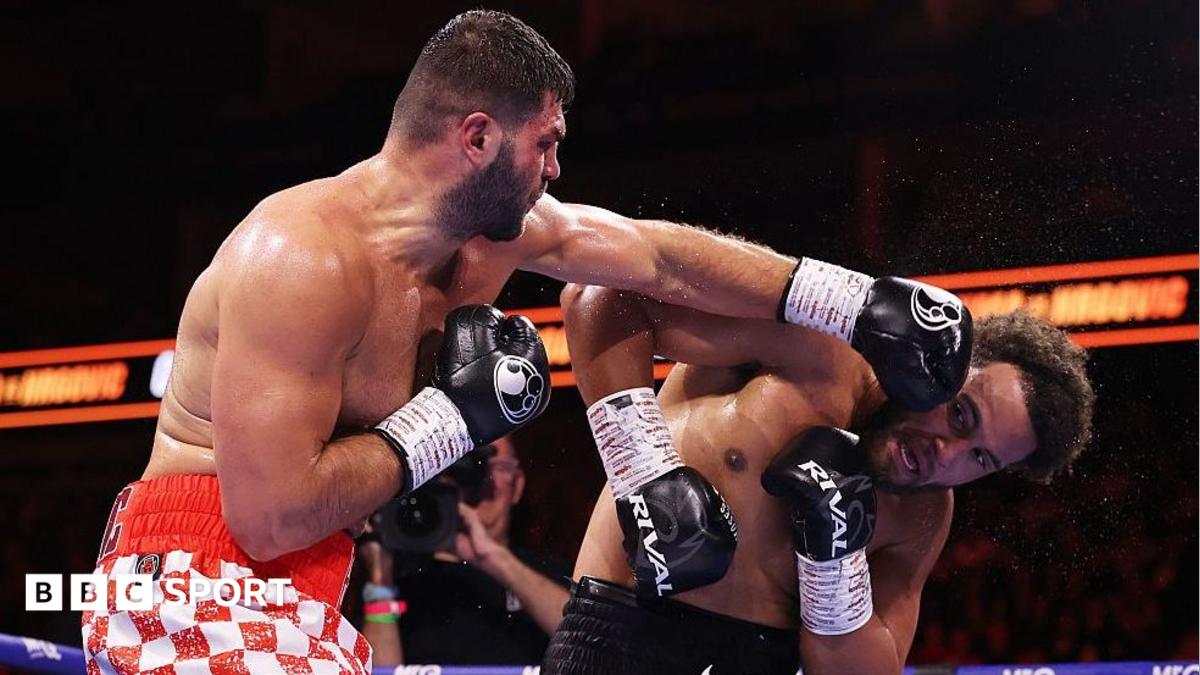
London, August 30, 2026. The lights were bright, the crowd was loud, and the expectations were louder still. Moses Itauma, the young British heavyweight who had been talked about in hushed, reverent tones for years, stepped into a world-title contest against Croatia’s Filip Hrgovic carrying the weight of a nation’s hopes. By the final bell, those hopes lay scattered across the canvas. Hrgovic walked away with the victory, leaving Itauma and his supporters to confront a brutal truth: ambition, when unchecked, can be the most punishing opponent of all.
A Fight That Told Its Story Early
From the opening exchanges, there was a reckless, almost beautiful urgency to Itauma’s work. He came forward hard, throwing with conviction and searching for the kind of dramatic, defining moment that cements a young fighter’s legend. The problem was that this approach demanded an enormous physical toll, and Hrgovic, a seasoned and technically disciplined operator, was quietly absorbing, reading, and waiting.
As the rounds accumulated, something unmistakable began to happen. The snap in Itauma’s punches softened. His feet, once carrying him with purpose and speed, began to slow. The Briton appeared to be running on fumes, the victim of his own intensity. It was, as detailed reporting on the fight made clear, an extraordinary spectacle, but not the one anyone in the British corner had scripted.
Hrgovic: The Calm That Wins Championships
Filip Hrgovic is not the kind of fighter who sets social media on fire with highlight-reel knockouts every few months. He is something arguably more dangerous: a heavyweight who thinks, who conserves, and who makes opponents pay for every error. Against Itauma, he was a study in controlled aggression, picking his moments with the patience of someone who understood that the fight would eventually come to him.
The Croatian’s experience at the highest level of the sport proved decisive. He has operated in big fights, against quality opponents, and he carried that composure into the London arena like a coat he never once took off. When Itauma began to tire, Hrgovic did not panic or rush. He simply turned the screw, and the outcome became increasingly inevitable.
What Happens When a Fighter Punches Himself Out?
It is one of boxing’s most painful phenomena: a fighter so committed to winning early that he depletes the very resources needed to win late. There is no malice in it, no lack of heart. If anything, it is the opposite. Itauma’s problem on this night appeared to be an excess of fighting spirit married to an aggressive game plan that the body simply could not sustain over the full duration of a world-title contest.
Heavyweights burn extraordinary amounts of energy in the ring. The punches are heavier, the clinches are grinding, and the sheer muscular effort required to throw combinations at full weight and power is immense. When a fighter loads up early and the knockout does not come, the bill arrives, usually somewhere in the middle rounds, and it is rarely negotiable.
British Boxing Wakes Up to a Difficult Morning
There will be analysis, there will be debate, and there will almost certainly be calls for a rematch. British boxing has invested considerable emotional capital in Itauma, a young man whose physical gifts have been evident for some time. One loss, even a world-title loss under circumstances as specific as these, does not erase that potential. Boxing is littered with fighters who absorbed early career setbacks and came back sharper, smarter, and ultimately better for the experience.
But the sport is also honest in a way few others are. The result stands. Hrgovic is champion. And Itauma must now look at himself, his team, and his approach with clear eyes. The question of pacing, of fight management, of knowing when to press and when to bank rounds safely, these are the kinds of lessons that cannot be taught in a gym. They are learned in the hardest possible classroom.
The Road Back Is Not Closed
At his age and with his physical attributes, Itauma still holds more cards than most heavyweights ever will. The elite level of the division is more congested and competitive than it has been in years, which means that navigating it requires not just power and athleticism, but strategic maturity. Hrgovic exposed a gap in that maturity on this particular night. Whether Itauma uses that exposure as a foundation for growth or allows it to define him is the real story still being written.
Hrgovic, for his part, deserves enormous credit. He came into a hostile arena, faced a younger, heavily supported opponent, and executed his plan with remarkable discipline. That is what world-class boxing looks like when experience and technique align against raw aggression.
A Night London Will Not Forget Quickly
Whatever the future holds for either man, this fight secured its place as one of the more memorable heavyweight title contests in recent British boxing memory. Not because it was perfect, but because it was real, volatile, and full of the kind of high-stakes drama that only championship boxing can manufacture.
Itauma came to London’s biggest stage and swung for everything. Hrgovic came to win. On the night, the difference between those two intentions was the difference between champion and challenger.
So the question now belongs to you, the boxing fan: does Moses Itauma come back from this stronger and wiser, or does the weight of this night follow him into future fights? Drop your thoughts below and tell us where you think British heavyweight boxing goes from here.