



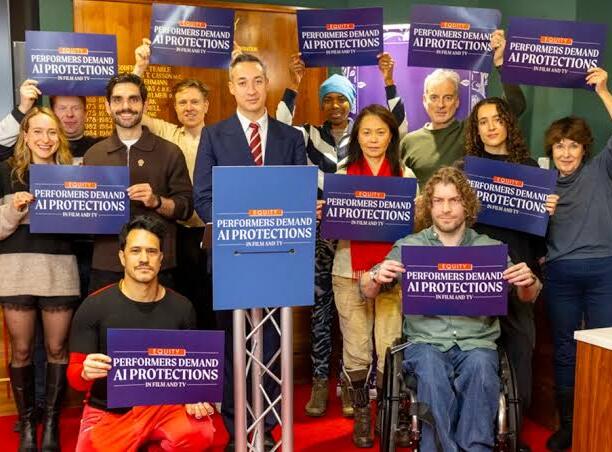
More than 80 performers across British film, television and audio have signed an open letter to the UK government calling for legislation that would give every person in the country a legal right to own their own voice. The signatories include household names like Matt Lucas, Hugh Bonneville and Nicola Coughlan, along with Derry Girls star Siobhán McSweeney, all of whom are united by a shared and increasingly urgent concern: that artificial intelligence is being used to clone human voices without consent, without compensation, and without consequence.
The Mechanics of a Modern Heist
Understanding why this issue has reached boiling point requires a quick look at how AI voice cloning actually works. These systems are trained on recordings of real people, absorbing the cadence, tone, and unique acoustic fingerprint of a human voice. A basic clone can be assembled in a matter of minutes from just a few seconds of audio. Higher-quality replicas, the kind that could genuinely deceive a listener, typically demand hours of source material, but that bar is not nearly as high as it should be for something this consequential.
For performers who spend years, sometimes entire careers, cultivating a distinctive vocal identity, that is a profoundly unsettling reality. Audiobook narrators, in particular, have built livelihoods entirely around their voices. Their recordings already exist in the public domain, on streaming platforms, in libraries and on retail sites. That accessibility, once a sign of professional success, has become a vulnerability.
“An Existential Threat” to an Entire Profession
Alice Sockett, an audiobook narrator who co-founded the campaign behind the letter, did not soften her language when describing what is happening. She called the situation “an existential threat to our entire industry”, noting that voice theft is increasing week by week. Her words carry weight because they are grounded in professional reality rather than abstract anxiety. Her voice is, in a legal sense, completely unprotected the moment it enters the public domain. Anyone with the right software and a few minutes of her recordings could theoretically produce content that sounds exactly like her, without her knowledge or permission.
That is not a hypothetical. It is happening now, at scale, across the creative industries.
What the Performers Are Actually Asking For
The letter is addressed to Prime Minister Andy Burnham, and its core demand is straightforward: introduce legislation that establishes every person’s voice as something they legally own. This would not be a ban on AI voice technology. The performers are careful to distinguish between tools that harm and tools that help. Siobhán McSweeney, perhaps best known for her deadpan brilliance in Derry Girls, articulated this distinction with some precision.
“There is a way to work alongside AI and to use it as a tool that benefits us rather than rendering us obsolete,” she said. That framing matters. This is not a movement of Luddites opposed to technology on principle. It is a movement of working professionals asking that the law protect their labour and their identity in the same way it protects other forms of intellectual and creative property.
McSweeney also expressed genuine concern that the government is moving too slowly, saying she was “deeply worried” about the lag between technological development and legislative response. It is a fair point. The pace at which AI capabilities have outrun regulation has been a consistent theme across sectors, but in creative industries, where livelihoods depend directly on unique human expression, the consequences of delay are felt more acutely and more personally.
The Government’s Position: Cautious, Not Committed
A government spokesperson acknowledged both the potential and the risk of AI voice technology, telling the BBC that digital replicas can serve legitimate creative purposes while also carrying meaningful potential for harm. The spokesperson confirmed that a consultation on how to address these harms while protecting what they described as “legitimate innovation” has been announced.
Consultations, of course, are not legislation. For the performers who signed this letter, a promise to consult is several steps removed from the legal protection they are asking for. The announcement does signal that the government is at least engaging with the issue rather than dismissing it, but the gap between “we are consulting” and “you are protected” is wide, and in a fast-moving technological landscape, that gap costs people real income and real dignity every week it remains open.
Why This Matters Beyond the Famous Names
It would be easy to read this story as a celebrity campaign, a gathering of well-known faces attaching their names to a cause that affects them personally. And yes, Matt Lucas and Hugh Bonneville have the kind of public profiles that make their participation newsworthy. But the most important person in this story might be Alice Sockett, a working narrator whose name most people would not recognise but whose livelihood is directly on the line.
For every household name on that letter, there are dozens of voice artists, narrators, dubbing professionals and session performers whose entire income depends on the value of their voice. They do not have the financial cushion that comes with a long career in high-profile television. When their voice is cloned and used commercially without their consent, they lose work, income and the competitive advantage that years of craft have built.
The question of who owns a voice is, at its core, a question about who owns their own body and its outputs. The answer should be obvious. The fact that it requires legislation in 2026 to make it so says something significant about how quickly AI has disrupted assumptions we never thought needed to be written into law.
A Reckoning the Industry Can No Longer Defer
The UK has positioned itself as a global hub for creative industries, from film production to video games to the audiobook market. Allowing AI voice cloning to go unregulated does not just harm individual performers. It undermines the entire ecosystem of trust and fair compensation that makes those industries function. Clients hire voice talent because they want a specific, human, expressive quality. If that quality can be replicated and sold without the originator’s involvement, the economic logic of hiring that person begins to erode.
Legal clarity would not kill AI voice tools. It would simply require that they operate with consent and compensation. That is a reasonable baseline for any technology that profits from another person’s identity.
The performers who signed this letter are not asking to stop the future. They are asking to be part of it on fair terms. That seems like the least the law should be able to guarantee them.
So here is the question worth sitting with: if someone could replicate your voice tomorrow, sell it, profit from it, and leave you with nothing, would you consider that theft? And if the answer is yes, what exactly are we waiting for?