




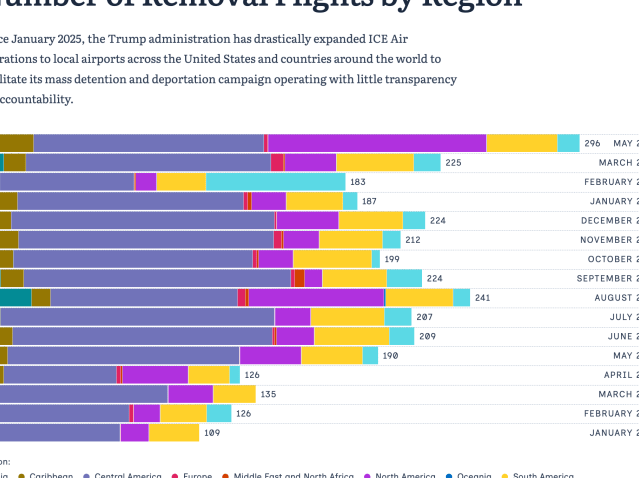
The numbers landed quietly on a Tuesday, but their weight is anything but light. Newly released US government data shows that in July 2026, the Trump administration reached a grim milestone: an average of 1,500 immigrants arrested every single day, and roughly 1,100 removed from the country in that same 24-hour window. That is not a surge. That is a machine operating at full throttle, every day, with barely a news camera in sight.
From Spectacle to System
For much of the past year, the administration’s immigration crackdown was defined by its theatrics. Heavily armed agents. Coordinated, high-profile sweeps in major cities. Images that were designed as much for the evening news as for any enforcement goal. That era appears to be giving way to something more methodical and, in many respects, more consequential.
Attorneys and immigrant advocacy groups operating on the ground across the United States have been sounding the alarm for months, describing a quiet but relentless wave of enforcement activity that rarely makes headlines. The newly released government data now puts hard numbers to what those advocates have long been witnessing firsthand.
The shift is strategic. Militarized, televised raids carry political energy but also political risk. Footage of children crying, community members scattering, and churches offering sanctuary generates backlash. The quieter approach, routine stops, workplace visits, courthouse apprehensions, targeted operations with minimal media footprint, achieves more removals with less noise. It is, in a sense, enforcement that has grown up.
What the Numbers Actually Mean
Averages can be deceptive, but in this case they are clarifying. At 1,500 arrests per day, the July 2026 figure surpasses previous monthly records and reflects a deportation apparatus that has been systematically expanded in terms of personnel, legal infrastructure, and logistical capacity. Similarly, 1,100 removals per day means that in a single month, the administration processed the equivalent of a mid-sized American city out of the country.
These are not just statistics. Behind each number is a person with a history, a family, a reason for being in the United States. Some are long-term residents. Others arrived recently. Some have pending legal cases. The pace of enforcement raises serious questions about whether due process is keeping up with the speed of removal.
The Legal Community’s Growing Concern
Immigration attorneys across the country describe a system that is overwhelmed and, in some cases, bypassing the usual safeguards. When removals happen this quickly and at this volume, the risk of errors increases significantly. Cases where individuals have legal claims to stay, including asylum seekers, people with pending appeals, or those with documented ties to US citizens, can fall through the cracks of an overstretched system.
Advocacy organizations report difficulty keeping up with the pace of detentions. Families are sometimes separated before legal counsel can even be contacted, let alone retained. The speed that makes the data look impressive from an enforcement standpoint is the same speed that leaves the legal system scrambling.
The Politics of Invisible Enforcement
There is something deliberately calculated about the low-profile nature of the current approach. The administration appears to have concluded that results matter more than optics at this stage, and that visible enforcement operations carry diminishing political returns. The base is already energized. What the numbers now demonstrate is institutional commitment rather than performative action.
This is, arguably, a more durable form of enforcement. Raids generate headlines and protests. Quietly sustained, high-volume operations generate records. And records, in the context of immigration enforcement policy, translate directly into political capital for an administration that has made border security the cornerstone of its domestic agenda.
Communities Living Under Pressure
The human geography of this enforcement wave is uneven. Immigrant-dense communities in major cities, as well as smaller towns that rely heavily on agricultural and service-industry labor, are absorbing the daily reality of this crackdown. Local economies in some regions are beginning to feel the labor market effects. Restaurants, construction sites, farms, and meatpacking plants that depend on immigrant workers are reporting staffing strains that are feeding into broader economic ripple effects.
This is not a side note. It is central to understanding what record-level deportations mean beyond the political narrative. Removing 1,100 people a day from a workforce does not happen in a vacuum. It reshapes industries, stresses supply chains, and alters the social fabric of communities that have often existed alongside immigrant populations for generations.
Where This Leads
The July data is almost certainly not a ceiling. With enforcement infrastructure continuing to expand and the administration showing no signs of easing its approach, advocates and legal experts expect the pace to hold or even accelerate through the remainder of 2026. Whether courts, civil society organizations, or political opposition can create meaningful friction in this machine remains an open question.
What is clear is that the era of the dramatic raid as the defining image of US immigration enforcement has, at least for now, been replaced by something far more methodical. Less cinematic. And, by every available metric, far more effective at achieving its stated goal of mass removal.
The real question for American society is not whether these numbers are a record, but what kind of country is being built in the process of breaking them. What does it mean for the soul of a nation when its most consequential domestic policy is executed quietly, daily, and at industrial scale? Leave your thoughts below.