











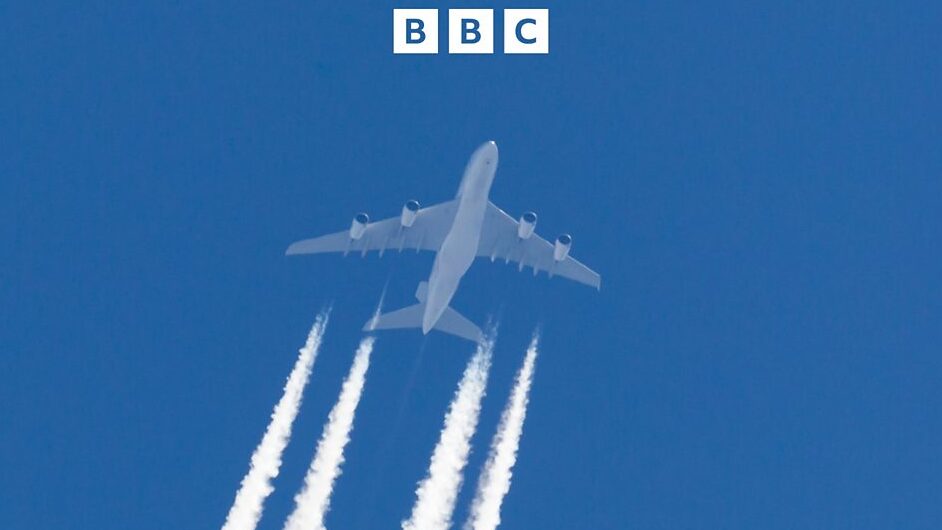
Look up on a clear day almost anywhere in the world and you will likely see them: long white streaks scoring the blue sky behind commercial aircraft, slowly spreading into wispy, cotton-like clouds before disappearing. Vapour trails, or contrails as scientists call them, have become such a familiar feature of modern skies that most people never give them a second thought. That casual indifference, it turns out, may be one of the more costly environmental blind spots of our time.
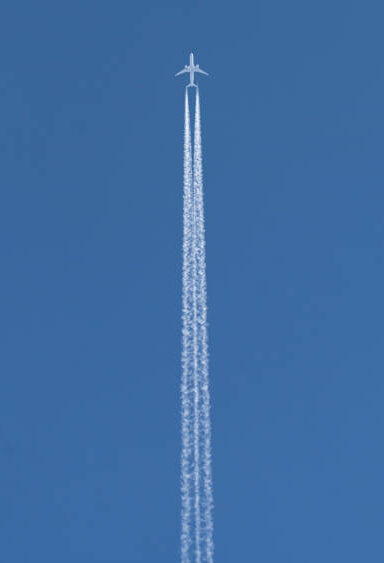
What Actually Happens When a Jet Engine Burns Fuel at Altitude
When an aircraft engine burns jet fuel at cruising altitude, the combustion process produces water vapour as a byproduct. In the cold, thin air of the upper troposphere, that moisture freezes almost instantly into tiny ice crystals. These crystals cluster around particles of soot and other aerosols released by the engines, forming the bright white lines we see stretching across the sky. So far, so physics. The problem is what happens next.
Those ice crystal clouds do not simply vanish. Depending on atmospheric humidity levels, they can persist for hours, spreading out horizontally into thin, cirrus-like cloud layers that cover significant portions of the sky. And those artificial clouds trap heat. They act like a thermal blanket, absorbing outgoing infrared radiation from the Earth’s surface and radiating some of it back downward, contributing to warming in the atmosphere. This atmospheric warming effect from vapour trails is now drawing serious attention from climate researchers and aviation policymakers alike.
The Scale of the Problem Is Bigger Than Carbon Alone
When most people think about aviation’s contribution to climate change, they think about carbon dioxide. And CO2 from jet fuel is absolutely a real and lasting problem. But researchers have been making a strong case for years that contrail warming could actually rival or even exceed the warming effect of all the CO2 that aviation has ever produced, when measured over shorter timescales.
This is a genuinely uncomfortable finding for the industry. Carbon dioxide lingers in the atmosphere for centuries, which makes it easy to measure and model. Contrails, on the other hand, are short-lived and highly variable. Their warming effect depends on where in the world the aircraft is flying, what time of day it is, the season, and the humidity of the surrounding air. That variability has made them harder to regulate and easier to overlook.
Why Night Flights and Certain Routes May Be Worse
Not all contrails are created equal. Research suggests that contrails formed at night may have a stronger net warming effect than those formed during the day. During daylight hours, contrails also reflect some incoming solar radiation back into space, which creates a minor cooling offset. At night, with no sunlight to reflect, that cooling mechanism disappears entirely, leaving only the warming effect intact.
Similarly, flights over certain geographic regions where the upper atmosphere is particularly humid are far more likely to produce persistent, spreading contrails than flights over drier air masses. This means that, theoretically, rerouting specific flights slightly could reduce their overall climate footprint without any change in fuel type or engine technology. Some airlines and researchers are already experimenting with this idea, using weather data to identify so-called “contrail hotspots” and adjusting flight paths accordingly.
Can Technology Actually Fix This?
The good news is that contrails are not inevitable. Several approaches are being explored to reduce their formation or limit their warming impact. Sustainable aviation fuels, which burn cleaner and produce fewer soot particles for ice crystals to form around, may reduce contrail persistence. Engine design improvements that reduce the number of aerosol particles in exhaust could have a similar effect.
Real-time atmospheric monitoring is another avenue generating genuine interest. If pilots and air traffic controllers had access to accurate, high-resolution data about humidity levels in the upper atmosphere, they could make targeted decisions about altitude adjustments for specific flights. Rising a few thousand feet, or dropping slightly, can sometimes move a flight out of a humidity zone where persistent contrails would otherwise form.
None of these solutions is simple, and none comes without trade-offs. Altitude changes can affect fuel consumption. Rerouting adds distance. Sustainable aviation fuels are still expensive and produced in limited quantities. But the fact that contrail warming is a problem that could be partially addressed through operational changes, without waiting for entirely new aircraft technology, makes it an unusually practical target for near-term climate action in aviation.
A Gap Between Public Awareness and Scientific Urgency
Perhaps the most striking aspect of this issue is how little public conversation surrounds it. Climate debates about flying tend to focus almost entirely on carbon emissions, with occasional mentions of frequent flyer guilt and the ethics of short-haul travel. The warming role of vapour trails rarely features. Meanwhile, scientists have been raising concerns about contrail-induced cloudiness for well over two decades.
That gap between scientific urgency and public awareness matters. Policy tends to follow public understanding, and regulations around aviation emissions have been slow enough to develop even with decades of carbon research behind them. Adding the complexity of contrail science to the mix requires both better communication from researchers and a willingness from the aviation industry to treat this as a serious accountability issue rather than a fringe concern.
What This Means for the Everyday Traveller
For passengers, there is currently no label on a boarding pass that reflects a flight’s contrail risk. No carbon calculator widely in use accounts for the non-CO2 warming effects of aviation, which means that most estimates of a flight’s climate impact are, by definition, incomplete. Some researchers argue that true aviation climate accounting should apply a multiplier to standard carbon figures to capture these additional effects.
That is a shift in thinking that the industry has resisted, partly because the science around contrail warming, while robust in its general findings, still carries uncertainties in its precise magnitude. But uncertainty is not the same as insignificance. The evidence that vapour trails contribute meaningfully to atmospheric warming is strong enough that continuing to ignore it in both public discourse and policy frameworks looks increasingly like a choice, not an oversight.
The sky above us is not a passive backdrop. Every white line drawn across it carries a consequence. The question worth sitting with is this: now that we understand what those trails are actually doing, how long are we willing to look up and say nothing?