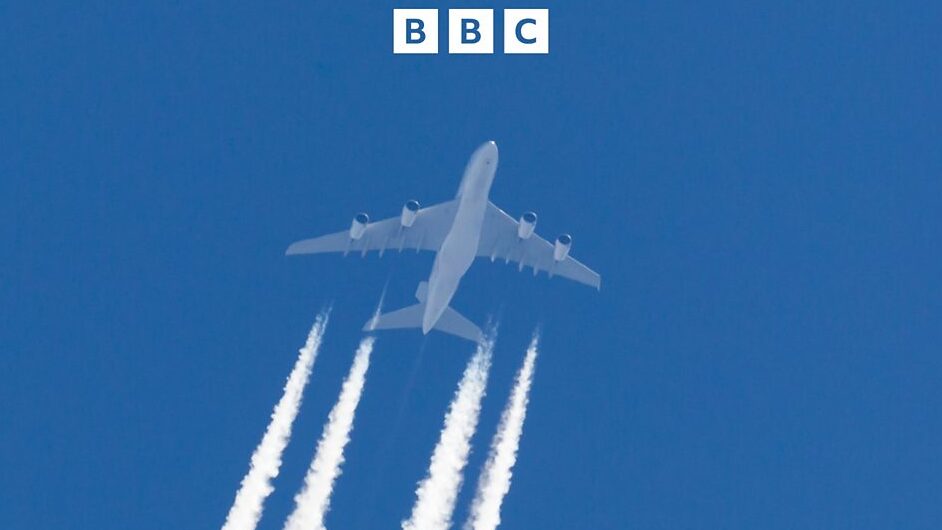
Look up on any given day and you will likely spot them: long white streaks stretching across the sky, left by commercial aircraft cruising at altitude. They look harmless, almost decorative. But scientists and climate researchers have spent years building a case that these trails, known technically as contrails or condensation trails, are doing something far less benign than decorating the heavens. They are trapping heat in the atmosphere, contributing to a warming effect that has largely flown under the public radar.
What Exactly Are Vapour Trails?
When a jet engine burns fuel at high altitude, it releases hot exhaust gases that contain water vapour. The moment that vapour hits the extremely cold air of the upper atmosphere, it freezes almost instantly into tiny ice crystals. Those crystals cluster together and form the streaky white lines we see stretching across the sky. Under the right atmospheric conditions, these lines spread out, thin, and eventually turn into wispy cirrus-like clouds that can linger for hours.
That is where the problem begins. While they may resemble natural clouds, these artificial formations behave in a way that is deeply consequential for the planet’s energy balance. Natural or not, any cloud-like structure in the upper atmosphere has the ability to trap outgoing heat that would otherwise radiate away from Earth into space. The result is a net warming effect, particularly at night when there is no incoming solar radiation to offset the equation.
The Warming Effect Nobody Talks About
Here is the part that surprises most people. When climate conversations turn to aviation, the focus almost always lands squarely on carbon dioxide emissions. CO2 from burning jet fuel is, without question, a serious issue. But the warming contribution of contrails is estimated by some researchers to rival, or in certain measures even exceed, the direct warming caused by aviation’s CO2 output. That is a striking claim, and it has been gaining traction in scientific circles for years.
This subject has attracted serious scrutiny from researchers and science communicators alike. BBC Science programming has explored how these vapour trails from aircraft contribute to warming in the atmosphere, helping bring a fairly technical subject to broader public audiences who may have never considered that a streak across the sky could carry real environmental consequences.
Why This Is Harder to Solve Than Carbon Emissions
Carbon dioxide is a long-lived greenhouse gas. Once it enters the atmosphere, it stays there for decades, even centuries. Contrails, by contrast, are short-lived, forming and dissipating within hours. That difference sounds like good news, but it actually makes the problem more complex rather than simpler.
Because contrails form and dissolve so quickly, their warming impact is highly variable and depends on a web of factors: the humidity at cruising altitude, the time of day, the flight path, even the season. This variability makes them genuinely difficult to model with the precision that policymakers need to act. It also means that the warming they cause is both immediate and inconsistent, two qualities that resist easy regulatory frameworks.
Airlines operate on routes and altitudes optimised primarily for fuel efficiency and safety. Rerouting flights to avoid altitude zones where contrail formation is most likely could theoretically reduce the warming contribution significantly. Some studies suggest that a relatively small percentage of flights are responsible for the vast majority of contrail-related warming, because they happen to pass through particularly humid patches of upper atmosphere at exactly the wrong time. Targeting those specific flights could, in theory, yield outsized benefits.
The Technology Angle: Can Aviation Innovate Its Way Out?
This is where the story gets genuinely interesting from a technological standpoint. Several avenues are being explored simultaneously. Sustainable aviation fuels, or SAFs, burn with less soot than conventional jet fuel. Soot particles act as nuclei around which ice crystals form, so cleaner combustion could, in principle, produce fewer and less persistent contrails.
There is also growing interest in real-time atmospheric monitoring tools that could alert pilots and flight planners to conditions favourable to contrail formation. Paired with dynamic routing software, this kind of system could allow aircraft to sidestep the most problematic altitude bands with only modest increases in fuel burn, possibly delivering a net climate benefit despite the slight efficiency trade-off.
Engine design is another frontier. Next-generation turbofan engines, some of which are already entering service, operate at higher efficiency levels and produce different exhaust profiles. Researchers are studying whether these engines produce contrail patterns that warm less aggressively than those from older technology.
A Problem That Demands Honest Accounting
Aviation accounts for a small but meaningful share of global transport emissions, and demand for air travel continues to grow across Asia, Africa, and Latin America as middle classes expand and low-cost carriers make flying more accessible than ever before. That trajectory makes getting the full picture of aviation’s climate impact not just an academic exercise but a genuinely urgent policy question.
The trouble is that contrails do not show up neatly in most national or corporate emissions accounting frameworks, which tend to focus on CO2 equivalents. Without a standardised way to measure and report contrail warming, airlines have little regulatory incentive to address it, even if the technology and operational changes to do so are within reach.
Climate advocates argue that any serious effort to make aviation sustainable cannot afford to treat contrails as a footnote. If these transient white lines in the sky are contributing to warming at a scale comparable to the sector’s CO2 output, then ignoring them is not just an oversight. It is a form of environmental accounting that simply does not add up.
What You Can Do Right Now
Consumer pressure has moved industries before, and aviation is not immune. Some booking platforms now offer carbon offset options, though the quality and verification of those offsets varies considerably. A more robust ask from environmentally conscious travellers would be for airlines to publish their contrail mitigation strategies alongside their CO2 reduction targets.
Flying less is the most direct lever any individual holds, but for many people that is not a realistic or complete answer. Choosing newer-fleet airlines, flying during the day when the warming effect of contrails is partially offset by their reflectivity, and picking direct routes over connecting ones all carry marginal benefits that, aggregated across millions of travellers, start to matter.
The sky is shared. The trails left in it are shared too, and so are the consequences. As the aviation industry plots its course through an era of climate accountability, contrails represent exactly the kind of inconvenient complexity that gets glossed over in favour of simpler narratives. The question worth sitting with is this: if the technology exists to reduce this hidden warming effect with only modest operational trade-offs, what exactly are we waiting for?