


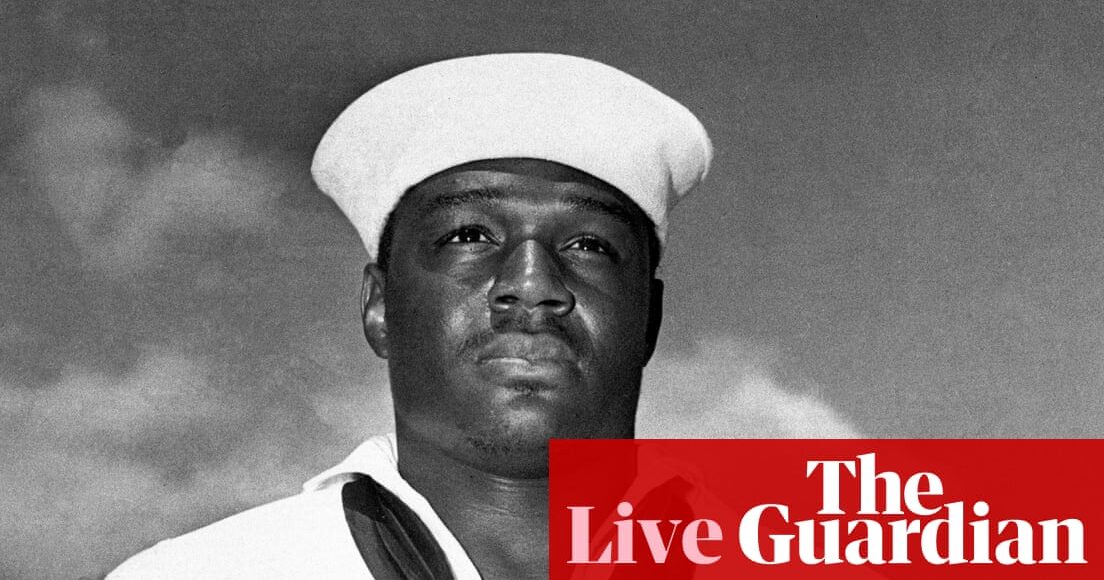
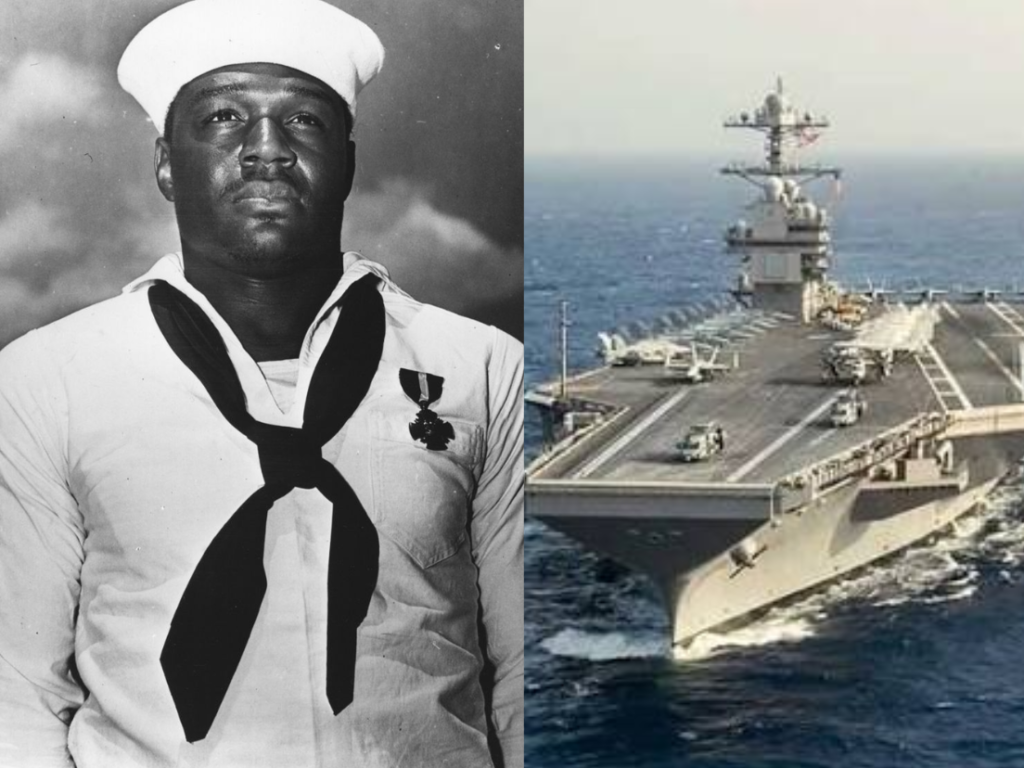
The family of Doris Miller, the Black Navy cook who became one of World War II’s most celebrated heroes, says they were blindsided. No phone call. No letter. No courtesy notice from the Department of the Navy. Instead, Thomas Bledsoe, a family representative, told CNN on August 21, 2026, that the reported consideration to rename the USS Doris Miller, a Gerald R. Ford-class aircraft carrier, in honor of President Donald Trump came as a complete surprise. “Quite a shock,” Bledsoe said, in what may rank as one of the more restrained descriptions of an extraordinary situation.
The story, confirmed by The Guardian’s live coverage, cuts to something raw in the American story: who gets remembered, who gets honored, and who gets to decide when that honor is quietly taken away.
Who Was Doris Miller?
Doris “Dorie” Miller was a messman third class aboard the USS West Virginia when Japanese forces attacked Pearl Harbor on December 7, 1941. His job, by the rigid racial segregation of the U.S. military at the time, was to cook and serve food. He had no formal combat training. When the bombs fell, none of that mattered.
Miller dragged his wounded captain to safety, then manned an anti-aircraft gun he had never been trained to use, firing at Japanese aircraft until ordered to abandon ship. His valor earned him the Navy Cross, the service’s highest honor at the time, making him the first Black American to receive it in World War II. He was 21 years old. He later died in 1943 when the escort carrier USS Liscome Bay was sunk by a Japanese submarine.
For decades, Miller’s name remained more footnote than front page in the mainstream telling of American military history. His recognition as a carrier’s namesake was itself a long-overdue reckoning with that oversight. The USS Doris Miller was commissioned as a direct acknowledgment that his service had been marginalized. To consider peeling his name off that hull, whatever the motivation, is to reopen a wound that many Americans thought was finally healing.
A Family Kept Out of the Conversation
What makes this particular episode sting beyond the political is the complete absence of any communication with Miller’s descendants. Bledsoe was clear: the family was not notified beforehand. They found out the way millions of other Americans did, through news reports. That is not a minor procedural oversight. It is a signal about whose feelings are considered worth protecting in this conversation.
Naming and renaming warships is not a trivial exercise. These vessels carry the weight of national identity. They represent the country’s values, projected steel and firepower across oceans. Removing a name, especially one tied to a figure who broke through racial barriers under fire, sends a message whether policymakers intend it to or not.
The Wider Political Picture
The potential carrier renaming did not emerge in isolation. It sits inside a broader pattern of the current administration revisiting military naming conventions, a project that has touched bases, installations, and now apparently ships that were previously named to correct historical oversights.
Meanwhile, the news cycle on August 21 also carried a separate but revealing story about political fractures within the Republican coalition. U.S. Senator Tim Sheehy, a Montana Republican and cattle rancher, publicly pushed back against a Trump administration plan to allow increased imports of ground beef. Sheehy wrote on X that he had been advising the president against the move for a year, arguing it would further harm American ranchers, most of whom he described as MAGA Republicans, who have been squeezed by what he characterized as a packer monopoly for decades.
It is a rare thing to see a senator from the president’s own party air that kind of disagreement so openly, particularly one who frames his objection in terms of harm to the very voter base that defines the MAGA coalition. But it underlines the point: even within a unified political movement, specific policy decisions can create unexpected friction when they clash with the material interests of core constituents.
What Is Actually at Stake
For the Miller family and for the communities that have long championed his legacy, the carrier renaming question is not abstract. It is personal. Doris Miller earned his place in history under conditions most people will never face, at a time when the country he served did not fully grant him citizenship in practice, even if it did on paper. The ship bearing his name is one of the most visible acknowledgments the U.S. military has ever made of that debt.
Stripping it away, particularly without so much as a conversation with his living relatives, would say something loud and clear about the hierarchy of whose sacrifices the nation chooses to keep visible. Families of honored veterans are not simply decorative fixtures in these conversations. They are custodians of a legacy, and basic dignity suggests they deserve a seat at the table.
As of August 21, 2026, no final decision has been announced. But the fact that it is being considered at all, and that the family had to learn about it from CNN rather than from the Navy, raises a question worth sitting with: when a nation decides whose name belongs on its most powerful machines of war, whose voice should matter most?