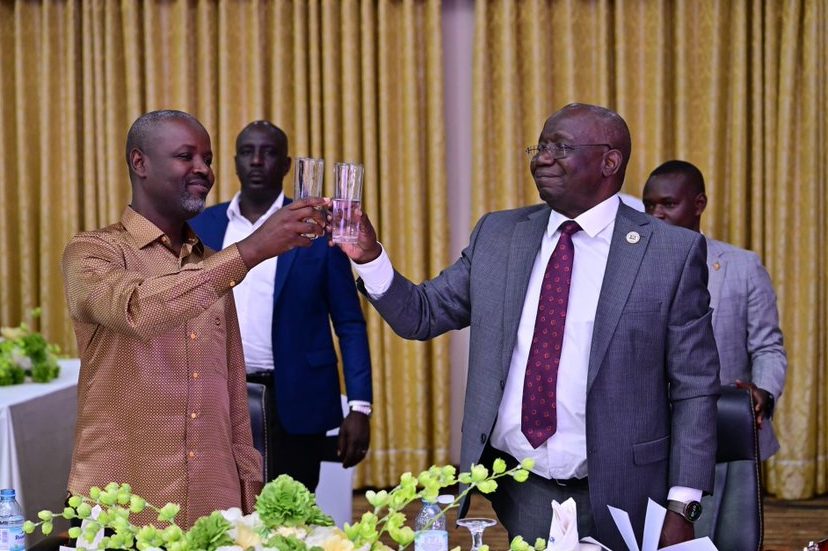
There are books written to impress, and then there are books written to instruct. Dan Odongo’s memoir, From Humble Beginnings: The Journey of a Teacher Who Rose to Lead a Nation’s Trust, appears firmly in the second camp. The Executive Director of the Uganda National Examinations Board launched the book on Friday, and the occasion drew not just applause but immediate, tangible action, with Uganda’s Deputy Speaker committing to put the story into the hands of students across Mitooma District.
A Story That Starts in the Soil
Odongo’s life, as told through the pages of his memoir, is the kind of narrative that tends to get dismissed as too cinematic to be real. A rural upbringing, parents with little formal education, his father stopped schooling at Primary 3, and yet a trajectory that eventually landed him at the helm of the body responsible for overseeing national examinations for millions of Ugandan students. That arc did not happen by accident, and Odongo makes no pretence that it did.
At the launch, Odongo was candid about his motivations for writing the book at all. He said he documented his journey not to celebrate how high he has climbed, but to preserve the lessons buried in the climb itself. The proceeds from sales, he revealed, will go toward establishing a foundation designed to support children from disadvantaged backgrounds, turning the story of one person’s fortune into a vehicle for others to find their own.
He also dedicated the book to his late parents, a gesture that carried weight given what he shared about them. Despite his father’s limited schooling, both parents prioritised his education fiercely. That detail alone challenges every comfortable assumption about what kind of household produces a national leader.
Tayebwa Steps Up with 100 Copies
Deputy Speaker Thomas Tayebwa, who also serves as the Member of Parliament for Ruhinda County in Mitooma District, attended the launch as the chief guest. He did not leave empty-handed, or empty-handed in spirit. Tayebwa announced he would purchase 100 copies of the book and distribute them to schools in Mitooma, framing the gesture as an investment in the imagination of young people in his constituency.
His words at the event were personal. Tayebwa said Odongo’s story resonated with his own experience, and that the themes of faith, discipline, hard work, and perseverance were not abstract virtues but lived realities he recognised. He was pointed in his message to young Ugandans: humble beginnings are not a ceiling. The classroom, he said, is not a waiting room, it is a launching pad.
That framing matters. In a country where many students from rural or low-income households quietly write off their own potential before they have finished secondary school, having a sitting public figure stand up and say “his story is your story too” carries weight that no curriculum can replicate.
Quality That Surprised the Room
UNEB Board Chairman Prof. Celestino Obua offered one of the more memorable lines of the day, remarking that the quality of the book was so high that a reader might not guess it was produced in Uganda. That observation cuts two ways: it is a genuine compliment to the craft behind the memoir, and it is also a quiet indictment of the low expectations often placed on Ugandan intellectual and literary output.
Whether intentional or not, Obua’s comment reframes the book as more than a personal story. It positions it as a statement about what Ugandan professionals are capable of producing when they commit to excellence.
The Warning Beneath the Celebration
Not everything Odongo said at the launch was celebratory. Alongside the personal milestones and the emotional dedication to his parents, he sounded a warning that deserves more attention than it likely received in the aftermath of the applause. He flagged that the institution of parenthood is under threat.
It is a broad statement, but a serious one coming from someone who credits his own parents, despite their limited education and modest means, as the foundation of everything he built. If the families producing the next generation of students are struggling to perform even the most basic functions of guidance and support, then no amount of policy reform or examination restructuring will close the gap. Odongo knows this better than most, and the fact that he chose a book launch to say it suggests it is not a throwaway concern.
Why This Moment Matters Beyond the Headline
Uganda has no shortage of success stories, but it has a chronic shortage of documented ones, stories that young people in rural districts can access, relate to, and actually believe apply to their own lives. Odongo’s memoir, and Tayebwa’s decision to buy 100 copies for Mitooma schools, is a small intervention in that larger problem.
Books cost money. Distribution takes effort. The fact that a senior public figure converted his presence at a launch event into a direct, material contribution to his constituents’ schools is the kind of civic behaviour that deserves recognition, if only because it is not as common as it should be.
For students in Mitooma who will soon hold those copies, the message is plain: the man who now runs Uganda’s national examinations board once sat where you sit, came from less than you might think, and still found a way forward. That is not motivation dressed up in poetry. That is a documented fact, now bound between two covers.
So here is the question worth sitting with: if one teacher’s journey from a rural home to national leadership can fill a room, fund a foundation, and reach 100 schools, what stories are we still leaving undocumented, and what would change if we finally told them?