










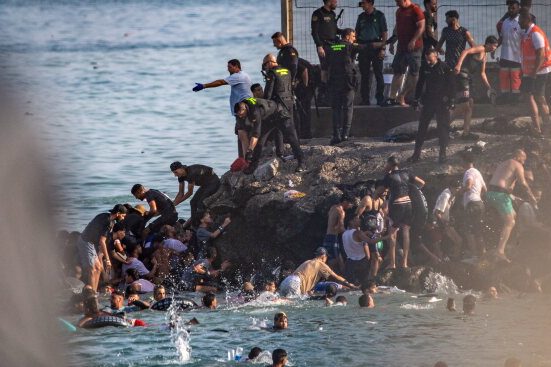
On Saturday, August 15, Moroccan police arrested 111 people as they tried to push through into Ceuta, the Spanish territory perched on the northern tip of Africa, just two weeks after a staggering mass crossing threw European border politics into fresh chaos. Security forces on both sides of the fence had been on high alert after a wave of social media posts openly called for a repeat of that surge, and the weekend’s events showed those warnings were not idle chatter.
A Border That Never Really Calmed Down
The timing of this latest attempt tells you everything. The world had barely processed the scale of what happened two weeks prior, when more than 72,000 migrants crossed into Ceuta in a single, overwhelming surge. At least 96 people lost their lives in the attempt to reach European soil during that crossing, a figure that carries its own quiet devastation. The sheer number of people who made it through sent shockwaves from Madrid to Brussels, and fed a fresh cycle of far-right political rhetoric in countries far beyond Spain’s borders.
Now, within a fortnight, another group was already at the fence. According to reporting on the incident, the attempted crossing came directly after social media coordination signalled a new push, which prompted both Moroccan and Spanish authorities to dramatically tighten security on their respective sides of the border.
Social Media as a Migration Catalyst
There is something worth sitting with here. The organising power of social media in migration movements is no longer a fringe concern or a talking point reserved for border hawks. When posts openly calling for mass crossings can mobilise hundreds of people within days of a prior surge, the mechanics of how people move across borders have fundamentally changed.
Smuggling networks have long used encrypted messaging apps to coordinate crossings, but what happened ahead of this Saturday’s arrests suggests something closer to open, public mobilisation. Authorities on both sides clearly monitored those channels closely enough to prepare. The question is whether that kind of surveillance and pre-emption is sustainable as a long-term security strategy, or whether it simply means attempts will grow more unpredictable and decentralised.
The Human Weight Behind the Numbers
It is easy for the figures to blur into abstraction. 72,000 people in two weeks. 96 dead. 111 arrested on a single Saturday morning. But each of those numbers represents a person who made a calculation that crossing one of the world’s most heavily fortified land borders was worth the risk. Worth the cost. Worth the possibility of not making it.
The deaths recorded during the larger surge two weeks ago were not anomalies. Ceuta and the broader stretch of the western Mediterranean migration route have been among the deadliest in the world for years. Crushes, drownings, heat exhaustion, and violence at fences have claimed lives with grim regularity. The scale of the July crossing did not create that danger; it simply made it impossible to ignore.
Europe’s Political Temperature Rises Again
Predictably, the July surge fed anti-immigration voices across the continent. Far-right parties in several European countries used the images and statistics from that crossing as recruitment material, framing Ceuta as a preview of what awaits Europe if border policies are not hardened further. That rhetoric tends to outlast the immediate news cycle and filters into mainstream political debates in ways that shape actual policy.
Spain faces a particularly delicate balancing act. Its relationship with Morocco is central to managing migration across this route, and that relationship requires constant diplomatic calibration. Morocco’s willingness to deploy its own police to stop crossings, as happened this weekend, is not automatic. It reflects a geopolitical arrangement that Spain and the EU must actively maintain, often at significant political and economic cost.
What Tightened Security Actually Looks Like
The 111 arrests on Saturday were a result of heightened deployment by Moroccan forces, with coordination reportedly extending to Spanish authorities on the Ceuta side. In practical terms, that means more officers on the ground, more surveillance of approach routes, and faster response times when groups begin to gather near the perimeter. It works, up to a point. The July surge is proof that when enough people move at once, even well-resourced security operations can be overwhelmed.
Border security at Ceuta involves a combination of physical barriers, including multi-layered fencing that has been upgraded repeatedly over the years, and a large human presence on both sides. The Spanish enclave, despite covering only around 18 square kilometres, sits at one of the most strategically significant and bitterly contested migration chokepoints on the planet.
Where Do Things Go From Here
The events of the past two weeks have reignited debates that the EU has been circling for over a decade without resolution. How do you manage a border when the pull of Europe’s relative stability and prosperity is set against the push of instability, poverty, and conflict across large parts of sub-Saharan Africa and the Middle East? Tougher fences and more arrests address symptoms. They do not touch the underlying dynamics that put people on the move in the first place.
For the 111 people detained on Saturday, the immediate future is in the hands of Moroccan authorities. For the broader conversation about migration, borders, and Europe’s obligations, the immediate future is rather less clear. What is clear is that Ceuta will not stay out of the headlines for long.
When the fence becomes the most visible symbol of a policy failure that goes all the way up to the highest levels of international governance, what does meaningful change actually look like, and who has the political will to try it?